|
Thursday, June 21, 2007


Wednesday, June 20, 2007
BOSNIAN PROMOTIONAL FILM “ENJOY LIFE” WINS GRAND PRIX TOURIST 2007

SARAJEVO,Bosnia – Bosnian promotional film “Enjoy Life” produced by Refresh Production has won the first prize at the Second International Festival of Tourist Film, which took place in the historic city of Plock, the capital of region Mazovia in Poland.
The Festival featured over one hundred films from Austria, Denmark, Japan, South Africa, Korea, Lebanon, Malaysia, Poland, Lithuania, Turkey... Apart from the films on tourism, the Festival also included roundtables on the role of tourism as an integrative industry that connects people, civilizations and cultures and helps to understand them better.
The symposium “Future of tourism in Europe and promotion of countries and regions through tourist films” focused on the topics of expanding and improving economic in the economic sector.
See the Video
Sunday, June 17, 2007
Now, BIHAR govt plans to make 'waves'
A bicycle mechanic, Raghav, recently made waves by sending radio waves from his small shop at Mansurpur village in Vaishali district. The "Radio Raghav" FM station was an instant hit among people residing within 10 km radius of Mansurpur village.
Now, realising that radio is a powerful mediun to interact with the masses at the grassroots level, the state government is seriously planning to launch its own FM stations — community radio stations (CRSs). The state government has already prepared a pilot project with the help of IIM students. The technological know-how is being prepared by students of IIT (Kanpur) and IIT (Mumbai).
To begin with, the state government has selected 10 schools of Patna and Nalanda districts to operate these FM stations. These schools would transmit the programmes, the contents of which would be prepared and developed at the Soochana Bhavan. The government would help these schools in obtaining FM frequency from the information and broadcasting ministry.
Bihar CM Nitish Kumar, during his visit to IIM (Ahmedabad) in November, 2006, had talked to some of the students there and had asked them to prepare a blue print for community radio stations. Nitish had said such radio stations would bridge the gap between the state headquarters and the villages, by using cost-effective means of information through entertainment.
State information and public relations department (IPRD) secretary Vivek Singh, who is monitoring the creation of community radio stations, told TOI that it would be a powerful medium to communicate with the people.
The IPRD secretary said the IIM team, comprising management professor Rajnish Sinha and IIM (Ahmedabad) students Kaushlendra, Abhishek, Irfan and Rahul, has worked out the financial viability. These students have also given presentation before the secretaries of different departments, including MM Jha (HRD), Anup Mukherjee (rural development) and special secretary (CM secretariat) Chanchal Kumar.
According to the plan, the schools will be stake-holders while the principals concerned would be presidents of the school community radio stations. Though the initial cost of setting up a transmission centre is estimated between Rs 5-6 lakh, the IPRD secretary said, students of IIT (Kanpur) and IIT (Mumbai) are being approached so that the transmission cost could be reduced.
The state government is planning to set up 800-1,000 community radio stations, having services in Bhojpuri, Magahi, Vajjika, Maithili and Angika.
Now, realising that radio is a powerful mediun to interact with the masses at the grassroots level, the state government is seriously planning to launch its own FM stations — community radio stations (CRSs). The state government has already prepared a pilot project with the help of IIM students. The technological know-how is being prepared by students of IIT (Kanpur) and IIT (Mumbai).
To begin with, the state government has selected 10 schools of Patna and Nalanda districts to operate these FM stations. These schools would transmit the programmes, the contents of which would be prepared and developed at the Soochana Bhavan. The government would help these schools in obtaining FM frequency from the information and broadcasting ministry.
Bihar CM Nitish Kumar, during his visit to IIM (Ahmedabad) in November, 2006, had talked to some of the students there and had asked them to prepare a blue print for community radio stations. Nitish had said such radio stations would bridge the gap between the state headquarters and the villages, by using cost-effective means of information through entertainment.
State information and public relations department (IPRD) secretary Vivek Singh, who is monitoring the creation of community radio stations, told TOI that it would be a powerful medium to communicate with the people.
The IPRD secretary said the IIM team, comprising management professor Rajnish Sinha and IIM (Ahmedabad) students Kaushlendra, Abhishek, Irfan and Rahul, has worked out the financial viability. These students have also given presentation before the secretaries of different departments, including MM Jha (HRD), Anup Mukherjee (rural development) and special secretary (CM secretariat) Chanchal Kumar.
According to the plan, the schools will be stake-holders while the principals concerned would be presidents of the school community radio stations. Though the initial cost of setting up a transmission centre is estimated between Rs 5-6 lakh, the IPRD secretary said, students of IIT (Kanpur) and IIT (Mumbai) are being approached so that the transmission cost could be reduced.
The state government is planning to set up 800-1,000 community radio stations, having services in Bhojpuri, Magahi, Vajjika, Maithili and Angika.
Patna girl in final round of Indian Idol 3

The melodious voice of this Patna girl has shot her to fame following her entry into the final round of Sony's Indian Idol 3 programme. In the final round Deepali, a Patna Women's College student, will compete with 12 other contestants.
Needless to say, her feat has brought immense joy to her parents Rita Kishore and Dinesh Kishore, the latter a sub-inspector attached to special branch of the Bihar police.
Interestingly, Deepali wanted to become a radio jockey. But given her performance in the Indian Idol show, it'll not be surprising if she ends up as one of Bollywood's most-sought-after playback singers. "Deepali is now aiming at becoming a playback singer in Bollywood. For her, the sky is the limit now," her parents told.
Besides giving credit to their daughter and her trainer — Sony's music director - both Dinesh and Rita also showered ample praise on people who voted for her through SMSes in the piano round. Deepali was among the 10 finalists among 28 contestants in the Piano round held in mid-May and which was telecast from June 1 to 9.
Her parents said programme panelists Udit Narayan and Alisha Chinai, music director Anu Mallick, lyricist and writer Javed Akhtar and special guest Kailash Kher all appreciated Deepali's musical talent.
"But Alisha had special praise for her," chipped in Rita with a sense of pride.
The final round is set to be interesting given that there would be two wild-card entries, besides a finalist from Indian Idol 2, Jolly Das, who couldn't appear earlier due to illness. While the two wild-card entries will perform on June 15 (Friday), Deepali will have a brush with other contestants in the subsequent programme.
Deepali, in fact, was selected from among 5,000 contestants during the audition held at Kanpur from March 12 to 14. Post-selection she was among the 128 contestants in the preliminary round.
Thursday, June 14, 2007
Sunday, June 10, 2007
Patna rice
 Patna rice, a variety of the species Oryza sativa, and one of the varieties of long-grain white rice, is extensively cultivated in the Indo-gangetic plains, in and around Patna, capital of Bihar state, India. Patna rice is known for its elongated kernel with grain length greater than 6 mm, and has been used as staple food by the local people for thousands of years. Sometimes, Patna rice is also called Parimal rice locally.
This mildly flavoured rice comes from the Bihar region of the Ganges plains. It has a robust, long and narrow, opaque grain that keeps its shape well for curries. Basmati rice is closely related to the Patna rice but has a stronger aroma. Patna rice is the most esteemed in UK and USA and is the highest priced rice in the grocery stores.
The Mughal chronicler Abul Fazal who collected the various types of rice grown in the Gangetic belt has described the rice cultivated in Patna in glowing terms. William Fullarton of Skeldon UK made his fortune by dealing in Patna rice. He chose to name the hamlet of the coal mining workers he built in East Ayrshire, Scotland as Patna.
As at one time, most of the rice sold in Europe came from this region, Patna Rice is also sometimes loosely used to mean any long grain aromatic rice.

Another example of long-grain rice is American long-grain rice which include Carolina rice. It is believed that Patna rice was the first type of rice cultivated in America [1], and acquired the name Carolina rice. The seeds of Patna rice were taken to America, grown in Carolina and exported to Britain before the American Civil War. Thus the term Carolina rice is also sometimes used to denote this variety of rice.
Saturday, June 09, 2007
Indian Idol-Meiyang Chang - Meri Saanson Mein Basa Hai
Remember Sanjaya Malakar from American Idol. Out of the blue he had become house hold name in USA. Meiyang Chang is going do same in india?. I think he is already one of the top contestants in Indian Idol. This third generation chinese from India is a dentist by profession who is popular for his good looks and he also sings very well. Overall looks like he has got a pleasant personality. (Don’t know somehow Indian idol site says “Contestant from China” though he himself had said that
he is third generation Chinese in India)
Udit Narayan who is one of the Judges had said that Chang had sung the song even better than Udit himself after hearing the song from chang which earlier was sung by Udit Narayan in a movie. Can have a look at the Chang’s Performance in the below Video.
he is third generation Chinese in India)
Udit Narayan who is one of the Judges had said that Chang had sung the song even better than Udit himself after hearing the song from chang which earlier was sung by Udit Narayan in a movie. Can have a look at the Chang’s Performance in the below Video.
Friday, June 01, 2007
Nalanda University - A cartoon film by
earn about the Nalanda University In the east in a funny animated short.
Monday, May 21, 2007
A beautiful performance in a concert by Jagjit Singh-Raag Bhairvee
A beautiful performance in a concert by Jagjit Singh when he sings Raag Bhairvee in his inimitable style. A must listen for all lovers of classical sub-continental music
Sunday, May 20, 2007
Thursday, May 17, 2007
East Mostar --- Hell on Earth 93/94
war documentry about besieged East Mostar, the bloodiest place in Herzegowina, about 6000 people, most of them civilians, died in East Mostar.
Must see before you see other Videos of Mostar.
Must see before you see other Videos of Mostar.
Stari Most in Mostar (Part 2)-We visited this City last Saturday.
This Ancient bridge was destroyed during the 92-95 Civil war in Bosnia. But now has been restored to its past Glories.
A song by Monoj Tiwari in bhojpuri..one of the sweetest language of India..frequently used in Bihar , Jharkhand and U.P.
A song by Monoj Tiwari in bhojpuri..one of the sweetest language of India..frequently used in Bihar , Jharkhand and U.P.
www.bijhar.org Singapore presents Loha Singh Skit
Loha Singh skit enacted by Vikas Trivedi during BIJHAR holi celebration in March 2007.
The skit is based on the popular radio play by the same name aired by akashwani patna, Bihar
The skit is based on the popular radio play by the same name aired by akashwani patna, Bihar
Ab ta Ban Ja Sajanwa Hamar
Hot Nagma Ravi Kissan Saira Banu Bhojpuri film (2006)
Why a Bhojpuri film as the first venture? Saira Banu's candid answer is that she has loved the language, ever since a dialect similar to Bhojpuri was spoken .
See a preview.
Why a Bhojpuri film as the first venture? Saira Banu's candid answer is that she has loved the language, ever since a dialect similar to Bhojpuri was spoken .
See a preview.
Tuesday, May 15, 2007
The inspiring story of Suresh Kamath

Suresh Kamath, the managing director of Chennai based Laser Soft Infosystems Ltd is an unusual man. Unlike most other entrepreneurs, he does not aspire to create a business empire; his sole ambition is to provide employment to 10,000 people. He also plans to reserve 40 per cent of the jobs for the disabled.
Suresh started Laser Soft in 1986 with just Rs 200 and five people. Today, the company is a force to reckon with in the banking software arena.
In recognition of his commitment to the disabled, President of India A P J Abdul Kalam felicitated Suresh with the Best Employer award in December 2005. He also won the Best Employer award from the Tamil Nadu government. He has been awarded the NCPEDP shell Helen Keller Award for giving equal rights and gainful employment to persons with disabilities.
Read on for the inspiring story of Suresh Kamath
Ambition as a child
I come from a poor family. We lived in a one-room-kitchen house in Mysore. Though my father struggled very hard, he did not let his penury affect the lives of his children. Unemployment, depravation, hardship pained me and right from my school days my ambition was to create employment in this country. As a child I was motivated by Mr Laxman Rao - one of my teachers at school who always advised me to do something for the country.
I heard tales of poverty and struggle from my father and grandmother. How my father could study only up to the 10th standard, as he did not have money for further education. My mother too did her schooling only till the 8th standard. But all this hardship did not stop them from encouraging us to continue with our studies. I was the eldest among my siblings and took up the mantle of setting an example. Encouraged by my performance - I was always a rank holder - my younger siblings too did very well in studies.
As far as my career was concerned, my father gave me full freedom and I decided to study engineering. I joined the National Institute of Engineering in Mysore in 1975 in electronics and then did my M Tech in computer science from the Indian Institute of Technology, Madras.
Life after graduation
I was keen to start my own company immediately after my post graduation. But since I did not have any job experience I was advised against any such move. So, I joined Tata Consultancy Services and worked for a year. I noticed that all the major Indian software companies were into services; they were not into creating products and it disappointed me.
I was convinced that India could create excellent products thanks to the huge talent pool available here.
While at TCS I found that most of my colleagues aspired to go abroad to further their career. But I was not interested in overseas assignments.
Even at IIT, I was the only student in our batch of 20 who did not go abroad after studies. On hearing of my ambition, many of my friends ridiculed me and even called me a 'fool'! I took their scorn in my stride. However, my parents were very supportive.
They encouraged me not to pay heed to what others were saying and encouraged me to strive to give shape to my ambition.
After TCS, I joined another company that was into hardware because I wanted some related experience. I worked there for three years.
Starting Laser Soft
When I was 28, my father told me to get married. I decided to marry the girl of his choice. By then I had decided to quit my job and start my own company. I told my fiancee of my plans and asked her if she still wanted to marry me. She said, 'Yes. I have faith in you.'
On May 1, 1986 I launched my company. I intentionally chose May Day as it is also labours' day.
With initial capital of Rs 200 and five technical people from NIIT the company was launched. I told them, 'I will give you whatever I can afford but all of us will draw the same salary.' I
did not even try to hire any engineers, as I was convinced that they won't work for a small company like mine. Also, I strongly believe that you don't need engineers for programming. What you need is logic. I also wanted a team that would be the foundation of the company, who would remain with the company.
Why Laser Soft?
Because the word laser - meaning accuracy and precision - appealed to me, and soft is of course from software. Our office was a room in my house, and our first job was to get visiting cards and letterheads printed.
First client
First client
We decided to focus on banking and healthcare. Banking because it was a gargantuan sector and had huge potential. At that time automation of the banking system was a faraway dream. We approached the State Bank of India and Apollo Hospitals and told how our products could facilitate their work. SBI admitted that they had a six-month backlog in the DD purchase for Madras Fertiliser Ltd. Since we did not have computers, we requested SBI to allow us to work in the bank in the evening. They agreed.
First product
Our product for SBI was out in two weeks' time and the backlog was cleared within a month. Our first product was thus a big success. Both SBI and MFL were very happy and we were paid a remuneration of Rs 5,000.
Sensing that we could help them in various quarters, SBI sent us to their overseas branch -- which incidentally was their largest branch in the South doing business of over Rs 5000 crores. Everything was done manually. On any given day the branch could take only 25 bills from the exporters. Our product, readied in a week's time, was exclusively for handling export bills.
From 25 bills, they were able to handle 200 bills a day and the profit of the branch zoomed to Rs 55 crores (Rs 550 million).
End of first year
By the end of the first year, our turnover was Rs 128,000, and our staff strength had doubled to 10. With Rs 1000 as monthly salary, we could manage. After the success of the export bills, SBI assigned more work to us. As our work pressure increased, we hired more people and by the end of the second year we were 25 people and our profit stood at a handsome Rs 600,000. In five years' time, we computerised 70 SBI branches all over India.
Parthasarathy
Then one morning in 1987 Parthasarathy - we call him Partha - came to meet me. He was disabled and was not an engineer but had undergone a computer course that the government had offered in an institute. I told Partha, "I like to employ people like you."
And it was not a wrong decision. Partha had an amazing zeal and his disability did not stop him from being mobile. I thought it was the right model for any industry to follow.
I was not doing any charity by employing him because my company benefited more from Partha than vice-versa. I have noticed that physically challenged people are more committed than others but unfortunately we pay scant attention to them. Business houses talk about attrition. I tell them, 'Look at these people, they will never leave you.'
Disabled-friendly office
At that time our office was in the first floor and Partah had difficulty tackling the stairs. Seeing him struggle, I decided to make the entire office disabled-friendly. Our ground floor is now exclusively for the disabled people, and we have ramps in our office and there are special toilets for them too. We have also built houses for them near the office so that they can avoid long travelling hours.
After meeting Partha, I decided to hire more disabled people. We waited six months to get a disabled person who could be our receptionist.
Reservation
I don't look at employing disabled people as charity. I look at this as my responsibility. This country has spent money to educate me and I feel it is my duty to do something for the less privileged.
It had been a great experience working with them. Seeing them work, get married, settle in life and have children is a wonderful experience.
We have 550 employees now, and 15 per cent of them are disabled. We go to engineering colleges looking for disabled people but find only one or two in each college. Parents don't send them out. The biggest challenge for the physically handicapped is the attitude of their parents. We, at LaserSoft, hire them even if they are not engineers.
Other than the physically challenged, we have people suffering from cerebral palsy too working for us. We find them good in graphics. Many of our employees are deaf and dumb.
Best employer award
I was elated when I won the award but with all humility, let me say I am doing very little. I am very disappointed to see that I was chosen when there are so many business giants in India. Seven per cent of India's population is disabled but all of us turn a blind eye to them.
I realised that if I could get an award by doing so little, it means that others are not doing even this much.I was honoured to meet Dr Abdul Kalam. He is a wonderful person, a real motivator. He asked me, 'What exactly do the disabled people do in the company? Do they do software or menial job?' I told him barring two all are involved with technology.
Ambition
Ambition
My ambition is to create 10,000 jobs, and I want to reserve 40 per cent of that for the disabled. We also have a light top model as far as salaries are concerned. We don't give huge salaries to those who occupy the top positions but distribute the money to all the employees.
Reservation row
Reservation based on caste is going to divide us further. Reservation should be based on economic criteria alone. We should learn to forget our past and start looking at the future. What have today's children got to do with what some people did in the past?
What difference does it make if you are a brahmin or a non-brahmin when you are poor? How many IITs and IIMs do we have? How many good medical colleges and engineering colleges do we have? We have such a vast population but not enough resources. Instead of starting more colleges, and there should be special colleges for the disabled, the government is talking about more and more reservation
Friday, May 11, 2007


Tuesday, April 10, 2007
Narayana Murthy as Prez would be a shame
This is excertps
from the Blog of D.P.Satish from IBNLIVE:COM
http://www.ibnlive.com/blogs/dpsatish/237/38147/narayana-murthy-as-prez-would-be-a-shame.html
I write this at my own risk. I know I invite the ire of Indian IT professionals by talking this way about their patron saint.
Kannadiga software pros, their parents, and other Infosys worshippers will call me an insane journalist. Naive Kannada enthusiasts will say I am anti-Kannada or traitor. Shouldn't I be proud that a son of the Kannada soil is getting a waitlisted ticket to Rashtrapati Bhawan?
Let me be blunt. N R Narayana Murthy will make a poor President.
Outlook special issues editor and an obsessed Mysore Kannadiga Krishnaprasad has posted a shocking report about our potential President on his popular blog site www.churumuri.wordpress.com .
It talks about an incident that happened in Mysore last week, just before our President APJ Abdul Kalam exclaimed that Narayana Murthy would be "fantastic" as the next President of India.
It is a pity that only two much respected and unbiased news papers in Karnataka ' Deccan Herald ' and ' Prajavani ' dared to report the same incident.
Excerpts:
" As the mascot of the new, emerging, rising, shining, strident, resurgent, pumped-up India id est Bharat, Infosys founder N.R. Narayana Murthy wears the tricolour on his cuff links. So, you would think that his hairs would stand on end hearing the National Anthem being sung on his campuses.
Well, think again.
The President (the real one) was in Mysore on Sunday. But what greeted A.P.J. Abdul Kalam was not the mellifluous rendition of Rabindranath Tagore's poem by human beings, but-in the grand tradition of call centres that India's IT "revolution" somewhat exemplifies-a prerecorded electronic version that sounded more like a cheap non-polyphonic cellphone ringtone.
Reason? Hear it from the host of the show NRN Murthy.
"Indeed we had arranged for five people to sing the anthem. But then we cancelled it as we have foreigners on-board here. They should not be embarrassed while we sing the anthem."
Yes, you read that right. He thinks that foreigners should not be embarrassed while we sing our national anthem. We want him to be the next President.
Infosys said last year it had some 1,800 foreigners on its rolls. But there are no precise figures on how many foreigners were at the Infosys Leadership Institute aka the Mysore campus, which is designed to seat 6,400 students , yesterday.But it is on record that it had offered jobs to 126 students from 82 foreign universities last year.
Even if that figure of foreigners is ten times greater, does it mean Mr Murthy's company is willing to slavishly mute his nation's anthem for their sake?
If that is OK, why is it difficult for Infosys' iPod wearing foreigners to listen to a 52-second, five-stanza number? Or for their faculty to make them listen to it?
But, above all, coming to a foreign country, to a foreign city, to a foreign company is all about learning, appreciating, assimilating, understanding, and respecting that country's, that city's, that company's culture.
If Infosys' foreigners-all 126 of or whatever multiples of them-are not doing that, then they have missed a vital ingredient of their education and even more vital ingredient of their excursion.
Narayana Murthy is being spoken of the "fantastic" next President. Hopefully, the first Kannadiga to be Rashtrapati will not have similar views of the rashtra geethe being sung in the presence of foreigners."
Every one in the country knows Narayana Murthy's views on reservation. He has always been opposing quota and saying merit alone should be the criterion for education and jobs. It shows his ignorance of India's caste struggle and its background.
Nagavara Ramarao Narayana Murthy, son of a school teacher, went to a government school as his father had no money to send him to a private school.
He now forgets that government-funded schools, "cowsheds", as he calls them, have made him what he is today.
And do you think our politicians will vote him to Rashtrapati Bhawan?
His views on Indian languages lack self-respect and pride.
He believes people without a knowledge of English have no future in India. Will leaders like Mulayam, Lalu, Paswan, Karunanidhi, Deve Gowda, and Bal Thackeray ever support him in their wildest dreams?
NRN may not be a greedy businessman with his eye only on profits. He may be good at heart. But his corporate philosopy allows no space for healthy cultural pride. Corporate success is his mantra, and he is blind to everything else around him.
Narayana Murthy often sees cultural questions as parochial concerns. To have such a sell-out manager as President would be a shame to those of us who pride ourselves on our cultural identities.
Narayana Murthy is a hero to decultured middle class Indians who have made money because of economic liberalisation. He is a "beacon of hope" to armchair journalists. But for the majority Indians, he has now become a symbol of middle class nonsense and upper class arrogance.
Since he is being suggested as a successor to President A.P.J. Abdul Kalam, I think it's time to debate whether corporate leaders are fit to lead in public life. Can they do us good, or does their blinkered view of the world make them dangerous?
Would we be better off if we barred people with corporate interests from holding public office?
As a Kannadiga and an Indian, I respect what he has achieved in just 20 years. But at the same time, he is just another businessman who created an empire. Infosys is in no way different from the other money-focused corporations of the world.
Let s be honest. Let's admit the truth and put a full stop to this Narayana smarane (Bhajan)!
But then, if you were more cynical, you'd say the President is just a figurehead. What do we care if it is Narayana Murthy or Narayanbhai Rathwa?
Tuesday, March 27, 2007


Friday, March 23, 2007
So finally I landed in Sarajevo- Bosnia & Herzegovina

A common site on the walls of Sarajevo - Marks of Bullets
Wednesday, January 31, 2007
Bihar to set up road development authority
Bihar has decided to set up a road development authority to speed up construction of roads in a state where infrastructure is in pitiful shape. According to official sources, the idea of setting up the Bihar State Road Development Authority (BSRDA) was mooted during a meeting on road construction chaired by Chief Minister Nitish Kumar over the weekend. "The chief minister directed that BSRDA be set up to monitor the construction of roads across the state," an official said. Road Construction Minister Nand Kishor Yadav said: "Officials have been asked to constitute the BSRDA soon." BSRDA would be a small body comprising technical and management experts and would have independent financial and administrative powers. It would be entrusted with the power to acquire land for road construction. Bihar is notorious for poor road connectivity. Most of the existing roads and highways are believed to be in a bad condition. This is despite budget allocations that run into billions of rupees. Last year the Patna High Court rapped the government on its failure to improve the condition of roads. In January again, the court directed the government to start building roads at the earliest and submit a report by March. The slow pace of road construction in Bihar is also attributed to threats criminal gangs mete out to construction firms. Last week, two engineers of Narsingh Constructions were killed in Madhepura, 200 km from Patna, for not paying an extortion of Rs 10 million.
Monday, January 15, 2007
British Oil Major Set to Start Oil Exploration in Ganges BAtion in Bihar
British exploration major Cairn Energy Search Ltd (CESL) is set to begin a survey in Bihar's Ganges basin for oil and natural gas Monday afternoon, the first such exploration in the state.
The CESL and its sister concern, Cairn Energy Search India Ltd, which has been given a seven-year license, will begin the survey in the basin, which comprises 13 districts spread over 15,500 sq km.
'The much-awaited work for exploration would formally start with launching of an aero magnetic survey by Chief Minister Nitish Kumar,' Energy Minister Vijendra Prasad Yadav said Monday.
A specially designed and high-tech airplane was hired from Canada Sunday for conducting the survey, sources in the state mines and geological department said.
Official sources said the exploration project had got clearance from all central ministries, including defence, petroleum, civil aviation and atomic energy as well as the Geological Survey of India.
According to independent estimates, reserves in the Ganges basin, known locally as Purina basin, could be as high as 465 million tonnes of crude and natural gas.
Experts say the reserves can be tapped after drilling up to 4,400 metres. The government will get 10 percent royalty for every tonne extracted. The Edinburgh-based exploration firm had proposed the project three years ago but it got delayed due to various reasons.
http://www.earthtimes.org/articles/show/20228.html
The CESL and its sister concern, Cairn Energy Search India Ltd, which has been given a seven-year license, will begin the survey in the basin, which comprises 13 districts spread over 15,500 sq km.
'The much-awaited work for exploration would formally start with launching of an aero magnetic survey by Chief Minister Nitish Kumar,' Energy Minister Vijendra Prasad Yadav said Monday.
A specially designed and high-tech airplane was hired from Canada Sunday for conducting the survey, sources in the state mines and geological department said.
Official sources said the exploration project had got clearance from all central ministries, including defence, petroleum, civil aviation and atomic energy as well as the Geological Survey of India.
According to independent estimates, reserves in the Ganges basin, known locally as Purina basin, could be as high as 465 million tonnes of crude and natural gas.
Experts say the reserves can be tapped after drilling up to 4,400 metres. The government will get 10 percent royalty for every tonne extracted. The Edinburgh-based exploration firm had proposed the project three years ago but it got delayed due to various reasons.
http://www.earthtimes.org/articles/show/20228.html

Wednesday, January 10, 2007
Stop the bias against Bihar-Sign this petition
Here we are in 2007 , embarking in this New Year with great hope and conviction to take our country to new heights. We are talking about world being flat and information being power, we are talking about tele density and broadband penetration but alas we still come across horrific incidents where people are being killed for just being Bihari.By destiny they were born as Bihari and that become the cause of their gruesome killing.
The recent gruesome of killing of Biharis in Assam by ULFA militants is yet another incident which shows the kind of bias which exits in our Country against Bihar and Biharis.So how do we react to this as a Bihari and citizens of this country?
How do we express our anguish and pain when our fellow country men are being killed for being Bihari ? Following the great tradition of this great country we humbly submit our petition to all , please spare a moment for the cause of the bereaved soul and lodge your protest against this incident in strongest possible word. Let’s hope and pray that incidents like these are never repeated and also express our solidarity with the family members of the bereaved ones.
I have started this petition drive to ensure that we raise our voice against this act of cowardice. I'll request you all to send this link to all your friends and relatives and request them to sign this petition, let's try and ensure that each Bihari put his protest against this heinous act.
http://www.petitiononline.com/1bihar/petition.html
The recent gruesome of killing of Biharis in Assam by ULFA militants is yet another incident which shows the kind of bias which exits in our Country against Bihar and Biharis.So how do we react to this as a Bihari and citizens of this country?
How do we express our anguish and pain when our fellow country men are being killed for being Bihari ? Following the great tradition of this great country we humbly submit our petition to all , please spare a moment for the cause of the bereaved soul and lodge your protest against this incident in strongest possible word. Let’s hope and pray that incidents like these are never repeated and also express our solidarity with the family members of the bereaved ones.
I have started this petition drive to ensure that we raise our voice against this act of cowardice. I'll request you all to send this link to all your friends and relatives and request them to sign this petition, let's try and ensure that each Bihari put his protest against this heinous act.
http://www.petitiononline.com/1bihar/petition.html
Friday, December 29, 2006




Tuesday, December 26, 2006
Bihar inventor of lantern projector awaits govt nod even after 66 years
Photographer Manoranjan Ghosh's wait for a patent from the Government of Bihar for his invention-a lantern projector-continues even after 66 years. Though the inventor has died, his family's hope remains alive.
The 'Lantern Projector' was made with the objective of it being used to spread awareness and education in rural areas, and was invented in 1940. .
According to Ghosh's son, Rajat Ghosh, a sculptor by profession, it was his deceased father's long cherished dream to help in spreading education in the remote areas of the Bihar, and this motivated him to invent a "poor man's projector".
"This 'Lantern Projector' was invented for the purpose of promoting and propagating various education programmes such as children's education, women's education and others in remote villages where electricity was not available, says Rajat.
Apart from Gujarat, Madras, Calcutta and other States, the projector became famous in Germany too," Ghosh adds. "If the projector and the literature slides with some modifications and are used at places that are without electricity, it could prove to be very beneficial," says Rajat.
Besides creating slides of rare pictures of the Indian freedom struggle, Manoranjan Ghosh had a collection of slides with analytical descriptions of literature, art and many other subjects.
The 'Lantern Projector' was made with the objective of it being used to spread awareness and education in rural areas, and was invented in 1940. .
According to Ghosh's son, Rajat Ghosh, a sculptor by profession, it was his deceased father's long cherished dream to help in spreading education in the remote areas of the Bihar, and this motivated him to invent a "poor man's projector".
"This 'Lantern Projector' was invented for the purpose of promoting and propagating various education programmes such as children's education, women's education and others in remote villages where electricity was not available, says Rajat.
Apart from Gujarat, Madras, Calcutta and other States, the projector became famous in Germany too," Ghosh adds. "If the projector and the literature slides with some modifications and are used at places that are without electricity, it could prove to be very beneficial," says Rajat.
Besides creating slides of rare pictures of the Indian freedom struggle, Manoranjan Ghosh had a collection of slides with analytical descriptions of literature, art and many other subjects.
Bihar Chronicle- A New Begining

http://www.biharchronicle.blogspot.com/
Today on the dawn of 2007, we realise that Bihar is Changing. In last couple of days we had have couple of good new. i.e.
- Resurrection of Nalanda University
- Starting the Road Project in Patna
- Proposal for Setting up NIFT campus in BIHAR
- National Highways Developement - Phase III giving bihar nearly 900 KMS of
highways connection all major cities in BIHAR
- Proposal for setting up an IIT in BIHAR
- Global meeting in JAN for a Resurgent BIHAR
and many more like this.
In such an environment in which the wind of chages are blowing from all direction it it imperative to give my BIHAR something new from my side. This feeling prompted me to launc this blog. The objective is to give plateform to all the good news which are not covered or reported elsewhere are covered on this Blog.
I invite BIHARI people all across the globe to come join this plateform and contribute in thier own unique way to give BIHAR a voice.
Thursday, December 21, 2006
Now US students come calling to hear Lalu

The Great Railway Turnaround Story seems to have become a fable, and its author an international management guru.
Having shared the tale of how he pulled back the Indian Railways from impending doom into a likely Rs 2,000 crore profit for this year with IIM-Ahmedabad students, Lalu Prasad Yadav is now polishing his phrases to deliver it to an American audience.
A group of 137 students, 100 from Harvard and the rest from Wharton, is coming here for a December 27 lecture by Yadav. The minister will spell out the finer points of the turnaround story in a day-long interaction at Rail Bhawan.
Insiders say the session has been in the works for quite some time, with Yadav keen on selling his success story internationally to counter the skepticism about his achievements within the country.
It will not be Yadav’s first interview with the American campus on this issue.
He has played host to professors from Harvard, Wharton, Boston University and American Defence Institute over the past couple of months, taking them to different parts of the country to show the Indian rail network and explaining to them the basics of what he did to the ailing national network, ministry sources said.
Now the jester-turned-pundit wants to ensure a visit by the US students to add to the sizeable bunch of brownie points he has already earned.
The professors, say the sources, were also keen to examine the genuineness of the claims made by the Indian Railways. “Initially, they were also a bit skeptical. They wanted to see for themselves whether the turnaround was only limited to government files in Rail Bhawan or extended to the rest of the country,” said one official.
“Once they travelled on the network, they shed many of their concerns and found the Railways a fit case to be studied by their students.”
Yadav’s lieutenants are preparing all the statistical support, but which language will he speak? Not known for his English, Yadav is reportedly brushing up whatever he has of it on him to be able to take direct questions from the young audience.
Yadav’s address, said sources, will mainly dwell on how the Railways has been restored its health without increasing fares or downsizing of staff.
More Nation HeadlinesI've a vision for Indo-Pak relations: PMIt was my fate to get lifer, says Manu'I really couldn't ask God for more'Life comes full circle for Manu SharmaDismiss Mulayam for our support: BJP to UPA'We had not asked Manu's father to resign'
Bihar, N-E, TN to be thrust areas in highway Phase III, Govt OK on way
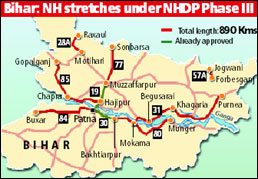
Seemingly central government is addressing and Bihar is going to be
benefitted by this infrastructure initiative in a great way.
http://www.indianexpress.com/story/19060.html
Several good news on the horizon about Bihar after usual stereotype.
If good news kept on flowing this, they would sweep away the
stereotype and make them eat their words. Amen.
Cheers and regards for now and hope to be back with more soon..
New Delhi, December 20: The Government is set to clear the entire Phase Three of the National Highway Development Programme (NHDP III) where seven new road projects are to be included for Bihar, taking the length of roads in the state under NHDP III from 113 km to 890 km.
A sizeable portion or around 10 per cent of the total length under NHDP III would be for the North-East states, covering Assam, Arunachal Pradesh, Manipur, Meghalaya, Mizoram, Nagaland and Tripura. This fits into UPA plans to improve connectivity in states along the China border.
In all, the Government is going to increase the length of roads under NHDP III to 11,530 km — the Cabinet has already given its nod for 6,139 km. In fact, Bihar will have the largest increase in the total length under this programme — up by 777 km.
The Cabinet was to okay this proposal at its meeting tomorrow but it is being rescheduled, possibly for next week, as Road Transport Minister T R Baalu will not be able to attend the meeting tomorrow.
The NHDP III basically envisages connecting important state capitals and cities of economic and tourist importance that are otherwise not covered under the Golden Quadrilateral and the North-South East-West corridor projects.
While work has already started on some of the NHDP III projects (under NHDP III A), the Cabinet approval will be for the entire programme.
Under the approval sought for NHDP III, seven projects would be added for Bihar and five new projects, totalling a length of 613 km, for Assam.
J&K will have one new 101 km project connecting Srinagar-Baramula-Uri.
Tamil Nadu, which already has approval for ten projects totalling 1,146 km under NHDP III, will now have a total of 13 projects, totalling 1,455 km under this programme — the largest for any state.
IITs to come up in Bihar, Andhra and Rajasthan
JAIPUR: With the Union human resource development ministry approval, the path has been cleared for the setting up of three more Indian Institutes of Technology (IITs) — in Rajasthan, Bihar and Andhra Pradesh. At present there are seven IITs in the country — in New Delhi, Mumbai, Kharagpur, Kanpur, Roorkee, Chennai and Guwahati.
Vasudeo Devnani, minister of state for education, Rajasthan has been demanding the opening of an IIT for sometime now, as students from the state qualify in large number in IIT-JEE entrance and the state has produced number of toppers in the examination.
Rajasthan government is yet to decide where the IIT would be located, as the state government will have to make available 500 to 600 acres of land for setting up the institute. The chances are that it would be set up either in Jaipur or Kota.
Earlier, the state government had proposed that Kota Engineering College run by the state government be converted into an IIT, as all the necessary infrastructure was available there.
Vasudeo Devnani, minister of state for education, Rajasthan has been demanding the opening of an IIT for sometime now, as students from the state qualify in large number in IIT-JEE entrance and the state has produced number of toppers in the examination.
Rajasthan government is yet to decide where the IIT would be located, as the state government will have to make available 500 to 600 acres of land for setting up the institute. The chances are that it would be set up either in Jaipur or Kota.
Earlier, the state government had proposed that Kota Engineering College run by the state government be converted into an IIT, as all the necessary infrastructure was available there.
Wednesday, December 20, 2006
NIFT Comes to Patna
After a branch of BIT, Mesra, and a National Law Institute, Bihar is getting ready for a centre of the National Institute of Fashion Technology (NIFT). After the Centre's proposal for a branch of NIFT in Patna, the union textile ministry has sought 10 acres of land and a sum of Rs 29 crore from the Bihar government. Chief Minister Nitish Kumar readily agreed to the Centre's decision and the state government has earmarked 10 acres of prime land in the Mithapur agricultural farm for the project.
Informing members of the Bihar Legislative Council, the chief minister said he had conveyed the decision to the Union textile minister and urged him to start work for the project at the earliest. The NIFT centre is coming up in the area earmarked recently by the Nitish Kumar government as a new institutional area.
Besides, the newly-opened Chanakya National Law University (giving a five-year integrated degree course in Law), the state government proposes to set up other institutions of repute like NIFT and a branch of the Indian Institute of Management in the area. During his recent visit to IIM, Ahmedabad, the Bihar CM had proposed that a branch of the IIM be set up in Patna as well.
Informing members of the Bihar Legislative Council, the chief minister said he had conveyed the decision to the Union textile minister and urged him to start work for the project at the earliest. The NIFT centre is coming up in the area earmarked recently by the Nitish Kumar government as a new institutional area.
Besides, the newly-opened Chanakya National Law University (giving a five-year integrated degree course in Law), the state government proposes to set up other institutions of repute like NIFT and a branch of the Indian Institute of Management in the area. During his recent visit to IIM, Ahmedabad, the Bihar CM had proposed that a branch of the IIM be set up in Patna as well.
NIFT Comes to Patna
After a branch of BIT, Mesra, and a National Law Institute, Bihar is getting ready for a centre of the National Institute of Fashion Technology (NIFT). After the Centre's proposal for a branch of NIFT in Patna, the union textile ministry has sought 10 acres of land and a sum of Rs 29 crore from the Bihar government. Chief Minister Nitish Kumar readily agreed to the Centre's decision and the state government has earmarked 10 acres of prime land in the Mithapur agricultural farm for the project.
Informing members of the Bihar Legislative Council, the chief minister said he had conveyed the decision to the Union textile minister and urged him to start work for the project at the earliest. The NIFT centre is coming up in the area earmarked recently by the Nitish Kumar government as a new institutional area.
Besides, the newly-opened Chanakya National Law University (giving a five-year integrated degree course in Law), the state government proposes to set up other institutions of repute like NIFT and a branch of the Indian Institute of Management in the area. During his recent visit to IIM, Ahmedabad, the Bihar CM had proposed that a branch of the IIM be set up in Patna as well.
Informing members of the Bihar Legislative Council, the chief minister said he had conveyed the decision to the Union textile minister and urged him to start work for the project at the earliest. The NIFT centre is coming up in the area earmarked recently by the Nitish Kumar government as a new institutional area.
Besides, the newly-opened Chanakya National Law University (giving a five-year integrated degree course in Law), the state government proposes to set up other institutions of repute like NIFT and a branch of the Indian Institute of Management in the area. During his recent visit to IIM, Ahmedabad, the Bihar CM had proposed that a branch of the IIM be set up in Patna as well.
Nitish has big plans for ‘resurgent’ Bihar
The ruling NDA headed by Chief Minister Nitish Kumar has geared up for a total facelift of Patna in connection with the proposed first ever global conclave on “resurgent Bihar”.
The conclave in the state capital between January 19 and 21 will follow Prabashi Bharatiya Sanmelan scheduled to be held in Delhi in the first week of January.
Mr Ajay Kumar, CEO, Bihar Times, along with the Institute of Human Development, Delhi, is acting as a facilitator to bring prospective investors across the world and the Bihar Government on a common platform in connection with the conclave.
Talking to the media here, Mr Ajay Kumar said the government had planned to go for an aggressive campaign to strongly position Bihar as the most happening state of the country in the years to come.
Deputy Chief Minister and the Chairman of the steering committee for the conclave Sushil Modi claimed that with the growing acknowledgement of the positive changes in Bihar in past one year from different quarters, the state was poised to emerge as a developed state in next 10 year.
Mr Modi informed that about 500 delegates, including those from US, UK, Europe and West Asia, as well as from other parts of the country, were expected to attend the conclave which would deliberate on various parameters of development.
The conclave was also expected to come out with an agenda to guide the government in adopting the right path to bring back Bihar on tracks.
The Chief Minister, however, has already ruled out the possibility of considering any special economic zone (SEZ) for Bihar.
The conclave in the state capital between January 19 and 21 will follow Prabashi Bharatiya Sanmelan scheduled to be held in Delhi in the first week of January.
Mr Ajay Kumar, CEO, Bihar Times, along with the Institute of Human Development, Delhi, is acting as a facilitator to bring prospective investors across the world and the Bihar Government on a common platform in connection with the conclave.
Talking to the media here, Mr Ajay Kumar said the government had planned to go for an aggressive campaign to strongly position Bihar as the most happening state of the country in the years to come.
Deputy Chief Minister and the Chairman of the steering committee for the conclave Sushil Modi claimed that with the growing acknowledgement of the positive changes in Bihar in past one year from different quarters, the state was poised to emerge as a developed state in next 10 year.
Mr Modi informed that about 500 delegates, including those from US, UK, Europe and West Asia, as well as from other parts of the country, were expected to attend the conclave which would deliberate on various parameters of development.
The conclave was also expected to come out with an agenda to guide the government in adopting the right path to bring back Bihar on tracks.
The Chief Minister, however, has already ruled out the possibility of considering any special economic zone (SEZ) for Bihar.
Patna parties late as safety returns to Bihar
Once a metaphor for lawlessness and urban decline, Bihar's capital Patna is fast becoming a happening city, thanks to a much-improved governance coupled with a booming economy.
A visit to the city - where a new government came to power last year - helps change the erstwhile perception about the safety of its people. With an improved law and order situation, women are now seen venturing out alone, driving cars and even taking children to favourite evening hangouts - all unimaginable until a couple of years ago.
"Earlier, we were so petrified that in spite of being financially well-off, we couldn't enjoy our lives. But now things have changed. We have started living a normal life. There is a marked improvement in law and order," Anjani, a housewife with two children, told IANS.
"New restaurants like Yo China, Moti Mahal and Roti have come up. The government is also making efforts to provide entertainment to the public," she added.
Added Sanjeev Sinha, who owns a chain of hotels in Bihar and Jharkhand: "We have two restaurants and three bars in Patna. Though we didn't have any problems during (former chief minister) Lalu Prasad Yadav's regime but business has certainly improved in last one year. Now more and more families visit us. They come to eateries as well as the bars. And people are more relaxed now."
He added that the government was planning to extend the closing time for bars beyond 10 p.m.
After living in fear for decades, the city is finally getting back to normalcy. In fact, travelling into the interiors of the state has now become less risky. Crime rates in villages have also declined.
"'Don't worry madam, you are safe,' cab driver Mansoor assured us while we were on our way to Patna from Amawan (a small village about 110 km from here)," said Krishna Shandilya who was travelling with her sister and daughter.
He stopped the car at Bakhtiyarpur, once one of the most crime-infested places in the region for the evening tea.
The city's business community is also reaping benefits of the current positive trend.
The purchasing power of consumers has gone up significantly. "There was a 43 percent growth in the sales of Maruti cars in 2006. We have sold the highest number of cars in eastern zone this year," said Rakesh Prasad Singh, owner of a Maruti showroom in the city.
Ever since the new government came to power last year, the fear factor has started evaporating and people feel more relaxed now, he added.
Talking about the significant changes, Singh said: "One of the most significant changes seen in the last one year is the city's business community fearlessly investing in new projects. Earlier, people dreaded showing off their wealth."
Apart from the mushrooming of new shopping malls and an increase in cars plying on roads, what has come as a relief is that people have started enjoying their lives.
"Patna is like any other city. I don't understand why people fear so much. We also go out with friends and freak out," retorted Priya, a student of the Patna Women's College.
However, youngsters feel the city should have more entertainment spots. Also, they want a better public transport facility.
Another growing demand among the citizens is that the state government needs to create job opportunities on a large scale.
But at the same time, the city is plagued by some serious infrastructure problems, which need to be remedied immediately.
People, however, hope that the city will soon prosper and, like many Indian cities of its size, become a favourite investment destination for non-resident Indians (NRIs).
A visit to the city - where a new government came to power last year - helps change the erstwhile perception about the safety of its people. With an improved law and order situation, women are now seen venturing out alone, driving cars and even taking children to favourite evening hangouts - all unimaginable until a couple of years ago.
"Earlier, we were so petrified that in spite of being financially well-off, we couldn't enjoy our lives. But now things have changed. We have started living a normal life. There is a marked improvement in law and order," Anjani, a housewife with two children, told IANS.
"New restaurants like Yo China, Moti Mahal and Roti have come up. The government is also making efforts to provide entertainment to the public," she added.
Added Sanjeev Sinha, who owns a chain of hotels in Bihar and Jharkhand: "We have two restaurants and three bars in Patna. Though we didn't have any problems during (former chief minister) Lalu Prasad Yadav's regime but business has certainly improved in last one year. Now more and more families visit us. They come to eateries as well as the bars. And people are more relaxed now."
He added that the government was planning to extend the closing time for bars beyond 10 p.m.
After living in fear for decades, the city is finally getting back to normalcy. In fact, travelling into the interiors of the state has now become less risky. Crime rates in villages have also declined.
"'Don't worry madam, you are safe,' cab driver Mansoor assured us while we were on our way to Patna from Amawan (a small village about 110 km from here)," said Krishna Shandilya who was travelling with her sister and daughter.
He stopped the car at Bakhtiyarpur, once one of the most crime-infested places in the region for the evening tea.
The city's business community is also reaping benefits of the current positive trend.
The purchasing power of consumers has gone up significantly. "There was a 43 percent growth in the sales of Maruti cars in 2006. We have sold the highest number of cars in eastern zone this year," said Rakesh Prasad Singh, owner of a Maruti showroom in the city.
Ever since the new government came to power last year, the fear factor has started evaporating and people feel more relaxed now, he added.
Talking about the significant changes, Singh said: "One of the most significant changes seen in the last one year is the city's business community fearlessly investing in new projects. Earlier, people dreaded showing off their wealth."
Apart from the mushrooming of new shopping malls and an increase in cars plying on roads, what has come as a relief is that people have started enjoying their lives.
"Patna is like any other city. I don't understand why people fear so much. We also go out with friends and freak out," retorted Priya, a student of the Patna Women's College.
However, youngsters feel the city should have more entertainment spots. Also, they want a better public transport facility.
Another growing demand among the citizens is that the state government needs to create job opportunities on a large scale.
But at the same time, the city is plagued by some serious infrastructure problems, which need to be remedied immediately.
People, however, hope that the city will soon prosper and, like many Indian cities of its size, become a favourite investment destination for non-resident Indians (NRIs).
Nalanda as an innovation hub
Interdisciplinary interaction could work the magic to re-establish an age-old academic institution
NK SINGH, JESSICA S WALLACK
Talk of the renaissance of Nalanda is gathering momentum. Plans for the university have been discussed at high-level meetings between China and India, India and Japan, and most recently at a multi-country interaction in Singapore which had President Abdul Kalam participating via teleconference, sharing his views and vision for the Nalanda of tomorrow. The university would have been on the agenda of the postponed Pan Asia Summit at Cebu.
The debate went truly ‘international’ last week when Nalanda and its potential became the centerpiece of a lengthy New York Times and International Herald Tribune editorial by the former Dean of the Yale School of Management Jeffrey Garten. Concrete actions for the university’s rebirth are also underway. The government of Bihar has a bill under consideration that provides for governance by an international body. Land is being acquired, and resources raised.
But what is the modern reincarnation of Nalanda? Agreement on this vision is an essential first step for the strategy to build an institution that attracts the right group of scholars, students, advisors, and others as well as fosters research.
Discussion has centered so far on the re-birth of the university’s Buddhist heritage. I have discussed this in an earlier piece as well. To reiterate my main point: Buddhism, as understood today, is as much a philosophy and a way of life as a religion. It takes many forms across countries, and is known for its non-exclusionary, peaceful, integrative ideals. An open, non-discriminatory university is very much in line with this tradition.
The university’s history as a crossroads of science and humanities is equally significant: Nalanda was the hub of a knowledge network that we have yet to recreate for the modern era. The old divisions were by geography. Nalanda overcame distance by bringing together a physical community of thousands of researchers and students from Korea, Japan, China, Tibet, Indonesia, Persia, and Turkey among other countries, according to Wikipedia. Its campus, an architectural masterpiece, was one of the first to have dormitories—fostering a community spirit.
Dormitories and a physical presence are no longer enough. The new divisions in knowledge are by academic discipline, economic opportunity, and culture. Geography is no longer such a significant factor.
The new Nalanda must be interdisciplinary, as also an innovation hub that explicitly engages academics, industry and policymakers and encourages them to put minds together on research programmes directed by questions from NGOs, social groups and policymakers. Garten’s editorial emphasized the importance of Nalanda as a center of academic excellence. But an innovation hub is more than a university or training facility. We must go beyond conventional definitions of excellence (publications and so on).
This is a unique historical opportunity to make a greenfield investment in a new kind of academic-industry-society cluster to promote innovation for smart growth, problem-driven research, and a holistic approach to development questions. How can this be achieved? Basically, it requires creating a funding structure and a communications infrastructure to encourage interdisciplinary research and knowledge sharing across academic and social divides. And so, even before the physical site is ready. We must encourage people to begin research projects, develop applications for their academic findings, and think about pressing social problems.
The first step would be to create a Nalanda Board, composed of internationally diverse academics and policymakers, as well as social and corporate leaders. This board would determine the goals and priorities, identify opportunities for collaborative work on broad social problems such energy security, environmental sustainability, international peace, poverty reduction, lessening of inequality and other pressing development issues, and interface with donors and sponsors.
Several mechanisms could then be added to this core governing body. First, a virtual clearing house for problems and solutions that would serve as the point of contact for policymakers, NGOs, companies and so on. This group could then identify the appropriate resources in the participating countries’ academic systems. This would solve an important information asymmetry that hinders collaboration today.
Second, a network of centres that takes advantage of existing research capacity around the world and directs it toward specific goals. Member institutions would provide information about their faculty and other available resources to a central place to facilitate joint research projects. Ongoing collaborative projects could be brought in here.
Both of these mechanisms would encourage a wide set of specific projects, driven by individuals, and directed by dispersed knowledge. The community—the eventual goal—will emerge from these projects. Existing innovation hubs such as the Silicon Valley cluster, the San Diego UCSD–biotech–IT cluster, the North Carolina “research triangle”, to name a few existing clusters, grew organically. The Nalanda project would be a way to jumpstart something similar.
Nalanda conjures nostalgia about a golden period in Indian history. To make this relevant for contemporary challenges, we must think beyond the past, out of the box, looking to the future. We must incubate an innovation hub.
NK SINGH, JESSICA S WALLACK
Talk of the renaissance of Nalanda is gathering momentum. Plans for the university have been discussed at high-level meetings between China and India, India and Japan, and most recently at a multi-country interaction in Singapore which had President Abdul Kalam participating via teleconference, sharing his views and vision for the Nalanda of tomorrow. The university would have been on the agenda of the postponed Pan Asia Summit at Cebu.
The debate went truly ‘international’ last week when Nalanda and its potential became the centerpiece of a lengthy New York Times and International Herald Tribune editorial by the former Dean of the Yale School of Management Jeffrey Garten. Concrete actions for the university’s rebirth are also underway. The government of Bihar has a bill under consideration that provides for governance by an international body. Land is being acquired, and resources raised.
But what is the modern reincarnation of Nalanda? Agreement on this vision is an essential first step for the strategy to build an institution that attracts the right group of scholars, students, advisors, and others as well as fosters research.
Discussion has centered so far on the re-birth of the university’s Buddhist heritage. I have discussed this in an earlier piece as well. To reiterate my main point: Buddhism, as understood today, is as much a philosophy and a way of life as a religion. It takes many forms across countries, and is known for its non-exclusionary, peaceful, integrative ideals. An open, non-discriminatory university is very much in line with this tradition.
The university’s history as a crossroads of science and humanities is equally significant: Nalanda was the hub of a knowledge network that we have yet to recreate for the modern era. The old divisions were by geography. Nalanda overcame distance by bringing together a physical community of thousands of researchers and students from Korea, Japan, China, Tibet, Indonesia, Persia, and Turkey among other countries, according to Wikipedia. Its campus, an architectural masterpiece, was one of the first to have dormitories—fostering a community spirit.
Dormitories and a physical presence are no longer enough. The new divisions in knowledge are by academic discipline, economic opportunity, and culture. Geography is no longer such a significant factor.
The new Nalanda must be interdisciplinary, as also an innovation hub that explicitly engages academics, industry and policymakers and encourages them to put minds together on research programmes directed by questions from NGOs, social groups and policymakers. Garten’s editorial emphasized the importance of Nalanda as a center of academic excellence. But an innovation hub is more than a university or training facility. We must go beyond conventional definitions of excellence (publications and so on).
This is a unique historical opportunity to make a greenfield investment in a new kind of academic-industry-society cluster to promote innovation for smart growth, problem-driven research, and a holistic approach to development questions. How can this be achieved? Basically, it requires creating a funding structure and a communications infrastructure to encourage interdisciplinary research and knowledge sharing across academic and social divides. And so, even before the physical site is ready. We must encourage people to begin research projects, develop applications for their academic findings, and think about pressing social problems.
The first step would be to create a Nalanda Board, composed of internationally diverse academics and policymakers, as well as social and corporate leaders. This board would determine the goals and priorities, identify opportunities for collaborative work on broad social problems such energy security, environmental sustainability, international peace, poverty reduction, lessening of inequality and other pressing development issues, and interface with donors and sponsors.
Several mechanisms could then be added to this core governing body. First, a virtual clearing house for problems and solutions that would serve as the point of contact for policymakers, NGOs, companies and so on. This group could then identify the appropriate resources in the participating countries’ academic systems. This would solve an important information asymmetry that hinders collaboration today.
Second, a network of centres that takes advantage of existing research capacity around the world and directs it toward specific goals. Member institutions would provide information about their faculty and other available resources to a central place to facilitate joint research projects. Ongoing collaborative projects could be brought in here.
Both of these mechanisms would encourage a wide set of specific projects, driven by individuals, and directed by dispersed knowledge. The community—the eventual goal—will emerge from these projects. Existing innovation hubs such as the Silicon Valley cluster, the San Diego UCSD–biotech–IT cluster, the North Carolina “research triangle”, to name a few existing clusters, grew organically. The Nalanda project would be a way to jumpstart something similar.
Nalanda conjures nostalgia about a golden period in Indian history. To make this relevant for contemporary challenges, we must think beyond the past, out of the box, looking to the future. We must incubate an innovation hub.
Bihar catches UN fancy
PATNA: The United Nations has included Bihar in its select list of seven Indian states where it plans to introduce a slew of welfare and developmental programmes during its four-year plan. A total of 200 districts across the seven states will be benefited under the scheme.
UN Resident Coordinator Dr Maxine Olson told TOI on Saturday that the UN System in India was in the process of formulating its next UN Development Assistance Framework (UNDAF) for the programme cycle 2008-12. "The mission of this four-year plan is to promote social, economic and political inclusion of the most disadvantaged, particularly women and girls," said Olson, who is also the UNDP Resident Representative in India.
She further said that the UNDAF programme has been harmonised substantially in terms of its time frame with India’s 11th Five-Year Plan (2007-12). Olson was here in connection with a programme of the Bihar Legislative Forum on HIV/AIDS held in the assembly annexe on Saturday.
The programmes to be taken up in Bihar in close collaboration with the state government include quality education, coordinated HIV/AIDS and STD response through awareness, capacity building of Panchayati Raj institutions and environmental management, she said.
Olson said the districts will be shortlisted later and in consultation with the state government, the magnitude of the programme and its range would be decided.
Olson said, "The United Nations shares a very valuable relationship with Bihar and has been working in partnership with the state government on various developmental issues."
She disclosed that the UNDAF has spent around three million dollars on its schemes in Bihar in the last five years.
UN Resident Coordinator Dr Maxine Olson told TOI on Saturday that the UN System in India was in the process of formulating its next UN Development Assistance Framework (UNDAF) for the programme cycle 2008-12. "The mission of this four-year plan is to promote social, economic and political inclusion of the most disadvantaged, particularly women and girls," said Olson, who is also the UNDP Resident Representative in India.
She further said that the UNDAF programme has been harmonised substantially in terms of its time frame with India’s 11th Five-Year Plan (2007-12). Olson was here in connection with a programme of the Bihar Legislative Forum on HIV/AIDS held in the assembly annexe on Saturday.
The programmes to be taken up in Bihar in close collaboration with the state government include quality education, coordinated HIV/AIDS and STD response through awareness, capacity building of Panchayati Raj institutions and environmental management, she said.
Olson said the districts will be shortlisted later and in consultation with the state government, the magnitude of the programme and its range would be decided.
Olson said, "The United Nations shares a very valuable relationship with Bihar and has been working in partnership with the state government on various developmental issues."
She disclosed that the UNDAF has spent around three million dollars on its schemes in Bihar in the last five years.
Friday, December 01, 2006
A New Magazine Bhojpuri World Launched
Mumbai: A new Hindi Glossy Magazine titled BHOJPURI WORLD launched with the auspicious hands of the Bhojpuri doyen's i.e. Kumkumji veteran actress of Hindi Films & also Mother India fame & the first leading lady of Bhojpuri cinema (first bhojpuri film Ganga Maiyya Tohe Pihari Chadhaido) & Surendra Pal renowned actor & Bhojpuri personality on 18th Nov, 2006 in Bandra, Mumbai.

On the occasion, Kumkumji said that this is the first ever Bhojpuri Magazine of is kind, in fact in the last 45-years of Bhojpuri history no such interesting magazine has been come out that can present not only the true picture of Bhojpuri films & culture but also the Bhojpuri customs & traditions. She also said that the bhojpuri people and the bhojpuri film industry must be grateful to the publisher for establishing such a quality magazine.

Renowned actor Surendra Pal appreciating the initiative taken by Vinod Gupta, said on the informal launch event that this magazine will truly bridge the gap between the Bhojpurians spread over the country & abroad.
Nirav Publications' BHOJPURI WORLD is published & edited by Vinod Gupta who was in headlines in early of this year for starting the first ever BHOJPURI FILM AWARDS. He recognized and appreciated the efforts done by Nathubhai Gandhi, Ishwarpal Singh, SP Yadav, Rajnikant Kataria and Jayant Printery for achieving a quality product, because eventually quality product is all about what matters the most in any business.

Truly honest and hard worker Vinod Gupta, editor of the magazine whose ideal & idol is Lal Bahadur Shastri, told on the occasion that He basically belongs to the Bhojpuri Mati, Culture and Life, therefore Publishing of this magazine BHOJPURI WORLD is like His old dream come true.
Apart form Kumkumji, Surendra Pal & Vinod Gupta who attended the brief launch ceremony also were Sajjad Khan, Hadi Abrar, Zahid Abrar, Nirav Gandhi, SP Yadav, Ishwar Pal Singh among other Common Bhojpurians.

Surendra Pal, Kumkum & Vinod Gupta launching BHOJPURI WORLD
On the occasion, Kumkumji said that this is the first ever Bhojpuri Magazine of is kind, in fact in the last 45-years of Bhojpuri history no such interesting magazine has been come out that can present not only the true picture of Bhojpuri films & culture but also the Bhojpuri customs & traditions. She also said that the bhojpuri people and the bhojpuri film industry must be grateful to the publisher for establishing such a quality magazine.

Surendra Pal, Kumkum, Vinod Gupta, Sajjad Khan, Hadi Abrar, Zahid Abrar & Nirav Gandhi at the launch of BHOJPURI WORLD
Renowned actor Surendra Pal appreciating the initiative taken by Vinod Gupta, said on the informal launch event that this magazine will truly bridge the gap between the Bhojpurians spread over the country & abroad.
Nirav Publications' BHOJPURI WORLD is published & edited by Vinod Gupta who was in headlines in early of this year for starting the first ever BHOJPURI FILM AWARDS. He recognized and appreciated the efforts done by Nathubhai Gandhi, Ishwarpal Singh, SP Yadav, Rajnikant Kataria and Jayant Printery for achieving a quality product, because eventually quality product is all about what matters the most in any business.

Truly honest and hard worker Vinod Gupta, editor of the magazine whose ideal & idol is Lal Bahadur Shastri, told on the occasion that He basically belongs to the Bhojpuri Mati, Culture and Life, therefore Publishing of this magazine BHOJPURI WORLD is like His old dream come true.
Apart form Kumkumji, Surendra Pal & Vinod Gupta who attended the brief launch ceremony also were Sajjad Khan, Hadi Abrar, Zahid Abrar, Nirav Gandhi, SP Yadav, Ishwar Pal Singh among other Common Bhojpurians.
Monday, November 20, 2006
Patna: A famous port city of India
Once upon a time, there was a great king Putraka, who
had a queen named “Patali” which means “Trumpet flower”. The king loved the queen so much that he created a city for her with a magic stroke and named the city “Pataligram.” Later, the king changed the city name to “Pataliputra” in honor of the queen’s first born. In Sanskrit, “Putra” means son. Well friends, the legend could be true or not but the place named Pataliputra still exists today as the capital of Bihar in India. Through its long history, the city is known as Pataligram, Pataliputra, Kusumpur, Pushpapura, and Azimabad. During the reign of Sher-Shah-Suri, it got its present name Patna.

There are two explanations about the origin of the name Patan. According to one explanation, the name derived from the name of a Hindu Goddess. The second explanation is that Patna was a port city. Hence, it is called “Pattan.” In Sanskrit language “Pattan” means port.
Megasthenes, the famous Greek traveler and geographer, talked about the city named Pataliputra in his book. Patna’s recorded history can be traced back to 490 B.C. Ajatshatru; the King of Magadh, made the city his capital. Lord Buddha passed through this city and he prophesized about the future prosperity and ruination of this city.

The present day Patna is approximately a 15 kilometer long and 5-7kilometer wide city, situated on the southern bank of the Ganges. The city is a pilgrim for Jains and Buddhists. Vaishali, Rajgriha (King’s House), Nalanda, Bodhgya and Pawarpuri are major pilgrim sites for Jains and Buddhists. The tenth Guru of Sikhs, Guru Gobind Singh, was born in Patna. Hence, this is also a major religious site for Sikhs.
Aside from being the administrative center, Patna also serves as a major education center of Bihar. Students from all over Bihar come here to study. Reputed institutions include: Notre Dame Academy, St. Dominic Savio's High School, Don Bosco Academy, St Michael's Higher Secondary School, D.A.V., Khagaul, St Karen's School,
Gyan Niketan. In 1917, Patna University was established. It is one of the oldest Universities in the Indian subcontinent. Under the university, there are eleven colleges including Bihar College of Engineering, Science College, Bihar National College Patna Women's College, Patna College and Patna Medical College & Hospital.
Since it is a port city, Patna has been an important business center from ancient times. The rice of Patna was very famous among the Indian royals and in Europe. In Ain-i-Akbari (the famous book about the Mughal Emperors) the author talks about Patna. It was famous for paper, stone and glass industries. In the colonial period, Patna attracted French, Danes, Dutch and Portuguese. The English started a factory and started trading silk and calico. Present day Patna is heavily dependent on agriculture. Grain, sugarcane, sesame, and medium-grained Patna rice are the major export products.
Patna is a city with rich historical background. The ruins of old monuments would give the tourists an idea about the glorious past of the city. Here are some of the tourist sites of city:
Agam Kuan: A very deep well dug during the Ashokan period.
Hanuman Mandir: Situated in front of the Patna Junction, the central railway of the city, it is one of the most favorite deities of the locals.
Kumhrar: A place where you can see the ruins of Ashokan Patliputra.
Takht Shri Harmandir Saheb: The birth place of Guru Gobind Singh. It was decorated by Maharaja Ranjit Singh.
Martyrs Memorial: Built in the memory of the students of seven schools and colleges who were killed by British soldiers in 1942.
Golghar: A bee hive shaped granary one of the oldest buildings in Patna.
Other major tourist sites includes Patna Museum, Khuda Baksh Oriental Library, Begu Hajjam's mosque, Pathar ki Masjid, Qila House, Sadaqat Ashram, Zoological and Botanical garden, Padri Ki Haveli, Bankipore Club, Darbhanga House.
The transportation system of Patna is very developed. Lok Nayak Jayaprakash Airport has daily flights to major Indian cities like Delhi, Calcutta, Mumbai, Ranchi, and Lucknow. National Highway No.31 passes through Patna. Bailey Road is the longest road of Patna. The Railway station of Patna has trains to all the major cities of India. There are ferry services, and cargo service by the river Ganges
had a queen named “Patali” which means “Trumpet flower”. The king loved the queen so much that he created a city for her with a magic stroke and named the city “Pataligram.” Later, the king changed the city name to “Pataliputra” in honor of the queen’s first born. In Sanskrit, “Putra” means son. Well friends, the legend could be true or not but the place named Pataliputra still exists today as the capital of Bihar in India. Through its long history, the city is known as Pataligram, Pataliputra, Kusumpur, Pushpapura, and Azimabad. During the reign of Sher-Shah-Suri, it got its present name Patna.
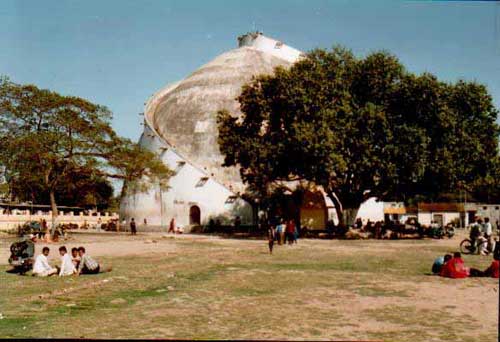
Gol Ghar Patna
There are two explanations about the origin of the name Patan. According to one explanation, the name derived from the name of a Hindu Goddess. The second explanation is that Patna was a port city. Hence, it is called “Pattan.” In Sanskrit language “Pattan” means port.
Megasthenes, the famous Greek traveler and geographer, talked about the city named Pataliputra in his book. Patna’s recorded history can be traced back to 490 B.C. Ajatshatru; the King of Magadh, made the city his capital. Lord Buddha passed through this city and he prophesized about the future prosperity and ruination of this city.

Gurudwara Patna Sahib, Birth Place of The Tenth Sikh Guru, Sri Guru Gobind Singh
The present day Patna is approximately a 15 kilometer long and 5-7kilometer wide city, situated on the southern bank of the Ganges. The city is a pilgrim for Jains and Buddhists. Vaishali, Rajgriha (King’s House), Nalanda, Bodhgya and Pawarpuri are major pilgrim sites for Jains and Buddhists. The tenth Guru of Sikhs, Guru Gobind Singh, was born in Patna. Hence, this is also a major religious site for Sikhs.
Aside from being the administrative center, Patna also serves as a major education center of Bihar. Students from all over Bihar come here to study. Reputed institutions include: Notre Dame Academy, St. Dominic Savio's High School, Don Bosco Academy, St Michael's Higher Secondary School, D.A.V., Khagaul, St Karen's School,
Gyan Niketan. In 1917, Patna University was established. It is one of the oldest Universities in the Indian subcontinent. Under the university, there are eleven colleges including Bihar College of Engineering, Science College, Bihar National College Patna Women's College, Patna College and Patna Medical College & Hospital.
Since it is a port city, Patna has been an important business center from ancient times. The rice of Patna was very famous among the Indian royals and in Europe. In Ain-i-Akbari (the famous book about the Mughal Emperors) the author talks about Patna. It was famous for paper, stone and glass industries. In the colonial period, Patna attracted French, Danes, Dutch and Portuguese. The English started a factory and started trading silk and calico. Present day Patna is heavily dependent on agriculture. Grain, sugarcane, sesame, and medium-grained Patna rice are the major export products.
Patna is a city with rich historical background. The ruins of old monuments would give the tourists an idea about the glorious past of the city. Here are some of the tourist sites of city:
Agam Kuan: A very deep well dug during the Ashokan period.
Hanuman Mandir: Situated in front of the Patna Junction, the central railway of the city, it is one of the most favorite deities of the locals.
Kumhrar: A place where you can see the ruins of Ashokan Patliputra.
Takht Shri Harmandir Saheb: The birth place of Guru Gobind Singh. It was decorated by Maharaja Ranjit Singh.
Martyrs Memorial: Built in the memory of the students of seven schools and colleges who were killed by British soldiers in 1942.
Golghar: A bee hive shaped granary one of the oldest buildings in Patna.
Other major tourist sites includes Patna Museum, Khuda Baksh Oriental Library, Begu Hajjam's mosque, Pathar ki Masjid, Qila House, Sadaqat Ashram, Zoological and Botanical garden, Padri Ki Haveli, Bankipore Club, Darbhanga House.
The transportation system of Patna is very developed. Lok Nayak Jayaprakash Airport has daily flights to major Indian cities like Delhi, Calcutta, Mumbai, Ranchi, and Lucknow. National Highway No.31 passes through Patna. Bailey Road is the longest road of Patna. The Railway station of Patna has trains to all the major cities of India. There are ferry services, and cargo service by the river Ganges
PATNA -City soaked in history
From Carolina in the U.S. to Scotland in the U.K., the city of Patna is a household name.
What connects Carolina in the U.S., Scotland and Bihar? The answer is not easy. The connection is Patna; more precisely it is the Patna rice. Many may be familiar with the long grain and aromatic Basmati rice. Equally long and mildly aromatic the rice grown in the fertile Gangetic plains of Bihar and specifically around Patna is known as the Patna rice. Some claim that this strain is one of the oldest rice varieties grown on the earth. According to Buddhist legends, Fa Hein's travel writings and records of Abul Faizal there is mention about this special rice. It is believed that this rice was taken to the U.S. in the 17th century and grown in Carolina. Till date the Carolina rice is one of the most popular varieties in that country. In Scotland, there is a small village named Patna. William Fullerton, who made large sums of money selling Patna rice, established this town in the 19th century. He thankfully remembered his productive stay in India by naming the newfound village Patna.
More than rice
But it's not just the rice; Patna is a city known for other rich legacies. It is known by many names, the most famous being Pataliputra. It is on the banks of the Ganga and in its vicinity three more rivers Ghagra, Sone and Gandak , converge. Buddhism and Jainism flourished in this place and Guru Gobind Singh was born here. It was the seat of the Mauryas and two legendary kings Chandra Gupta Maurya and Ashoka ruled this place. The city has been inhabited for centuries together without a break. In 1912, it became the capital of the combined province of Orissa and Bihar and from 1935 till now that of Bihar.
Patna is richly endowed with architecture from the British period — the Museum, High Court, Rajbhavan and the Assembly are some of them. Golghar, is the most famous of the monuments. This is a large circular egg-like structure built in 1786. It is about 29 m high and 3.5 m wide and was built to store grain, which was to be distributed during famine. Patna is not just about rice and famine. It is the land of Madhubani paintings, Obra carpets, Sujini quilts and Khatwa appliqués. Bhojpuri, Magahi and Maithili are some of the languages spoken in this region.
Champaran Movement
Gandhiji wrote that Champaran was the turning point of his life. Champaran is a small village about 300km from Patna. It is here that Gandhiji for the first time experimented with the Satayhagraha movement and successfully freed the peasants from the oppressive Indigo cultivators. Gandhiji established an ashram here at a place called Motihari and strived for the uplift of the poor villagers.
Subscribe to:
Posts (Atom)