Tuesday, December 26, 2006

Bihar inventor of lantern projector awaits govt nod even after 66 years

Photographer Manoranjan Ghosh's wait for a patent from the Government of Bihar for his invention-a lantern projector-continues even after 66 years. Though the inventor has died, his family's hope remains alive.

The 'Lantern Projector' was made with the objective of it being used to spread awareness and education in rural areas, and was invented in 1940. .

According to Ghosh's son, Rajat Ghosh, a sculptor by profession, it was his deceased father's long cherished dream to help in spreading education in the remote areas of the Bihar, and this motivated him to invent a "poor man's projector".

"This 'Lantern Projector' was invented for the purpose of promoting and propagating various education programmes such as children's education, women's education and others in remote villages where electricity was not available, says Rajat.

Apart from Gujarat, Madras, Calcutta and other States, the projector became famous in Germany too," Ghosh adds. "If the projector and the literature slides with some modifications and are used at places that are without electricity, it could prove to be very beneficial," says Rajat.

Besides creating slides of rare pictures of the Indian freedom struggle, Manoranjan Ghosh had a collection of slides with analytical descriptions of literature, art and many other subjects.

Bihar Chronicle- A New Begining


http://www.biharchronicle.blogspot.com/


Today on the dawn of 2007, we realise that Bihar is Changing. In last couple of days we had have couple of good new. i.e.

- Resurrection of Nalanda University

- Starting the Road Project in Patna

- Proposal for Setting up NIFT campus in BIHAR

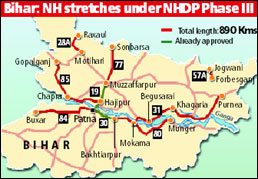
- National Highways Developement - Phase III giving bihar nearly 900 KMS of
highways connection all major cities in BIHAR

- Proposal for setting up an IIT in BIHAR

- Global meeting in JAN for a Resurgent BIHAR

and many more like this.


In such an environment in which the wind of chages are blowing from all direction it it imperative to give my BIHAR something new from my side. This feeling prompted me to launc this blog. The objective is to give plateform to all the good news which are not covered or reported elsewhere are covered on this Blog.

I invite BIHARI people all across the globe to come join this plateform and contribute in thier own unique way to give BIHAR a voice.

Thursday, December 21, 2006

Now US students come calling to hear Lalu


The Great Railway Turnaround Story seems to have become a fable, and its author an international management guru.


Having shared the tale of how he pulled back the Indian Railways from impending doom into a likely Rs 2,000 crore profit for this year with IIM-Ahmedabad students, Lalu Prasad Yadav is now polishing his phrases to deliver it to an American audience.

A group of 137 students, 100 from Harvard and the rest from Wharton, is coming here for a December 27 lecture by Yadav. The minister will spell out the finer points of the turnaround story in a day-long interaction at Rail Bhawan.

Insiders say the session has been in the works for quite some time, with Yadav keen on selling his success story internationally to counter the skepticism about his achievements within the country.


It will not be Yadav’s first interview with the American campus on this issue.

He has played host to professors from Harvard, Wharton, Boston University and American Defence Institute over the past couple of months, taking them to different parts of the country to show the Indian rail network and explaining to them the basics of what he did to the ailing national network, ministry sources said.

Now the jester-turned-pundit wants to ensure a visit by the US students to add to the sizeable bunch of brownie points he has already earned.

The professors, say the sources, were also keen to examine the genuineness of the claims made by the Indian Railways. “Initially, they were also a bit skeptical. They wanted to see for themselves whether the turnaround was only limited to government files in Rail Bhawan or extended to the rest of the country,” said one official.

“Once they travelled on the network, they shed many of their concerns and found the Railways a fit case to be studied by their students.”

Yadav’s lieutenants are preparing all the statistical support, but which language will he speak? Not known for his English, Yadav is reportedly brushing up whatever he has of it on him to be able to take direct questions from the young audience.

Yadav’s address, said sources, will mainly dwell on how the Railways has been restored its health without increasing fares or downsizing of staff.


More Nation HeadlinesI've a vision for Indo-Pak relations: PMIt was my fate to get lifer, says Manu'I really couldn't ask God for more'Life comes full circle for Manu SharmaDismiss Mulayam for our support: BJP to UPA'We had not asked Manu's father to resign'

Bihar, N-E, TN to be thrust areas in highway Phase III, Govt OK on way


Seemingly central government is addressing and Bihar is going to be
benefitted by this infrastructure initiative in a great way.

http://www.indianexpress.com/story/19060.html

Several good news on the horizon about Bihar after usual stereotype.
If good news kept on flowing this, they would sweep away the
stereotype and make them eat their words. Amen.

Cheers and regards for now and hope to be back with more soon..


New Delhi, December 20: The Government is set to clear the entire Phase Three of the National Highway Development Programme (NHDP III) where seven new road projects are to be included for Bihar, taking the length of roads in the state under NHDP III from 113 km to 890 km.

A sizeable portion or around 10 per cent of the total length under NHDP III would be for the North-East states, covering Assam, Arunachal Pradesh, Manipur, Meghalaya, Mizoram, Nagaland and Tripura. This fits into UPA plans to improve connectivity in states along the China border.

In all, the Government is going to increase the length of roads under NHDP III to 11,530 km — the Cabinet has already given its nod for 6,139 km. In fact, Bihar will have the largest increase in the total length under this programme — up by 777 km.

The Cabinet was to okay this proposal at its meeting tomorrow but it is being rescheduled, possibly for next week, as Road Transport Minister T R Baalu will not be able to attend the meeting tomorrow.

The NHDP III basically envisages connecting important state capitals and cities of economic and tourist importance that are otherwise not covered under the Golden Quadrilateral and the North-South East-West corridor projects.

While work has already started on some of the NHDP III projects (under NHDP III A), the Cabinet approval will be for the entire programme.

Under the approval sought for NHDP III, seven projects would be added for Bihar and five new projects, totalling a length of 613 km, for Assam.

J&K will have one new 101 km project connecting Srinagar-Baramula-Uri.

Tamil Nadu, which already has approval for ten projects totalling 1,146 km under NHDP III, will now have a total of 13 projects, totalling 1,455 km under this programme — the largest for any state.

IITs to come up in Bihar, Andhra and Rajasthan

JAIPUR: With the Union human resource development ministry approval, the path has been cleared for the setting up of three more Indian Institutes of Technology (IITs) — in Rajasthan, Bihar and Andhra Pradesh. At present there are seven IITs in the country — in New Delhi, Mumbai, Kharagpur, Kanpur, Roorkee, Chennai and Guwahati.

Vasudeo Devnani, minister of state for education, Rajasthan has been demanding the opening of an IIT for sometime now, as students from the state qualify in large number in IIT-JEE entrance and the state has produced number of toppers in the examination.

Rajasthan government is yet to decide where the IIT would be located, as the state government will have to make available 500 to 600 acres of land for setting up the institute. The chances are that it would be set up either in Jaipur or Kota.

Earlier, the state government had proposed that Kota Engineering College run by the state government be converted into an IIT, as all the necessary infrastructure was available there.

Wednesday, December 20, 2006

NIFT Comes to Patna

After a branch of BIT, Mesra, and a National Law Institute, Bihar is getting ready for a centre of the National Institute of Fashion Technology (NIFT). After the Centre's proposal for a branch of NIFT in Patna, the union textile ministry has sought 10 acres of land and a sum of Rs 29 crore from the Bihar government. Chief Minister Nitish Kumar readily agreed to the Centre's decision and the state government has earmarked 10 acres of prime land in the Mithapur agricultural farm for the project.

Informing members of the Bihar Legislative Council, the chief minister said he had conveyed the decision to the Union textile minister and urged him to start work for the project at the earliest. The NIFT centre is coming up in the area earmarked recently by the Nitish Kumar government as a new institutional area.

Besides, the newly-opened Chanakya National Law University (giving a five-year integrated degree course in Law), the state government proposes to set up other institutions of repute like NIFT and a branch of the Indian Institute of Management in the area. During his recent visit to IIM, Ahmedabad, the Bihar CM had proposed that a branch of the IIM be set up in Patna as well.

NIFT Comes to Patna

After a branch of BIT, Mesra, and a National Law Institute, Bihar is getting ready for a centre of the National Institute of Fashion Technology (NIFT). After the Centre's proposal for a branch of NIFT in Patna, the union textile ministry has sought 10 acres of land and a sum of Rs 29 crore from the Bihar government. Chief Minister Nitish Kumar readily agreed to the Centre's decision and the state government has earmarked 10 acres of prime land in the Mithapur agricultural farm for the project.

Informing members of the Bihar Legislative Council, the chief minister said he had conveyed the decision to the Union textile minister and urged him to start work for the project at the earliest. The NIFT centre is coming up in the area earmarked recently by the Nitish Kumar government as a new institutional area.

Besides, the newly-opened Chanakya National Law University (giving a five-year integrated degree course in Law), the state government proposes to set up other institutions of repute like NIFT and a branch of the Indian Institute of Management in the area. During his recent visit to IIM, Ahmedabad, the Bihar CM had proposed that a branch of the IIM be set up in Patna as well.

Nitish has big plans for ‘resurgent’ Bihar

The ruling NDA headed by Chief Minister Nitish Kumar has geared up for a total facelift of Patna in connection with the proposed first ever global conclave on “resurgent Bihar”.

The conclave in the state capital between January 19 and 21 will follow Prabashi Bharatiya Sanmelan scheduled to be held in Delhi in the first week of January.

Mr Ajay Kumar, CEO, Bihar Times, along with the Institute of Human Development, Delhi, is acting as a facilitator to bring prospective investors across the world and the Bihar Government on a common platform in connection with the conclave.

Talking to the media here, Mr Ajay Kumar said the government had planned to go for an aggressive campaign to strongly position Bihar as the most happening state of the country in the years to come.

Deputy Chief Minister and the Chairman of the steering committee for the conclave Sushil Modi claimed that with the growing acknowledgement of the positive changes in Bihar in past one year from different quarters, the state was poised to emerge as a developed state in next 10 year.

Mr Modi informed that about 500 delegates, including those from US, UK, Europe and West Asia, as well as from other parts of the country, were expected to attend the conclave which would deliberate on various parameters of development.

The conclave was also expected to come out with an agenda to guide the government in adopting the right path to bring back Bihar on tracks.

The Chief Minister, however, has already ruled out the possibility of considering any special economic zone (SEZ) for Bihar.

Patna parties late as safety returns to Bihar

Once a metaphor for lawlessness and urban decline, Bihar's capital Patna is fast becoming a happening city, thanks to a much-improved governance coupled with a booming economy.

A visit to the city - where a new government came to power last year - helps change the erstwhile perception about the safety of its people. With an improved law and order situation, women are now seen venturing out alone, driving cars and even taking children to favourite evening hangouts - all unimaginable until a couple of years ago.

"Earlier, we were so petrified that in spite of being financially well-off, we couldn't enjoy our lives. But now things have changed. We have started living a normal life. There is a marked improvement in law and order," Anjani, a housewife with two children, told IANS.

"New restaurants like Yo China, Moti Mahal and Roti have come up. The government is also making efforts to provide entertainment to the public," she added.

Added Sanjeev Sinha, who owns a chain of hotels in Bihar and Jharkhand: "We have two restaurants and three bars in Patna. Though we didn't have any problems during (former chief minister) Lalu Prasad Yadav's regime but business has certainly improved in last one year. Now more and more families visit us. They come to eateries as well as the bars. And people are more relaxed now."

He added that the government was planning to extend the closing time for bars beyond 10 p.m.

After living in fear for decades, the city is finally getting back to normalcy. In fact, travelling into the interiors of the state has now become less risky. Crime rates in villages have also declined.

"'Don't worry madam, you are safe,' cab driver Mansoor assured us while we were on our way to Patna from Amawan (a small village about 110 km from here)," said Krishna Shandilya who was travelling with her sister and daughter.

He stopped the car at Bakhtiyarpur, once one of the most crime-infested places in the region for the evening tea.

The city's business community is also reaping benefits of the current positive trend.

The purchasing power of consumers has gone up significantly. "There was a 43 percent growth in the sales of Maruti cars in 2006. We have sold the highest number of cars in eastern zone this year," said Rakesh Prasad Singh, owner of a Maruti showroom in the city.

Ever since the new government came to power last year, the fear factor has started evaporating and people feel more relaxed now, he added.

Talking about the significant changes, Singh said: "One of the most significant changes seen in the last one year is the city's business community fearlessly investing in new projects. Earlier, people dreaded showing off their wealth."

Apart from the mushrooming of new shopping malls and an increase in cars plying on roads, what has come as a relief is that people have started enjoying their lives.

"Patna is like any other city. I don't understand why people fear so much. We also go out with friends and freak out," retorted Priya, a student of the Patna Women's College.

However, youngsters feel the city should have more entertainment spots. Also, they want a better public transport facility.

Another growing demand among the citizens is that the state government needs to create job opportunities on a large scale.

But at the same time, the city is plagued by some serious infrastructure problems, which need to be remedied immediately.

People, however, hope that the city will soon prosper and, like many Indian cities of its size, become a favourite investment destination for non-resident Indians (NRIs).

Nalanda as an innovation hub

Interdisciplinary interaction could work the magic to re-establish an age-old academic institution

NK SINGH, JESSICA S WALLACK

Talk of the renaissance of Nalanda is gathering momentum. Plans for the university have been discussed at high-level meetings between China and India, India and Japan, and most recently at a multi-country interaction in Singapore which had President Abdul Kalam participating via teleconference, sharing his views and vision for the Nalanda of tomorrow. The university would have been on the agenda of the postponed Pan Asia Summit at Cebu.
The debate went truly ‘international’ last week when Nalanda and its potential became the centerpiece of a lengthy New York Times and International Herald Tribune editorial by the former Dean of the Yale School of Management Jeffrey Garten. Concrete actions for the university’s rebirth are also underway. The government of Bihar has a bill under consideration that provides for governance by an international body. Land is being acquired, and resources raised.

But what is the modern reincarnation of Nalanda? Agreement on this vision is an essential first step for the strategy to build an institution that attracts the right group of scholars, students, advisors, and others as well as fosters research.

Discussion has centered so far on the re-birth of the university’s Buddhist heritage. I have discussed this in an earlier piece as well. To reiterate my main point: Buddhism, as understood today, is as much a philosophy and a way of life as a religion. It takes many forms across countries, and is known for its non-exclusionary, peaceful, integrative ideals. An open, non-discriminatory university is very much in line with this tradition.

The university’s history as a crossroads of science and humanities is equally significant: Nalanda was the hub of a knowledge network that we have yet to recreate for the modern era. The old divisions were by geography. Nalanda overcame distance by bringing together a physical community of thousands of researchers and students from Korea, Japan, China, Tibet, Indonesia, Persia, and Turkey among other countries, according to Wikipedia. Its campus, an architectural masterpiece, was one of the first to have dormitories—fostering a community spirit.

Dormitories and a physical presence are no longer enough. The new divisions in knowledge are by academic discipline, economic opportunity, and culture. Geography is no longer such a significant factor.

The new Nalanda must be interdisciplinary, as also an innovation hub that explicitly engages academics, industry and policymakers and encourages them to put minds together on research programmes directed by questions from NGOs, social groups and policymakers. Garten’s editorial emphasized the importance of Nalanda as a center of academic excellence. But an innovation hub is more than a university or training facility. We must go beyond conventional definitions of excellence (publications and so on).

This is a unique historical opportunity to make a greenfield investment in a new kind of academic-industry-society cluster to promote innovation for smart growth, problem-driven research, and a holistic approach to development questions. How can this be achieved? Basically, it requires creating a funding structure and a communications infrastructure to encourage interdisciplinary research and knowledge sharing across academic and social divides. And so, even before the physical site is ready. We must encourage people to begin research projects, develop applications for their academic findings, and think about pressing social problems.

The first step would be to create a Nalanda Board, composed of internationally diverse academics and policymakers, as well as social and corporate leaders. This board would determine the goals and priorities, identify opportunities for collaborative work on broad social problems such energy security, environmental sustainability, international peace, poverty reduction, lessening of inequality and other pressing development issues, and interface with donors and sponsors.

Several mechanisms could then be added to this core governing body. First, a virtual clearing house for problems and solutions that would serve as the point of contact for policymakers, NGOs, companies and so on. This group could then identify the appropriate resources in the participating countries’ academic systems. This would solve an important information asymmetry that hinders collaboration today.

Second, a network of centres that takes advantage of existing research capacity around the world and directs it toward specific goals. Member institutions would provide information about their faculty and other available resources to a central place to facilitate joint research projects. Ongoing collaborative projects could be brought in here.

Both of these mechanisms would encourage a wide set of specific projects, driven by individuals, and directed by dispersed knowledge. The community—the eventual goal—will emerge from these projects. Existing innovation hubs such as the Silicon Valley cluster, the San Diego UCSD–biotech–IT cluster, the North Carolina “research triangle”, to name a few existing clusters, grew organically. The Nalanda project would be a way to jumpstart something similar.

Nalanda conjures nostalgia about a golden period in Indian history. To make this relevant for contemporary challenges, we must think beyond the past, out of the box, looking to the future. We must incubate an innovation hub.

Bihar catches UN fancy

PATNA: The United Nations has included Bihar in its select list of seven Indian states where it plans to introduce a slew of welfare and developmental programmes during its four-year plan. A total of 200 districts across the seven states will be benefited under the scheme.

UN Resident Coordinator Dr Maxine Olson told TOI on Saturday that the UN System in India was in the process of formulating its next UN Development Assistance Framework (UNDAF) for the programme cycle 2008-12. "The mission of this four-year plan is to promote social, economic and political inclusion of the most disadvantaged, particularly women and girls," said Olson, who is also the UNDP Resident Representative in India.

She further said that the UNDAF programme has been harmonised substantially in terms of its time frame with India’s 11th Five-Year Plan (2007-12). Olson was here in connection with a programme of the Bihar Legislative Forum on HIV/AIDS held in the assembly annexe on Saturday.

The programmes to be taken up in Bihar in close collaboration with the state government include quality education, coordinated HIV/AIDS and STD response through awareness, capacity building of Panchayati Raj institutions and environmental management, she said.

Olson said the districts will be shortlisted later and in consultation with the state government, the magnitude of the programme and its range would be decided.

Olson said, "The United Nations shares a very valuable relationship with Bihar and has been working in partnership with the state government on various developmental issues."

She disclosed that the UNDAF has spent around three million dollars on its schemes in Bihar in the last five years.

Friday, December 01, 2006

A New Magazine Bhojpuri World Launched

Mumbai: A new Hindi Glossy Magazine titled BHOJPURI WORLD launched with the auspicious hands of the Bhojpuri doyen's i.e. Kumkumji veteran actress of Hindi Films & also Mother India fame & the first leading lady of Bhojpuri cinema (first bhojpuri film Ganga Maiyya Tohe Pihari Chadhaido) & Surendra Pal renowned actor & Bhojpuri personality on 18th Nov, 2006 in Bandra, Mumbai.


Surendra Pal, Kumkum & Vinod Gupta launching BHOJPURI WORLD


On the occasion, Kumkumji said that this is the first ever Bhojpuri Magazine of is kind, in fact in the last 45-years of Bhojpuri history no such interesting magazine has been come out that can present not only the true picture of Bhojpuri films & culture but also the Bhojpuri customs & traditions. She also said that the bhojpuri people and the bhojpuri film industry must be grateful to the publisher for establishing such a quality magazine.


Surendra Pal, Kumkum, Vinod Gupta, Sajjad Khan, Hadi Abrar, Zahid Abrar & Nirav Gandhi at the launch of BHOJPURI WORLD


Renowned actor Surendra Pal appreciating the initiative taken by Vinod Gupta, said on the informal launch event that this magazine will truly bridge the gap between the Bhojpurians spread over the country & abroad.

Nirav Publications' BHOJPURI WORLD is published & edited by Vinod Gupta who was in headlines in early of this year for starting the first ever BHOJPURI FILM AWARDS. He recognized and appreciated the efforts done by Nathubhai Gandhi, Ishwarpal Singh, SP Yadav, Rajnikant Kataria and Jayant Printery for achieving a quality product, because eventually quality product is all about what matters the most in any business.


Truly honest and hard worker Vinod Gupta, editor of the magazine whose ideal & idol is Lal Bahadur Shastri, told on the occasion that He basically belongs to the Bhojpuri Mati, Culture and Life, therefore Publishing of this magazine BHOJPURI WORLD is like His old dream come true.

Apart form Kumkumji, Surendra Pal & Vinod Gupta who attended the brief launch ceremony also were Sajjad Khan, Hadi Abrar, Zahid Abrar, Nirav Gandhi, SP Yadav, Ishwar Pal Singh among other Common Bhojpurians.

Monday, November 20, 2006

Patna: A famous port city of India

Once upon a time, there was a great king Putraka, who

had a queen named “Patali” which means “Trumpet flower”. The king loved the queen so much that he created a city for her with a magic stroke and named the city “Pataligram.” Later, the king changed the city name to “Pataliputra” in honor of the queen’s first born. In Sanskrit, “Putra” means son. Well friends, the legend could be true or not but the place named Pataliputra still exists today as the capital of Bihar in India. Through its long history, the city is known as Pataligram, Pataliputra, Kusumpur, Pushpapura, and Azimabad. During the reign of Sher-Shah-Suri, it got its present name Patna.


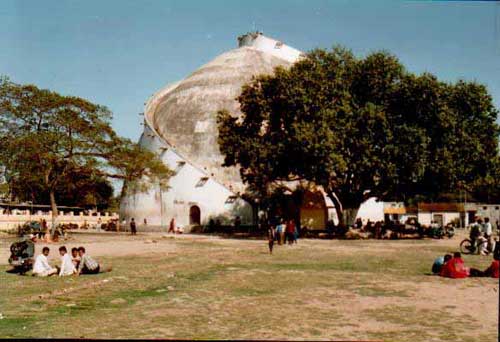
Gol Ghar Patna


There are two explanations about the origin of the name Patan. According to one explanation, the name derived from the name of a Hindu Goddess. The second explanation is that Patna was a port city. Hence, it is called “Pattan.” In Sanskrit language “Pattan” means port.


Megasthenes, the famous Greek traveler and geographer, talked about the city named Pataliputra in his book. Patna’s recorded history can be traced back to 490 B.C. Ajatshatru; the King of Magadh, made the city his capital. Lord Buddha passed through this city and he prophesized about the future prosperity and ruination of this city.


Gurudwara Patna Sahib, Birth Place of The Tenth Sikh Guru, Sri Guru Gobind Singh

The present day Patna is approximately a 15 kilometer long and 5-7kilometer wide city, situated on the southern bank of the Ganges. The city is a pilgrim for Jains and Buddhists. Vaishali, Rajgriha (King’s House), Nalanda, Bodhgya and Pawarpuri are major pilgrim sites for Jains and Buddhists. The tenth Guru of Sikhs, Guru Gobind Singh, was born in Patna. Hence, this is also a major religious site for Sikhs.

Aside from being the administrative center, Patna also serves as a major education center of Bihar. Students from all over Bihar come here to study. Reputed institutions include: Notre Dame Academy, St. Dominic Savio's High School, Don Bosco Academy, St Michael's Higher Secondary School, D.A.V., Khagaul, St Karen's School,

Gyan Niketan. In 1917, Patna University was established. It is one of the oldest Universities in the Indian subcontinent. Under the university, there are eleven colleges including Bihar College of Engineering, Science College, Bihar National College Patna Women's College, Patna College and Patna Medical College & Hospital.


Since it is a port city, Patna has been an important business center from ancient times. The rice of Patna was very famous among the Indian royals and in Europe. In Ain-i-Akbari (the famous book about the Mughal Emperors) the author talks about Patna. It was famous for paper, stone and glass industries. In the colonial period, Patna attracted French, Danes, Dutch and Portuguese. The English started a factory and started trading silk and calico. Present day Patna is heavily dependent on agriculture. Grain, sugarcane, sesame, and medium-grained Patna rice are the major export products.
Patna is a city with rich historical background. The ruins of old monuments would give the tourists an idea about the glorious past of the city. Here are some of the tourist sites of city:

Agam Kuan: A very deep well dug during the Ashokan period.

Hanuman Mandir: Situated in front of the Patna Junction, the central railway of the city, it is one of the most favorite deities of the locals.

Kumhrar: A place where you can see the ruins of Ashokan Patliputra.

Takht Shri Harmandir Saheb: The birth place of Guru Gobind Singh. It was decorated by Maharaja Ranjit Singh.

Martyrs Memorial: Built in the memory of the students of seven schools and colleges who were killed by British soldiers in 1942.

Golghar: A bee hive shaped granary one of the oldest buildings in Patna.

Other major tourist sites includes Patna Museum, Khuda Baksh Oriental Library, Begu Hajjam's mosque, Pathar ki Masjid, Qila House, Sadaqat Ashram, Zoological and Botanical garden, Padri Ki Haveli, Bankipore Club, Darbhanga House.

The transportation system of Patna is very developed. Lok Nayak Jayaprakash Airport has daily flights to major Indian cities like Delhi, Calcutta, Mumbai, Ranchi, and Lucknow. National Highway No.31 passes through Patna. Bailey Road is the longest road of Patna. The Railway station of Patna has trains to all the major cities of India. There are ferry services, and cargo service by the river Ganges

PATNA -City soaked in history

From Carolina in the U.S. to Scotland in the U.K., the city of Patna is a household name.


What connects Carolina in the U.S., Scotland and Bihar? The answer is not easy. The connection is Patna; more precisely it is the Patna rice. Many may be familiar with the long grain and aromatic Basmati rice. Equally long and mildly aromatic the rice grown in the fertile Gangetic plains of Bihar and specifically around Patna is known as the Patna rice. Some claim that this strain is one of the oldest rice varieties grown on the earth. According to Buddhist legends, Fa Hein's travel writings and records of Abul Faizal there is mention about this special rice. It is believed that this rice was taken to the U.S. in the 17th century and grown in Carolina. Till date the Carolina rice is one of the most popular varieties in that country. In Scotland, there is a small village named Patna. William Fullerton, who made large sums of money selling Patna rice, established this town in the 19th century. He thankfully remembered his productive stay in India by naming the newfound village Patna.

More than rice


But it's not just the rice; Patna is a city known for other rich legacies. It is known by many names, the most famous being Pataliputra. It is on the banks of the Ganga and in its vicinity three more rivers Ghagra, Sone and Gandak , converge. Buddhism and Jainism flourished in this place and Guru Gobind Singh was born here. It was the seat of the Mauryas and two legendary kings Chandra Gupta Maurya and Ashoka ruled this place. The city has been inhabited for centuries together without a break. In 1912, it became the capital of the combined province of Orissa and Bihar and from 1935 till now that of Bihar.

Patna is richly endowed with architecture from the British period — the Museum, High Court, Rajbhavan and the Assembly are some of them. Golghar, is the most famous of the monuments. This is a large circular egg-like structure built in 1786. It is about 29 m high and 3.5 m wide and was built to store grain, which was to be distributed during famine. Patna is not just about rice and famine. It is the land of Madhubani paintings, Obra carpets, Sujini quilts and Khatwa appliqués. Bhojpuri, Magahi and Maithili are some of the languages spoken in this region.

Champaran Movement

Gandhiji wrote that Champaran was the turning point of his life. Champaran is a small village about 300km from Patna. It is here that Gandhiji for the first time experimented with the Satayhagraha movement and successfully freed the peasants from the oppressive Indigo cultivators. Gandhiji established an ashram here at a place called Motihari and strived for the uplift of the poor villagers.

Tuesday, October 10, 2006

A tale of two (or three) Indias( Mahesh Bhat write on Succes of Bhojpuri Cinema)

‘Entertain them with what entertains them....’ said Prophet Mohammed fourteen hundred years ago. For some inexplicable reason these were the words that rang in my ears as I stood transfixed in Andheri Sports Complex among at least fifty thousand people who were there to be entertained with the yearly “Kushti” contest a few months ago. I could hardly believe that this upmarket complex, which has been host to performances of stars from Bollywood and to Michael Jackson, was now the battle ground for a seemingly ‘desi’ wrestling match, where the stage was covered in mud and gravel, and semi naked men from Benares to Pakistan grappled with each other, while the crowd roared.

“Who are these people and where have they all come from?” I asked Sanjay Nirupam, the hardliner Shiv Sena MP turned Congressman. “These are the people who are the back bone of your city and entertainment capital. Unfortunately, they have disappeared from your Bollywood radar. You guys used to make a Ganga Jamuna and Nadiya ke Paar, but now you have started catering to the Indian diaspora abroad, with films like Black and Kal Ho Na Ho, so its left to us to entertain these lonely people who are dislocated from their Indian heartland,” he said, subtly driving home his point.

It was then that with frightening clarity it dawned on me…. These are the people who have resurrected the Bhojpuri cinema which is over shadowing our self-proclaimed intelligent new age cinema today, and providing livelihood to a major bulk of our entertainment industry. “Give us back our movies,” was the unheard and unheeded cry of twenty five crores of people in the Indian heartland, who progressively discovered that the prominent film makers from Bollywood weren’t making films which mirrored their ethos, culture and language. It is the immigrant population who have left their homes and gone to the major cities in India, and are cut away from their families, land and language, which constitute the major bulk of the consumer base of the Bhojpuri films which run to full houses in Mumbai, Ahmedabad, Punjab, Rajasthan and even Chennai!

My long standing friend Shailendra Goyal, who made his foray into the world of Bhojpuri films with Ganga Mile Sagar Se, and which was adjudged the best Bhojpuri film of 2005, in the first Bhojpuri film award function, staggered me by saying that Sasura Bada Paise Vala did better business in Bihar than last year’s Bunty Aur Babli. Did you know that Dehati Babu ran for one whole week in Hyderabad? Where big budget Hindi films at times are pulled out after three days? Bhojpuri films find takers in countries like Mauritius, Surinam and even Bangladesh, where the Indian migrant labourer had settled down so many years ago, but still hungered for his roots and particular culture.

So what makes Bhojpuri cinema tick? “It’s like having home cooked food,” said Ravi Kishen, who is the biggest male star of the Bhojpuri film industry. Bollywood has ignored the issues of a villager and is catering to a class which is rooted in cities and fast-food culture. The reason there is an India where Manoj Tiwari Mridul serenades a huge sea of humanity and finds a space in their hearts more than a Shah Rukh Khan can, is because he still represents those core values which his ancestors brought him up on, and through which he feels mankind will find sustenance.

Its time for us to face the obvious —that there is an India whose value system believes in denying and saving. This is the working class which believes in slogging and saving for a better tomorrow, as opposed to the other India, which believes that satisfaction lies in spending, and wants instant gratification at any cost.

Obviously, these are two different universes which require two different kinds of stories. And since the first and the last rule of Bollywood has always been the same, which is make movies to make money, it has chosen to cater to the rich Indian diaspora and the urban multiplex consumer which has deeper pockets in comparison to its poorer counterpart. When an Asian in UK spends ten pounds to see a Bollywood film, and a native of Bihar finds it difficult to scrape together even ten rupees back home, its obvious which side the film industry will be on.

However, would it not be prudent to read the writing on the wall? Which is that if there are two India's today, with growing audiences in both sectors, then why not cater to both? In any business and Bollywood is no exception, it is demand which initiates supply. And while there is no longer a pan Indian audience which will consume collectively one kind of cinema, it would be foolish of Bollywood only to cater to one section and not the other. Doing so would only serve to alienate itself from its own heartland, which would be a complete catastrophe.

The writer is a filmmaker.

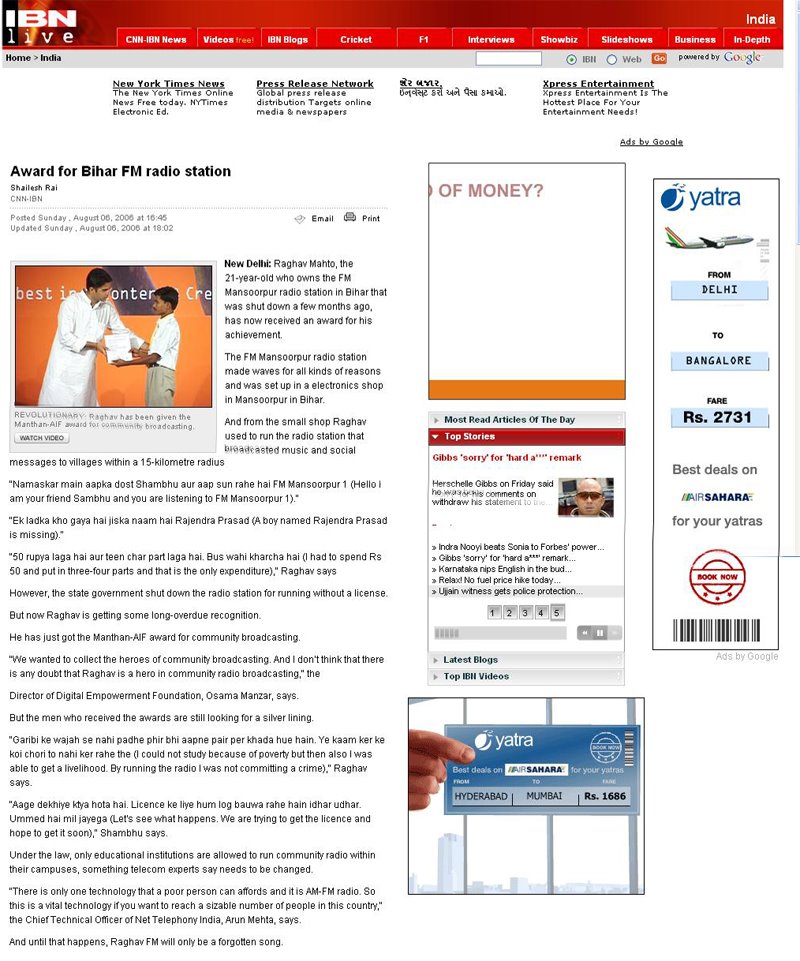
Manthan-AIF appreciation for Community Broadcasting to RADIO RAGHAV, MANSOORPUR

Raghav FM Mansoorpur


Product Description

Raghav Accepting the Appreciation

Rural and discreet Raghav Mahto started the community FM radio using a fifty rupee technology device that served the entire Mansoorpur village in his Vaishali District of Bihar as well as adjoining villages. He and his RJ (Radio Jockey) friend Sambhu started an innovative Rural FM service which enabled villagers and the local community to benefit from various services it offered. People at large benefited from announcements, messages, entertainments that touched their health, educational, trade, commerce, entertainment needs on day-to-day basis. Using an innovative knowledge enhancement & awareness driven simple technological platform, Raghav and his community FM served community needs and services in every possible way. The community FM was for the community and by the community, driven by community needs and demands. What was more unique was the manner in which the community embraced Raghav FM and become emotionally well attached to it. This was vividly revealed by the community members in sorrow and anger when Raghav FM was shut down in March 2006 after it served its listeners with grace and humility for more than 4 years, albeit unofficially.


ORGANISATION


Raghav FM Mansoorpur

LOCATION
Bihar

CONTACT
Raghav Mahto
09430262067

TECHNOLOGY/MEDIUM
FM/Community Radio

LANGUAGE
Bhojpuri, Hindi

Bhojpuria.com Manthan-AIF Award 2006 Winners

What is MANTHAN - AIF Award


The Manthan Award is an Indian initiative by Digital Empowerment Foundation, India as the national initiative of World Summit Award, to select and promote the best practices in e-Content and Creativity in India. It involves representatives from each state and union territory of India and visualizes the bridging of digital divide and narrowing of the content gap as its overall goal.
For The Manthan Award 2006, American India Foundation has come forward to become the Principal Partner. Thus the Manthan Award now is called The Manthan-AIF Award 2006


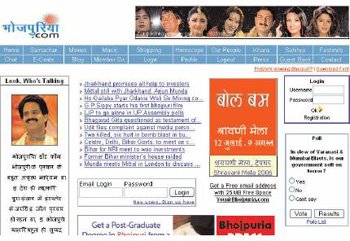
Bhojpuria.com

Product Description


World's first Portal for Bhojpuri Speaking people. The site attempts successfully to provide a holistic and a global platform for more than 34 Crore Bhojpuri speaking people across the Globe. One can find News, Bhojpuri Songs, Bhojpuria Dukan, Free E-mail, Bhojpuri E-greetings, ecards, Bhojpuria culture, Festivals etc through the online platform. The site is a value addition in itself with continuous information and coverage on latest and vital perspectives of life of Bhojpuri community. The site is a great wholesome service provider and entertainer with resourceful information on vital aspects of the community like matrimony, books, events and so on.


Citation

An online communication and networking platform is a great value addition for any group or community. Bhojpuria.com provides such a platform to the worldwide Bhojpuria population providing news and views from Bhojpuria region, and Bhojpuri Film industry. The aim is to connect the young generation from the 34 crore strong Bhojpuria community worldwide through its language, Bhojpuria
Bhojpuria.com is not just a website; it’s a way of life. The basic features are Online Shopping, People, Bhojpuri Sahitya, Khana, Festivals, Member's directory, and several others.


SUDHIR ACCEPTING THE AWARD


ORGANISATION

Infogate Exporters Pvt. Ltd

LOCATION

Jharkhand

CONTACTS

Sudhir Kumar
0657-2271219
kumar@bhojpuriya.com

URL
www.Bhojpuria.com

TECHNOLOGY/MEDIUM
Broadband/Online

LANGUAGE
Bhojpuri

Thursday, October 05, 2006

Publication of research paper title Bhojpuri Proverbs :: A Culture Study by Dr SD Ojha

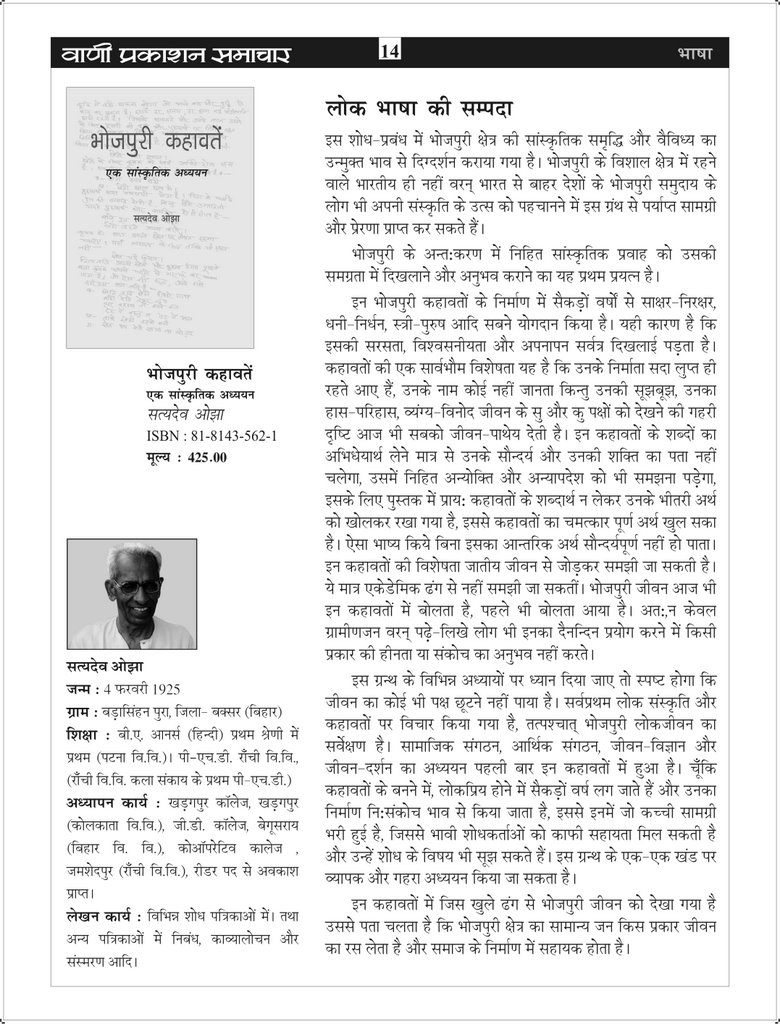
Bhojpuri Kahawaten- Ek Sanskritik Adhyayan By Dr SD Ojha


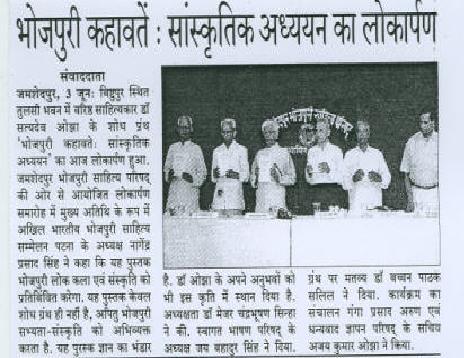
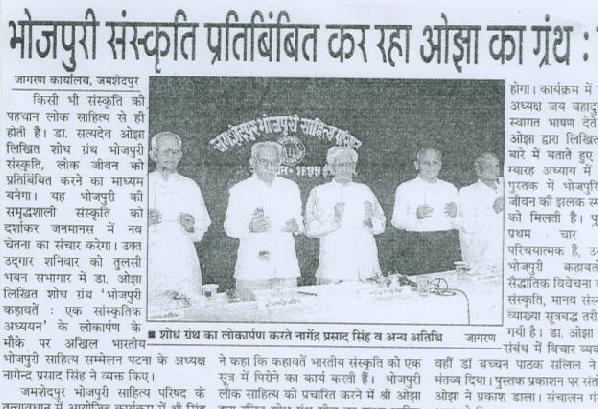
This book was released in Jamshedpur on 3rd June in a function organized by Jamshedpur Bhojpuri Sahitya Parishad. The vimochan was done by Sri Nagendra Prasad
Singh who is the chairman of Akhil Bhartiya Bhojpuri Sahitya Parishad Patna. This function was covered by the leading Hindi dailies of Jamshedpur: Hindustan, Dainik jagran and Prabhat Khabar.

The book has just been published by Vani Prakashan, Delhi. It is a valuable source of information on the evolution of & history Bhojpuri language and culture and the this must be possessed by all Bhojpuri lovers for knowledge and reference of bhjopuri.

This book has 416 pages, hard bound and is priced at Rs 425.

You can contact Sri Santosh Ojha to order this book at santoshojha1@yahoo.com

Press Coverage of the release of this book

Prabhat Khabar


Hindustan


Dainik Jagaran


An Introduction by the Publisher

Sunday, October 01, 2006

Women to help build Brand Bihar

PATNA: Women entrepreneurs are to help build Brand Bihar by showcasing the art, craft and cuisine of the state.

Bihar Mahila Udyog Sangh (BMUS) - a body of women entrepreneurs - will hold exhibitions in New Delhi, Mumbai, Kolkata and Bangalore to display the state's handicrafts.


"BMUS wants to market Bihar as a brand by showcasing products that have not been shown before. We will invite entrepreneurs from across the country to see our handicrafts," Pushpa Chopra, president of BMUS, told IANS.


"We plan to join hands with the government to market the products," she said.


BMUS was formed in 1996 to promote rural and cottage industries. Its annual fair in Patna provides a platform to women entrepreneurs to market their products.


A recent market survey shows a high demand for such artefacts in the metros. "If the government helps us we will market Brand Bihar in a big way," said Usha Jha, secretary of BMUS.

Keen to attract investment in agriculture, health, IT and tourism, Bihar will hold its first global meet early next year to attract NRI and foreign investment.

"The famous Madhubani paintings, Tikuli work, bamboo crafts, Sujni, a rare hand embroidery, and appliqué work will be showcased at the exhibitions," Jha said.

Food items like 'litti chokha', 'makhana', 'sattu', litchi squash, honey and 'badi' will also be sold along with the handicrafts.

This year the BUMS fair will be held from Sep 14 to 18. Apart from entrepreneurs from Bihar, women traders from Punjab, Haryana, Rajasthan, Delhi, Uttar Pradesh, Jharkhand, West Bengal, Andhra Pradesh and Maharashtra have also been invited to the fair.

"It's time to showcase Bihar's handicrafts because they reflect the culture of the state," said Indu Agrawal, vice president of BMUS.

His new republic of Bihar


Aditi Phadnis / New Delhi September 30, 2006


Aditi Phadnis journeys to the badlands of Lalu Prasad's former fiefdom, and comes away impressed by Nitish Kumar's initiatives.

The foetid smell of sweat, raw onions, garlic and mustard oil rises in the still, humid air of 1, Anne Marg as thousands collect in the sweltering heat to meet the chief minister of Bihar.


This is Nitish Kumar’s Janata Durbar, held at his residence twice a week. People spread their gamchhas under the trees outside the CM’s residence and sleep there to ensure they can meet Kumar the following morning.


Usually, their problems relate to unemployment, ex gratia medical relief, poverty, transfers and postings, police brutality and oppression...all the existential problems of any villager, all resolvable at the district level but imported to the Patna because of a dormant administration.


A young woman tugs at a security official’s sleeve. “I don’t have a petition,” she says, on the verge of hysterical tears. “I paid Re 1 to someone to write out my petition but he took my money and walked off.”


An officer is summoned and an application is written on her behalf. This will be entered in a data base designed by Tata Consultancy Services to enable the CM’s secretariat to track the complaint and redress it if the district administration doesn’t act on it.


Nitish Kumar arrives at the meeting with a cavalcade of bureaucrats. Every application is entered in the data base, and when the CM gets it, he hands out redressal on the spot. “Get me the Muzaffarpur SP,” he demands. A woman weeps in front of him. “This woman is a Dalit. Her children have been killed. Why isn’t the thana registering an FIR?” he yells on the mobile.


“There is no such thing as a ‘little’ height,” he tells a young man pleading with him to use his influence and get him admitted to the police overlooking a “small problem” — his height.


The scenes are not peculiar to Bihar. Every chief minister encounters them though Lalu Prasad and Rabri Devi never felt the need for such an exercise in their 15 years in office. Kumar is trying to bring governance back to Bihar after a long absence. Advocate general P K Shahi recalls the way the change in the state was relayed to him.


“It was the day after the election results and Nitish Kumar was to take oath. The chief minister told me to make preparations for the panchayat elections. I explained that the matter was before the Supreme Court in the form of a Special Leave Petition. He said, ‘Do what you want. I want the elections’.”


Within a day of assuming office, Kumar held a meeting with his bureaucrats and explained how he wanted things run.


For the first time in its history, the police in the state were asked to prioritise their job. Two problems were identified: one, gunslingers involved in extortion, intimidation and sometimes abduction by “bahubalis” (mafia lords). Second, abductions as an industry. Cases were divided into two categories based on their primacy and how recent they were. And then the Bihar police got down to the painful task of solving them.


“The challenge was obvious. The older the case, the harder it was to get evidence. Alongside, we also wanted to make an example of recent crimes. The message we wanted to send was: ‘Don’t think you can commit a crime and get away with it. Because you can’t, not now,” says additional DG of police (operations) Anil Sinha.


Once the police understood that criminals were going to get no political protection, they decided to go after them. The Arms Act is beautiful in its simplicity.


Nothing more than a sub inspector’s testimony is required to prosecute a criminal, so reports of arrests from districts began pouring in. The criminals were chargesheeted in three days, brought before a fast track trial court and convicted even before they could ask for bail.


In other states these incidents would be commonplace; in Bihar they are unbelievable. Now the second phase of operations has started: the arrest of those against whom FIRs have been lodged.


When arrest orders against minor “bahubalis” Sunil Pandey and Anant were issued, Bihar was in a state of shock. Both were sitting MLAs from the Janata Dal U, Nitish Kumar’s party.


Uncertain of their fate, the police went to Pande’s home, and though they knew he was inside, did not arrest him, merely pasted the proclamation on his door and returned. Inside, Pande granted interviews to television channels. When this was brought to Kumar’s notice, he publicly reprimanded the police brass.


The result of these moves has been nothing short of dramatic. Where earlier Patna cinema halls never screened evening and night shows, now they are sending cash registers ringing hysterically. Retail sales are up — people who used to visit shops only during the festive and marriage season are crowding shopping centres like Mauryalok.


Young people can be spotted waiting for a table in the swisher restaurants of the capital. Shops are open till 9 pm. Young women think nothing of going for a morning jog at Gandhi Maidan, the sprawling park in the centre of Patna.


Says principal secretary to the chief minister, R C P Singh: “Last month we logged 27 convictions a day. Of these, eight per day were for life imprisonment. In September we expect this to go up. In the last eight months we have convicted around 3,000 people in cases of heinous crime — murder, kidnapping and murder — and 2,000 people have been convicted in other crimes.”


The gain? “Once convicted, the person cannot get any government contract. Nor can he contest elections,” says a police officer.


Can the government sustain the momentum? Apart from an inefficient, corrupt and demoralised force, there are objective problems: lack of training and manpower shortages.


But the Bihar government has hit on a unique scheme that the President of India commended when he visited the state. It has already recruited 5,000 retired soldiers who have been banded as the Special Auxiliary Police for constabulary and cordon and search operations.


Therefore, when you have an incident like the Jehanabad jailbreak case, or where the local police is suspected to be either involved or frightened of acting (and this happens a lot in Bihar), this force will be used.


The Bihar government is also, for the first time in many years, actually spending the money given to it for modernisation — buildings, secure communication, and brand new computer systems to replace the aged 486 and Pentium II systems they had earlier.


Under another novel initiative, 50 officers have been headhunted in the CBI for vigilance functions. Beginning November, these officials will be tasked with handling cases relating to disproportionate assets, and entrapment.


It is not just on the law and order front that the state government has moved. A Single Window Act, 2006 seeks to cut red tape for industry wanting to invest in the state.


There are new rules for infrastructure development, the Rent Control Act has been abolished, stamp duty has been cut for better compliance, the Agricultural Produce Marketing Control Act used to force farmers to sell only at designated mandis has been abolished, the power sector has been unbundled into eight new entities, Bihar has a new sugarcane policy...


“Bihar is going to spend Rs 17,000 crore over three years just on roads. Apart from unbundling the power sector, we are going to franchise distribution,” says N K Singh, newly appointed vice chairman of the state’s Investment Board.


A 180-acre tourism complex has been envisaged in Bodh Gaya-Rajgir-Nalanda that will combine spa and health tourism. A golf course-multiplex-shopping mall-luxury hotel complex is to be set up here.


The project cost will be anywhere between Rs 850-1,000 crore. At the invitation of the Bihar government, a representative of the World Tourism Organisation and UN expert on regional planning, James Esserman is currently touring this area.


“The Nalanda University was world famous. We want to develop it into a modern world-class educational centre,” Nitish Kumar says. Singapore senior state minister for external affairs Balaji Sadashivan was in Patna earlier this week and he has promised Singapore’s support for the project.


Seductive as all this sounds, Kumar and his colleagues are acutely conscious that they need to have their feet firmly planted on the ground. Health is a formidable challenge with immunisation figures at a mere 11 per cent — against a national average of 54 per cent.


In January 2006, average patients per primary health centre (PHC) was 39 with 85 per cent or more patients going to doctors in the private sector.


In the last eight months, Rs 222 crore has already been spent on the health sector and the outlay in next year’s budget could be Rs 400 crore (it used to be Rs 100 crore before 2005).


“We want the doctors to be free from the management of support services so that they can concentrate on providing the specialised services they are meant for,” said Deepak Kumar, state health secretary.


Pathology services, radiology services, hospital maintenance, ambulance services and mobile medical unit services have all been outsourced.


Pathology services, for instance, are available at PHCs; the labs pay rent to the state government which makes no investment. Government patients are charged rates fixed after consultation between the government and the labs, on the understanding that the labs are free to use the premises and charge non-government patients market rates.


For those registered with PHCs, the charges are low. Ambulances are available at every hospital. But what has increased footfalls in PHCs is that 13 essential outpatient drugs and 24 essential inpatient drugs are provided free. From November, all medicines for indoor patients will be free.


Deepak Kumar concedes that absenteeism was a serious problem but there was not a lot the state government could do about it.


“Most doctors never viewed suspension as a punishment — it left them free for private practice. But we have tried to see the problem from their eyes: to see patients but neither be able to prescribe them medicines nor send them for an x-ray. Now that we’ve redressed this, the doctors are enjoying their job.”


A similar initiative in education has been planned. Nearly 2,40,000 teachers will be recruited over the next two years but the charge of managing them will be given to the panchayats.


As 58 per cent of the panchayats in Bihar are manned by women, Nitish Kumar says this will work beautifully. “There is no one who wants a child to study more than a mother, no matter how poor the family might be,” he says.


To correct the discrepancy between the quality of education in state run and private schools, a committee headed by former foreign secretary Muchkund Dubey is studying the issue.


Prem Shankar Mani, an MLC and Janata Dal U ideologue, says, “We believe the ends of social justice will be served only when children from lower castes get access to English education.”


Mani says declassing children is an important element in education for a state as poor as Bihar. “Talk to a child in a public school and ask him about hunger. He will describe it as appetite. But he has to learn the meaning of hunger as well from his low caste classmate.”


World Bank lead economist Dipak Dasgupta says health and education reforms by the government are steps in the right direction. “But,” he adds cautiously, “we need to know more about evaluation and monitoring.” Nitish Kumar smiles wryly at this. “They are right,” he says, “the programmes need to be monitored every day, every week.”


And this is the downside. In order to reform the Public Distribution System, the state government asked all district magistrates to collect figures of families Below the Poverty Line. One deadline has already been missed and a second one advanced.


Last week, at a videoconference with DMs, the chief minister lost his temper. The supply side story is that one block development officer complained he could not collect these figures because of threats by a “bahubali” and requested an NGO to conduct the survey. The NGO countered this by saying they would be subject to the same threat. The net result is that the figures are yet to come.


Nitish Kumar made the somewhat rash promise that all districts would be covered by the rural employment guarantees programme.


He told Business Standard that every district had reported that job cards were being handed out. But at a recent Jan Sunwai in Jehanabad, several women complained to the Land Reforms Commission’s D Bandopadhyaya that they had asked for work but had been denied cards.


This is the problem everywhere. There is one Nitish Kumar, a handful of officers by his side, battling the state of mind that is Bihar. His ministers, even if they are honest good men, don’t know how to be ministers.


When industries minister Gautam Singh was invited by the Bihar Industries Association along with the US Consul General in Kolkata, who speaks fluent Bengali, instead of discussing plans to encourage investment to Bihar, Singh spent the better part of an hour with the US envoy teaching him the Bhojpuri equivalent of Bengali words.


Ask Nitish Kumar and he will explain why he wants to encourage sugar mills to set up integrated sugar complexes in Bihar — ethanol, alcohol and suage plants — but when the government announced the new sugarcane policy, the minister in charge, Nitish Mishra cried off from an industry-government meet confessing he was yet to understand the policy.


State finance minister Sushil Modi was not even present at the press conference with Investment Commission chief Ratan Tata. Like a cuckolded husband, he is always the last to know when it comes to events in his department.


Understandably, big business is wary about investing in Bihar, though the state government is trying to make sure it doesn’t turn away for lack of a policy and legal architecture.


Although the chief minister says FDI worth Rs 14,000 crore has been approved for the state, the real bucks have come in only to set up 14 sugar mills. The chief minister is clear what he doesn’t want: “We will not be joining the race to set up Special Economic Zones in Bihar,” he says. “They are controversial and we can’t spare agricultural land.”


The Union government is holding out a helping hand. Thanks to a Patna visit by P Chidambaram earlier this year, bank CMDs are burning the tarmac at Patna airport. They are coming to Bihar in droves. What this activity yields is another matter. Last week, bids were opened for roadbuilding in Patna. The contract has gone to the Tantia group.


If words don’t match deeds, the Bihar elite, whom Kumar has kept engaged so far, will lose patience. But the World Bank says everything Kumar is doing is “exactly right”.

“In principal, Bihar should be growing twice as fast as the the national average if the government continues its reforms process. That’s the potential of the state,” says Dipak Dasgupta. But adds his associate, Mandakini Kaul, “Expectation management is a big issue.”

That is the challenge for the new republic that is Bihar.

Tuesday, September 26, 2006

Mahindras planning huge investments in Bihar


The diversified Mahindra and Mahindra group on Monday said it was keen on entering infrastructure, rural finance and the IT space in Bihar, besides utility vehicles but refrained from assinging any investment figures.

Sectors like tractors, infrastructure, rural financing and information techonolgy are some of the key areas in which the Mahindras would like to reigster their presence in the state in a big way, Group Vice-Chairman Anand Mahindra told reporters after a meeting with Chief Minister Nitish Kumar here.

"We are a big group and when we will arrive in the state.. it will be in a big way," he said when asked about the quantum of investment proposed by his company.
Mahindra said he was "very much impressed by the papers presented by Bihar government officials regarding investment opportunities in the state" and that his company was keen on availing of the "growth opportunity" the state presents.

Flanked by the Chief Minister Nitish Kumar and state planning board Vice-chairman N K Singh, he said agriculture and agro-based industries had a great potential in Bihar and that Mahindras would like to help the state emerge as the number one agro-product exporter in the country.


Kumar said the NDA Government had succeeded in creating a conducive atmosphere for industrialists to make investments in Bihar and that the state had decided to form a development council, which would have top industrialists of the country as members.
"I am happy to announce that Anand Mahindra has agreed to be a member of the council", Kumar said.

Monday, September 25, 2006

Go to Patna, young man

By Suhel Seth
The author is CEO of Equus Redcell Advertising and also a well known businessman.


For starters, it is a better-looking city than most I have ever been to in India. It is certainly better than most parts of Delhi; there are more schools and colleges which have first-rate syllabi and students than the ones run in Delhi and Mumbai: most of which with dubious ownership! The Bihari people are more large-hearted and far brighter than we would have ever believed, and in many ways Bihar today is at the cusp of what I would imagine will be a boom time in its rather sordid history.

I don?t know how much real progress Lalu Prasad Yadav is making with the Indian Railways, the IIM sojourn notwithstanding, but there sure is a silent revolution taking place in Bihar under Nitish Kumar. I never ever imagined that I would visit Patna. For anything. But I did just that last week and am delighted I did. For starters, it is a better-looking city than most I have ever been to in India. It is certainly better than most parts of Delhi; there are more schools and colleges which have first-rate syllabi and students than the ones run in Delhi and Mumbai: most of which with dubious ownership! The Bihari people are more large-hearted and far brighter than we would have ever believed, and in many ways Bihar today is at the cusp of what I would imagine will be a boom time in its rather sordid history. And much of the blame for that must rest with people who?ve governed Bihar.
I sincerely feel that the rulers of Bihar have consistently damaged the cause of Bihar more than anyone else has or will ever do. There are perceptions about it being a mafia state, which are completely untrue. I saw Bihar?s chief secretary drive in a Tata Indigo without any escort, whereas in Delhi and Mumbai every third-tier secretary also uses a silly red light atop his car with fancy escort vehicles. There was none of the red tape that Bihar is so well-known for. I had gone for some work and the presentations that were made by some officers of the Bihar government were first-rate; and it was only then that some interesting trivia about Bihar became all the more relevant.

Bihar today consumes pharmaceutical drugs worth Rs 1,500 crores per annum: the largest consumption amongst any state, and yet the tragedy is, there is no pharma company in Bihar ? an outcome of the negligent manner in which Bihar was run at the state-level and the treatment that was meted out to it by the Centre. Bihar today sends more people to the administrative services than any other state in the country. Of the 47,000 odd medical professionals working in the United States, 50 per cent are from Bihar. Bihar contributes 50 per cent to the patient inflow at AIIMS in New Delhi and so on and so forth.

The attitude of the Bihar government has also seemingly changed and it was no surprise that in the week gone by they?ve had Ratan Tata, Ashok Ganguly, Analjit Singh visit them, with people like Anand Mahindra and others expected this week. There is the obvious influence that the well-regarded N.K. Singh wields over the corporate world in India which plays a large role in getting these corporate honchos there. But having said that, one must applaud the changes that are being slowly brought into the very fabric of Bihar. And with N.K. heading the Planning Commission in Bihar, expect some more miracles.

The fact that you finally have a chief minister who is not a clown but a serious politician also helps, aided by people like G.S. Kang, the chief secretary whose integrity is unquestioned. I guess what Bihar now needs to do is cleanse itself of the past it so remarkably engendered and entrenched into people?s minds. In the serious talk for creating better infrastructure, for encouraging medical tourism, optimising the value of the hot sulphur springs in Rajgir, not to mention religious tourism in Bodh Gaya, you have a blend that just might work.

I believe from a marketing point too there is a lot of potential in Bihar that most of us, sadly, have not woken up to. I saw stretches of markets, not some odd number of shops, and I saw for myself the pattern of frenetic consumer buying: much more than what happens in our malls in the metros. I sometimes wonder why people have missed the Bihar bus.

Finally, the fact that the families in Bihar continue to lay a lot of emphasis on education, augurs well. I feel there may also be some merit in Bihar also becoming an important destination for the services backbone that Eastern India so desperately needs. I know Patna sounds a very incredible destination, but I guess this is what Incredible India is all about. We are so consumed by what we see and what we are fed by the so-called urbane media that we fail to observe the silent changes that are occurring right under our noses.
Go to Patna and see how India is really changing.

Friday, September 22, 2006

Investing in Bihar


Chief Minister Nitish Kumar had promised to bring in the winds of change in Bihar and his wish of putting Bihar back on track seems to be coming true.

In a first step of sorts, Ratan Tata visited Patna today (Sept 21), a big step in itself given the troubled ties the Tata's have had with the state. However, it is still too early for Nitish Kumar to smile, as only time will tell whether this visit translates into anything concrete.

When he first came to power, Nitish Kumar had said: "We want governance, and we also want to ensure that the new government will start developmental work and put Bihar back on track and we want everyone?s support."

And since then, it has been his constant endeavour to market Bihar and play down its reputation as a place, where muscle power is the only language that works. And after courting big bollywood directors like Prakash Jha, it is now the turn of business bigwigs. With Ratan Tata visiting the state after a personal invite from Nitish Kumar and raising hopes that after years of isolation, India?s biggest business house will look at Bihar again i.e. apart from its legacy in Jamshedpur, the TATA's have stayed away from the state.


Interestingly, Tata's are expected to be the first of many. It is learnt that Anand Mahindra is also expected to look at investing in the state.

However, for Nitish Kumar getting the men to his state is just the first step. He has to do serious work to raise the status of Bihar as an investment destination.

According to the World Bank report, Bihar is rated as India's poorest state and Bihar's per capita income ranks at the bottom of national income indices. To add to its woes, the state's industrial output is less than half the national average.

It's a tough task, however, for the past few months, Bihar politicians seem to be making news for their sharp business acumen. After all, if Lalu Prasad could turn around the fortunes of sagging Indian Railways, is it wrong for his biggest competitor to hope to turnaround the fortunes of Bihar, and for once, the state is hoping competition pays.

Wednesday, September 13, 2006

China can build things. Why can't India?

India?s top science and technology official is in China, making excuses about why his country?s infrastructure is so shoddy. Shanghai has brilliant new skyscrapers and museums and parks and trains ? and Bombay can?t manage to have a decent airport. According to Minister for Science and Technology Kapil Sibal, it?s all because of democracy. ?There is a different model of growth in our country,? Sibal told reporters in Beijing, according to this report from wire service PTI carried on Indian portal Rediff.com. ?We can?t, for example, build a Pudong overnight.?

Well, neither did the Chinese. Pudong today is the result of more than a decade?s worth of work and planning and investment. The place is hardly paradise; Pudong can feel overwhelming, especially along the district?s broad boulevard. I?m not saying that Indian officials should be trying to replicate Pudong in Bombay. But falling back on the old ?We?re a democracy, don?t expect too much of us? argument doesn?t cut it. Yes, the Chinese don?t have elections. But the Japanese do. So do the Koreans and the Taiwanese. They manage to build things anyway.

Monday, September 11, 2006

An Awakening In Bihar-How one rural school helps prepare poor youths for the Indian Institutes of Technology

source:

http://www.businessweek.com/magazine/content/06_34/b3998416.htm

Every April, some 230,000 Indian youths sharpen their pencils and sit for the intensely competitive entrance exam to the Indian Institutes of Technology (IITs) -- the seven prestigious schools that train India's top-notch engineers and entrepreneurs. After the grueling six-hour test, only 5,000 students are offered a place in the IITs. Most come from middle-class backgrounds and prepare for the exams through private coaching. But in the past few years, a small group of desperately poor, talented students have made it into the IITs, thanks to the Ramanujan School of Mathematics.

The school, named after a famous Indian mathematician, is even more intense than the IITs themselves. Located in Patna, the capital of Bihar, one of India's least developed states, the Ramanujan School trains just 30 students a year to take the IIT exam. Anand Kumar, 33, a local mathematician, and Abhayanand, 52, Patna's deputy director general of police and a lover of physics, founded the school in 2003 to help promising locals get ahead in the caste-based society.

They scoured Bihar's least privileged communities for 30 bright students to coach for the exam, providing free lessons and housing. They call their group the Super 30. "Intelligence is not birth-specific," says Abhayanand. In the first year, 16 of the group made it into the IITs. The next year, 22 made it. "This year," Kumar says confidently, "all 30 will get into the IITs."

Santosh Kumar, 19 (no relation to Anand Kumar), is one of this year's Super 30, and his story is typical of his classmates. He's from Dumari, a village in the Bihata district, about 22 miles from Patna. Nearly all the village's 3,000 residents scratch out meager livings as farmers. Santosh's sister and three brothers studied up to 10th grade but then returned to the fields. "Studying further required money, so that was that," he says.

VILLAGE HERO
Santosh wanted more. His school had no roof, no doors, and no teachers half the time, but he borrowed books and tutored two young students for 70 cents a month. He also sold vegetables the family cultivated in a nearby market town. "I didn't even know which subjects I was good at, and I'd certainly never heard of IIT. No one had," he says. Then an eighth-grade teacher noticed his mathematical talent and encouraged him to study further.

Santosh saw that "education was the only way out of poverty," he says. At first, he planned to study so he could become an officer in the Indian civil service. After high school, he enrolled in the Patna College of Commerce, and then he heard about the IITs and the Super 30. "I went straightaway to Anand Kumar and told him: 'I dream of IIT, but I have no money.' He gave me his test, and I came second in the class. [He] let me into his Super 30 -- free," Santosh recalls.

For seven months, Santosh studied every morning for four hours, then sat down for a three-hour test in math, physics, and chemistry, and after a break studied three more hours. From six to nine in the evening, he attended a class in the same subjects and prepared for the next day's test until 2 a.m. His work paid off last spring, when he won a coveted seat at the IIT in Kharagpur, near Calcutta. (He ranked 3,537 out of the 5,000 students chosen.) Santosh now aims to earn a doctorate in chemistry and become an inventor. His hero is Abdul Kalam, India's current President and father of the nation's missile program. Just as important, Santosh is on track to be the first person from Dumari to graduate from university, making him a hero in the eyes of his village.

Tuesday, June 27, 2006

Drive against BRIBE

Join Hands in

DRIVE against BRIBE


Don't pay bribe. Use RTI, it works faster than bribes.
This is the slogan for Anti-Bribe Campaign. For the people of Bihar and Jharkhand, this is a opportunity to join hands in the nationwide DRIVE AGAINST BRIBE.

The Right to Information Act came into force on 12th October 2005. This Act can be effective to keep an eye and bring transparency in the working of the government.


The citizen of several parts of India has successfully used this weapon to expose corruption as well as to get their work done without paying any bribe. But even till now the people of Jharkhand and Bihar is unaware of the importance and uses of this act. The government and the bureaucracy of both the states seem to be halfheartedly taking interest and it also seems unlikely to implement the act with full swing. The structure for providing the information is not sufficient. Jharkhand is still waiting for the formation of Information Commission meanwhile Bihar has appointed only two commissioners just few days back.

But, here is a big opportunity for the people of both states for testing the efficacy of this act. Leading Hindi Daily of Jharkhand and Bihar- Prabhat Khabar is coordinating this campaign in both states. We invite all concerned citizens and organizations to join hands.

DRIVE AGAINST BRIBE has to be launched as a massive nationwide awareness-cum-assistance program. The campaign would be run in coordination with several citizens, NGOs, business houses, media houses, government departments etc. NDTV, Hinduatan Times, Prabhat Khabar and several other media organizations are actively promoting it.

The Campaign will be launched on 1st July 2006. It will continue till 15th July 2006. During these 15 days, people would be trained and encouraged to use RTI instead of paying bribe to get their personal works done like getting ration card, getting passport etc.

During these 15 days, various citizens, groups and NGOs will set up camps in several cities across the country. People will be provided assistance at these camps in preparing and filing RTI applications. Arrangements have already been made in more than 20 cities including Delhi, Mumbai, Bangalore, Hyderabad, Pune, Sangli, Gorakhpur, Faizabad, Lucknow, Shillong, Bhubaneswar, Ranchi, Patna, Dhanbad etc.


According to the concept note of this drive, Right to Information (RTI) has emerged as a very powerful tool in the hands of a common citizen to hold government accountable. People have used it in various ways ranging from addressing issues related to their daily interface with government authorities to influencing major government policies. For instance,

Uday is a software engineer. He saw that the Outer Ring Road from IIT flyover to Panchsheel flyover was made last February and it came off within 10 days. He applied for inspection of files, inspection of road and sample of material used in the road. Two days before he was called for inspection, the entire road was relaid.
q Shailesh Gandhi was able to reduce the extent of political interference in transfer postings in Mumbai Police using RTI.
Vijay Kumbhar applied for a refill of his empty gas cylinder. He did not get a refill for more than a month. Everyday, someone would come to his colony to sell gas in black. Obviously, his gas dealer was not providing refills to the people and was diverting them to the black market. When Vijay applied under RTI, he got his refill within a few hours.
The note reads that one area where RTI has been most successful is - if you have a legitimate work pending in any Government Department and if they are not doing it for either expectation of bribe or due to simple bureaucratic delay, then use RTI and it gets done very fast. There are hundreds of such examples like

Nannu applied for a duplicate ration card in January 2004. Though his card should have been made in 10 days according to the rules, it wasn't done despite several visits. Three months later, when he applied under RTI, the card was made within four days.
Ashok Gupta was demanded Rs 5000 bribe for a new electricity connection in the year 2000. Connection was denied to him when he refused to pay. Two years later, when he applied under RTI, he got his connection within 10 days.
Prem Sharma applied for a passport. It should be made in 45 days according to the rules. However, he kept running for six months. When he took his application under RTI to the Regional Passport Officer, the passport was done within 7 days.
These success stories may come from Jharkhand and Bihar also, if we utilize RTI powerfully. Drive against Bribe will create massive awareness is both states and it will certainly help to force the government to make necessary arrangements to implement the act more positively. We are going to organize camps during 1-15 July at Patna, Ranchi, Jamshedpur, Dhanbad and Deoghar.
Contact for Campaign in Bihar and Jharkhand-
Vishnu Rajgadia,
Director, Prabhat Khabar Institute of Media Studies,
Ranchi
094311-04424
email- pkrti@yahoo.co.in

Monday, June 26, 2006

Patna Soon to Have Petrol and Power Generating Trash Incinerator

Urban Development Minister Ashwini Kumar Choubey, on Friday, on his return from Nagpur, said Patna would soon have the facility to produce petrol, LPG, and even electricity from all the garbage that the city collects everyday turning the city cleaner, greener, and self-dependent.

Choubey met with Professor Alka Jadgaonkar, the principal of G. H. Raisoni College of Engineering in Nagpur who is credited with inventing a contraption that turns garbage into gasoline and electricity and is currently being used in many metros including Mumbai and Jodhpur.

"Our team of six members took a closer look at the machine invented by Professor Jadgaonkar and we are all very satisfied with its performance. The Chief Minister has agreed to give it a go-ahead signal in the first week of next month after which the first phase of the plan will begin," Choubey said.

Initially the machine will turn 25 tons of garbage into petrol but later its capacity will be increased and the plan will be implemented in other parts of the state as well," he said.

The system is already being used in Nagpur where it produces 4,500 liters of petrol from 5,000 kilograms of plastic trash, the Minister said adding the machine is also capable of producing 100 MW of power from 500 ton of trash.

The project is expected to be completed in a record time of six months, Choubey said.

Friday, June 23, 2006

Bihar women cook up success tale


Bhagalpur (Bihar): Thirteen women in the Bhagalpur district of Bihar are cooking up a storm. In order to make a living, the women got together a year ago and set up a roadside dhaaba (eating joint).


The women jointly run the Asha Dhaaba with ?manager? Biwi Rajo at the forefront.


"Kaise maintenance karte? Ek aadmi kamane wala hai ghar pe, 12-13 aurat milkar ek committee khole. Sarkar ne bhi madat ki Rs 25,000 loan deke,. (How could we maintain with one man working? 12-13 women got together and opened a committee. We also took a loan from the government)," says Biwi Rajo.


The dhaaba has become a favourite with not just the villagers, but also truck drivers who make it a point to stop and savour the home-like food.


"Gaadi chalaate hai. Khana tasteful milta hai isliye yahaa rukte hai khaakar chalte hai (I drive a truck. The food is tasty, so I stop here to eat)," says truck driver, Shekhar Singh.


"Is jageh mei ek dum ghar jaisa mahaul hai. Koi dikkat nahi (The atmosphere is friendly here, there is no problem)," says another truck driver Tuntun Singh.


However, the going has not been smooth for these fearless women. While they earn accolades for their lip-smacking delicacies, they also have brave certain unruly elements.


"Peene waalo ko khaana diyaa nahi karte hai. Bhagaa dete hai ki bhai khaana nahi hai, dusra hotel dekh lo (We don't serve to people who come to drink. We tell them that there is no food so go to another hotel)," says dhaaba worker, Bohiya Biwi.


What started as a means to make ends meet has now become a success story. Having made a mark in an essentially male-dominated business, the women are not letting the success go to their head.

Bihar Police Going for an Image Makeover


In an attempt to revamp the image of Bihar police that generally evokes the picture of a pot-bellied, overweight, baton-swirling man in uniform, the state government has formed a 'dress committee' to look into the possibility of a new uniform that would give a different, 'sharp' image of the law enforcement officials in Bihar, sources in police said.

The committee is being led by Additional Director General of Police Abhayanand who will be assisted by IG (Provision) S. K. Bhardwaj, IG (Administration) Anil Sinha and three other IGs, DIGs, and four Superintendents of Police (SPs), officials said.

The move is the result of recent disparaging comments made by Chief Minister Nitish Kumar who had said that the sub-inspectors and havaldars, in their antiquated uniform, looked more like clowns and projected a bad image of the entire police force.

Kumar had also approved Rs. 2,650 cash for each sub-inspector to be spent on their new uniform each year.
The newly-formed committee will also consider improvement in other parts of the overall police uniform including shoes, belts, and badges, officials said.