Russian actor in Bhojpuri film
Anand Mohan Sahay in Patna | September 16, 2005 18:26 IST
Looks like casting foreign actresses is no longer a monopoly of Bollywood films. A Bhojpuri film featuring a model-turned-actress from Ukraine was released across Bihar on Friday.
Tanya, 27, plays the lead role in Firangi Dulhaniya (Foreign Bride). She was seen earlier in Bollywood music director Bappi Lahiri's Gori hai kalaiyan video.
Firangi Dulhaniya is shot extensively in foreign locations, which is quite rare for Bhojpuri films.
"Tanya is making history because she is the first foreign actress in a Bhojpuri movie," says director Rajan Kumar Singh.
"The film is inspired by the real-life story of a student in Patna, who went to study in Russia, fell in love with a Russian girl, married her and brought her here,"he adds.
Tanya plays the young bride who tries to adapt to an alien culture, language and food. She learnt to speak Bhojpuri from a teacher and Bhojpuri language expert from Fiji.
Wednesday, January 18, 2006


Madhushala (The Tavern)
Madhushala (The Tavern)
madiralay meiN jaane ko ghar se chaltaa hai peenewaala
kis path se jaaooN asmanjas meiN hai wo bhola bhaala
alag alag pathu batalaathi sab paR maiN ye bataata hooN
raah pakaD tu ek chalaa-chal paa jaayega madhushaala
Seeking wine, the drinker leaves home for the tavern.
Perplexed, he asks, "Which path will take me there?"
People show him different ways, but this is what I have to say,
"Pick a path and keep walking. You will find the tavern."
Hark! The wine gurgles and splashes as it falls from the goblet.
Hark! It sounds like the tinkling of bells on the feet of an intoxicated girl.
We have reached there, a few steps are we from the tavern,
Hark! Hear the laughter of the drinkers, as the fragrance of the tavern wafts through the air.
Call it not lava, though it flows red, like a tongue of flame.
Call it not the blistered heart, for it is only foaming wine.
Lost memories serve the wine, that intoxicates with pain.
If you find happiness in suffering, come to my tavern.
He who has burnt all scriptures with his inner fire,
Has broken temples, mosques and churches with carefree abandon,
And has cut the nooses of pandits, mullahs and priests ---
Only he is welcome in my tavern.
Alas, he that with eager lips, has not kissed this wine,
Alas, he that trembling with joy, has not touched a brimming goblet,
He that has not drawn close the coy wine-maiden by her hand,
Has wasted this honey-filled tavern of Life.
My beloved wine-maiden seems a priest; her wine as pure as the Ganga's waters.
With unbroken pace, she rotates the rosary of wine glasses.
"Drink more! Drink more!" she intones in prayer.
I am Shiva incarnate and this tavern is my temple.
Only once every year, the fires of Holi are lit.
Only once is the game played and are garlands of lamps lit.
But, O, those who are lost in the world, come and see the tavern any day,
The tavern celebrates a Holi, every morning and a Diwali every night.
Whatever the taste on my lips, it tastes like wine.
Whatever the vessel in my hands, it feels like a goblet.
Every face dissolves into the features of my wine-maiden,
And whatever be in front of my eyes, they fill only with visions of the tavern.
Ah, Beautiful, your lovely face is like a crystal bowl,
Whose precious gem is your beauty, sparkling like sweet, intoxicating wine.
I am the wine-maiden and I am the guest.
Where sit we together, there indeed is the tavern.
A mere two days she served me but the young maiden is sulking now.
She fills my goblet and passes it curtly to me.
Her coquetry and charms are lost arts;
All the tavern wishes now is to fulfil its obligations.
Life is short. How much love can I give and how much can I drink?
They say, "He departs," at the very moment that he is born.
While he is being welcomed, I have seen his farewell being prepared.
They started closing the shutters of the tavern, as soon as they were raised.
O maiden! Which burning heart has been pacified by drinking?
Every drinker repeats only one chant, "More! More!"
Seeking satisfaction, he leaves behind so many desires.
Of how many such hopes is this tavern a tomb?
Yama will come as the wine-maiden and bring his black wine,
Drink, and know no more consciousness, O carefree one.
This is the ultimate trance, the ultimate wine-maiden and the ultimate goblet.
O traveller, drink judiciously, for you will never find the tavern again.
Each day, O companion, spills more wine from my life.
Each day, O fortunate one, this goblet, my body, is burnt.
Each day, O lovely woman, this wine-maiden, my youth, distances itself from me.
Each day, O beauty, this tavern, my Life, is drying up.
When from the earthen jar of my body, the wine of life is emptied,
When the final wine-maiden comes with her bowl of poison,
When my hand forgets the touch of the goblet, and my lips the taste of wine,
Whisper in my ears, "the wine, the goblet, the tavern!"
Touch not my lips with tulasi, but with the goblet, when I die.
Touch not my tongue with the Ganga's waters, but with wine, when I die.
When you bear my corpse, pallbearers, remember this!
Call not the name of God, but call to the truth that is the tavern.
Weep over my corpse, if you can weep tears of wine.
Sigh dejectedly for me, if you are intoxicated and carefree.
Bear me on your shoulders, if you stumble drunkenly along.
Cremate me on that land, where there once was a tavern.
Pour on my ashes, not ghee, but wine.
Tie to a vine of grapes, not a waterpot, but a wine-goblet.
And when, my darling, you must call guests for the ritual feast,
Do this - call those who will drink and have the tavern opened for them.
If anyone asks my name, say it was, "The Drunkard".
My work? I drank and passed the goblet to everyone.
O Beloved, if they ask my caste, say only that I was mad.
Say my religion worshipped goblets and then chant with your rosary, "The tavern, the tavern!"
O son, raise not water at my final rites, but wine in your palms.
And sit somewhere, having filled the Ganga with wine.
If you can wet the earth somewhere, my soul will be satisfied.
Offer your libations to your ancestral spirits by reading repeatedly, "The tavern, the tavern."
-- Harivansh Rai Bachchan
madiralay meiN jaane ko ghar se chaltaa hai peenewaala
kis path se jaaooN asmanjas meiN hai wo bhola bhaala
alag alag pathu batalaathi sab paR maiN ye bataata hooN
raah pakaD tu ek chalaa-chal paa jaayega madhushaala
Seeking wine, the drinker leaves home for the tavern.
Perplexed, he asks, "Which path will take me there?"
People show him different ways, but this is what I have to say,
"Pick a path and keep walking. You will find the tavern."
Hark! The wine gurgles and splashes as it falls from the goblet.
Hark! It sounds like the tinkling of bells on the feet of an intoxicated girl.
We have reached there, a few steps are we from the tavern,
Hark! Hear the laughter of the drinkers, as the fragrance of the tavern wafts through the air.
Call it not lava, though it flows red, like a tongue of flame.
Call it not the blistered heart, for it is only foaming wine.
Lost memories serve the wine, that intoxicates with pain.
If you find happiness in suffering, come to my tavern.
He who has burnt all scriptures with his inner fire,
Has broken temples, mosques and churches with carefree abandon,
And has cut the nooses of pandits, mullahs and priests ---
Only he is welcome in my tavern.
Alas, he that with eager lips, has not kissed this wine,
Alas, he that trembling with joy, has not touched a brimming goblet,
He that has not drawn close the coy wine-maiden by her hand,
Has wasted this honey-filled tavern of Life.
My beloved wine-maiden seems a priest; her wine as pure as the Ganga's waters.
With unbroken pace, she rotates the rosary of wine glasses.
"Drink more! Drink more!" she intones in prayer.
I am Shiva incarnate and this tavern is my temple.
Only once every year, the fires of Holi are lit.
Only once is the game played and are garlands of lamps lit.
But, O, those who are lost in the world, come and see the tavern any day,
The tavern celebrates a Holi, every morning and a Diwali every night.
Whatever the taste on my lips, it tastes like wine.
Whatever the vessel in my hands, it feels like a goblet.
Every face dissolves into the features of my wine-maiden,
And whatever be in front of my eyes, they fill only with visions of the tavern.
Ah, Beautiful, your lovely face is like a crystal bowl,
Whose precious gem is your beauty, sparkling like sweet, intoxicating wine.
I am the wine-maiden and I am the guest.
Where sit we together, there indeed is the tavern.
A mere two days she served me but the young maiden is sulking now.
She fills my goblet and passes it curtly to me.
Her coquetry and charms are lost arts;
All the tavern wishes now is to fulfil its obligations.
Life is short. How much love can I give and how much can I drink?
They say, "He departs," at the very moment that he is born.
While he is being welcomed, I have seen his farewell being prepared.
They started closing the shutters of the tavern, as soon as they were raised.
O maiden! Which burning heart has been pacified by drinking?
Every drinker repeats only one chant, "More! More!"
Seeking satisfaction, he leaves behind so many desires.
Of how many such hopes is this tavern a tomb?
Yama will come as the wine-maiden and bring his black wine,
Drink, and know no more consciousness, O carefree one.
This is the ultimate trance, the ultimate wine-maiden and the ultimate goblet.
O traveller, drink judiciously, for you will never find the tavern again.
Each day, O companion, spills more wine from my life.
Each day, O fortunate one, this goblet, my body, is burnt.
Each day, O lovely woman, this wine-maiden, my youth, distances itself from me.
Each day, O beauty, this tavern, my Life, is drying up.
When from the earthen jar of my body, the wine of life is emptied,
When the final wine-maiden comes with her bowl of poison,
When my hand forgets the touch of the goblet, and my lips the taste of wine,
Whisper in my ears, "the wine, the goblet, the tavern!"
Touch not my lips with tulasi, but with the goblet, when I die.
Touch not my tongue with the Ganga's waters, but with wine, when I die.
When you bear my corpse, pallbearers, remember this!
Call not the name of God, but call to the truth that is the tavern.
Weep over my corpse, if you can weep tears of wine.
Sigh dejectedly for me, if you are intoxicated and carefree.
Bear me on your shoulders, if you stumble drunkenly along.
Cremate me on that land, where there once was a tavern.
Pour on my ashes, not ghee, but wine.
Tie to a vine of grapes, not a waterpot, but a wine-goblet.
And when, my darling, you must call guests for the ritual feast,
Do this - call those who will drink and have the tavern opened for them.
If anyone asks my name, say it was, "The Drunkard".
My work? I drank and passed the goblet to everyone.
O Beloved, if they ask my caste, say only that I was mad.
Say my religion worshipped goblets and then chant with your rosary, "The tavern, the tavern!"
O son, raise not water at my final rites, but wine in your palms.
And sit somewhere, having filled the Ganga with wine.
If you can wet the earth somewhere, my soul will be satisfied.
Offer your libations to your ancestral spirits by reading repeatedly, "The tavern, the tavern."
-- Harivansh Rai Bachchan
Ab Hamar Film Hit Hoi
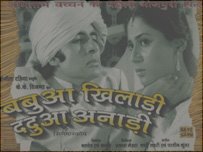
Ab Hamar Film Hit Hoi
The flavour of the season is Bhojpuri. These small films rake it in where the mega-budget ones flop.
NAMRATA JOSHI
Moti, Raj, Gagan, Swarn would have been long dead. These decrepit Delhi cinema halls had resigned themselves to imminent obsolescence when fancy multiplexes with their city-slick fairy tales had begun driving the Bollywood bazaar. But in the last couple of years, these old-world cinema paradisos have been given a new kiss of life by the success of fringe cinema of a largely unknown kind—Bhojpuri films.
This formidable phenomenon has been enjoying a great run at the margins of the Indian box office. Top heroes are Ravi Kishan (with 12 films in hand) and Manoj Tiwari Mridul (acting in another half a dozen), the most sought after heroine is Naghma, the big producers are Bollywood playback singer Udit Narayan and Mohanji Prasad and the recent megahit is called Panditji Batai Na Biyah Kab Hoi. Made at Rs 60 lakh, it has been running for more than 50 days in Patna and has earned four times more than the blockbuster Bunty Aur Babli. "These films have been doing well right under our noses yet people don't know they are there," says Naghma. Currently about 30 Bhojpuri films are under production. Around 16-odd films get released every year, boasting a success rate of 98 per cent. Bollywood, in comparison, musters only about a 10-12 per cent success rate. "It's boom time," says Kishan. "Our market has emerged," adds Narayan.
The bull run for Bhojpuri cinema began last year with Manoj Tiwari's Sasura Bada Paisewala. Bought by the distributor for a modest Rs 10-15 lakh, it garnered about Rs 2 crore in Bihar and eastern UP. It was followed by another hit, Daroga Babu I Love You. "In these areas, these films have been doing much better than any big star cast Hindi film," says distributor Sanjay Mehta. So much so that even the video rights for these modest films are going for as high as Rs 20 lakh. "You can call it the Laloo phenomenon of cinema," says Mehta.
Bhojpuri cinema came to life way back in 1961 with Ganga Maiya Tohe Piyari Chadhaibo, Balam Pardesia was the big hit of the '70s. Since then the industry has faced several ups and downs and has now got reborn in a new, glamorous avatar. Here's how:
Bhojpuri films are now regularly shot abroad. Narayan's production Kab Hoi Gauna Hamar was the first such film which was shot in Mauritius. Recently three films—Babul Pyaare, Dil Diwana Tohar Ho Gayi and Ganga—wrapped up an extended schedule in London. This week saw the release of Firangi Dulhania which isn't just shot abroad but also boasts of a Ukrainian actress, Tanya, in the lead role, a first for Bhojpuri films.
Big daddy Bollywood is courting Bhojpuri. Thespian Dilip Kumar is producing a film with Ravi Kishan in the lead role, Amitabh Bachchan and Hema Malini are acting in Ganga, Raj Babbar stars in Babul Pyaare and Rati Agnihotri appears in Mat Bhulaiye Mai Baap Ke. Ajay Devgan has already done a guest appearance in a Bhojpuri film. Famous choreographer Saroj Khan is turning director with Dil Diwana Tohar Ho Gayi, action director Tinnu Verma is filming a remake of Mera Gaon Mera Desh and failed Bollywood heroines like Hrishitaa Bhatt and Preeti Jhangiani have found a new career in them.
Bhojpuri films are also getting corporate backing. Vijay Mallya's film production unit is reportedly producing three Bhojpuri films. So is Ektaa Kapoor's Balaji Telefilms and AB Corp.
Big Hindi films, like Namak Halal, are now being dubbed and re-released in Bhojpuri. A fight is on to get the dubbing rights of 30-40 films including Sholay and Deewar. Last heard, Fox was rumoured to be dabbling with the idea of dubbing Hollywood films into Bhojpuri.
What works for Bhojpuri films are tight budgets and disciplined filmmaking.The budget is normally in the range of Rs 30-40 lakh with the bigger ones getting made in about Rs 60-80 lakh.The production also get wrapped up in three months flat. "There are no star tantrums on the sets, no indiscipline, no waste of time, no juices and sandwiches from 5 Star hotels. We mean business," says Kishan. However, with the recent spell of success the budgets are getting a lot more liberal. Kab Hoi..., for instance, was shot with Rs 1.5 crore, huge by Bhojpuri standards.
The most significant shift is how the market for Bhojpuri films has gone way beyond Bihar and eastern UP. "The territory has started to grow," says Mehta. These films are doing well in Jammu, Kashmir, Jalandhar, Ludhiana, Panipat, Kurukshetra, Noida and Gurgaon which have a sizeable population of the migrant labour from Bihar. "It's the belt along the GT Road where the Bihar labourers have settled down," says Mehta. There is an estimated 40 lakh Bhojpuri-speaking population in Mumbai, 18 lakh in Punjab and about 8 lakh in Delhi. Bengal and Nepal are emerging as the next big markets.
Bhojpuri films tend to do very well in the industrial areas like Badarpur or the theatres in Thane in Maharashtra. Hindi films run for about three weeks there while Bhojpuri ones go on for 6-8 weeks. Recently Bandhan Toote Na completed 100 days in Bombay. "That's a dream run even for mainstream Bollywood," says Kishan. Mehta says about a dozen hole-in-the-wall theatres in Delhi depend entirely on Bhojpuri films for survival.
Bhojpuri films have also created a committed subset of loyal viewers within the growing nri audience. The films have found huge following in the diaspora in Fiji, Mauritius and the West Indies where, years ago, Biharis had gone as indentured labour. Udit Narayan thought of producing Kab Hoi... when he went for a show to Mauritius. "It was a small India. It was good to see how people had kept the Bhojpuri culture alive," he says. So through his period film, Kab Hoi..., set a century ago in Mauritius, he looked at the clash between the Britishers and sugarcane plantation labourers.
But at the very basic, the resurgence in Bhojpuri films has been because of mainstream Bollywood itself. In its quest for niche urban crowds and NRI audiences, Bollywood has steadily moved away from the non-metro masses. "The audience which pays Rs 20 for a film ticket is getting neglected, his sensibility is getting ignored," says Mehta. "A guy who wants to eat home-cooked food is being offered dishes from a five-star hotel, they are wasted on him," says Kishan. So, the thrust is towards homegrown subjects and a sense of rootedness, not technicolour fantasies. Much like the family socials of the '60s, the concerns are largely to do with marriage and family. "Devar, bhabhi, gauna. There's a native, Rajshree touch to these films," says Vinod Mirani, editor, Box Office. "Sindoor, mangalsutra and lots of emotions. We sell our culture and tradition than sex," says Kishan.
Another popular genre is the Govinda-David Dhawan kind of risque comedies complete with double entendres. But they have now begun experimenting with newer subjects. A satire on the political system, Banke Bihari MLA, is under way. "Soon we will have our own Manmohan Desai and Yash Chopra brand of cinema," says Kishan. Ironically, then the migrant labourer from Bihar and his Moti cinema hall will have to look for another kind of cinema to connect with.
Move over Bollywood, here's Bhojpuri
Move over Bollywood, here's Bhojpuri
By Amarnath Tewary in Patna
Bhojpuri cinema has an audience of 200m.
Bollywood is having to take a backseat as the hitherto little-known regional Bhojpuri film industry steals the show in India.
The industry, catering to 200m people who speak the Bhojpuri language - a dialect of Hindi - and live in the states of Bihar and Uttar Pradesh, is raking in cash like never before.
Sticking to home-grown Indian family melodramas and throwing in some glamorous faces and slick foreign locations for a contemporary feel, Bhojpuri films are often outperforming Bollywood biopics at the box office these days.
Take, for example, two of the Bhojpuri mega hits of 2005, Sasura Bada Paisawela (My Father-in-Law is Rich) and Daroga Babu I Love You (Dear Policeman, I Love You).
Both did more business in Bihar and Uttar Pradesh than the A-list Bollywood releases, Bunty Aur Babli, a version of Bonnie and Clyde, and Mangal Pandey - The Rising, about the 1857 Indian mutiny.
Star cast
Made on a modest budget of $65,000, Sasura Bada Paisawela took in over $3m at the box office. Daroga Babu mopped up nearly $900,000 on a similar budget.
Many Bhojpuri movies take about 10 times their costs
With a success rate of almost 100% it is not surprising that Bhojpuri cinema is wooing Bollywood players like never before.
Superstar Amitabh Bachchan, presently recovering from surgery, and star actress of yesteryear, Hema Malini, have signed up for a Bhojpuri film together.
Other actors who have appeared in or are about to appear in Bhojpuri films are Ajay Devgan, Juhi Chawla, Raj Babbar, Rati Agnihotri and starlet Nagma.
That's not all - Bollywood's top choreographer Saroj Khan is directing a Bhojpuri movie, director Tinnu Verma is remaking a Bollywood hit, Mera Gaon Mera Desh (My Village, My Country), in Bhojpuri, and Bollywood singer Udit Narayan is producing a Bhojpuri film called Kab Hoi Gauna Hamar.
The four-decade-old Bhojpuri industry is attracting foreign talent too.
Ukrainian model Tanya has already played a Russian girl in love with a Bihari boy in Firangi Dulhania (Foreign Bride). Now 24-year-old Cambridge-educated British actress Jessica Bath has signed for two Bhojpuri films.
The Bhojpuri industry is buzzing as never before - with some 30 films this year, double the number of previous years.
Good business
So what makes Bhojpuri cinema tick?
Bhojpuri cinema is like home-cooked food
Ravi Kishan, actor
For one, the film-makers have astutely targeted the Bhojpuri-speaking audience at home and abroad - a substantial expatriate population in places such as Mauritius, Fiji, Surinam and the West Indies.
With Bollywood productions increasingly targeting the urban middle and upper classes in India's cities, Bhojpuri directors have cashed in by churning out home-grown local fare.
The industry also has its own stars now - Manoj Tiwari and Ravi Kishan are the biggest male actors, while an actress from Mumbai (Bombay) Rani Chatterji - originally Sabiha Sheikh and renamed after Bollywood actress Rani Mukherjee - is the most popular actress.
Tiwari, who began as a small-town crooner, now has more than a dozen films to his name and charges as much as $90,000 per film.
Kishan charges as much. He has been quoted on an Indian website as saying Bhojpuri cinema is like "home-cooked food".
Bollywood hits are now also being dubbed into Bhojpuri
Vinod Mirani, an editor of a Bollywood trade journal, said on the same site: "Bhojpuri movies are not about Technicolor fantasies. The thrust is towards home-grown subjects. The concerns are largely to do with marriage and family. There's lot of emotions."
Clearly, the formula is working.
"Bhojpuri cinema has finally got its identity and real worth. Now its commercial success is making everybody sit up and take notice," says Raghuvansh Babu, chief of the Bihar Motion Pictures Association.
Bhojpuri movies also make eminent business sense.
"Most Bhojpuri films are made on small budget of usually $50,000 to $60,000 and usually gross 10 times their costs at the box office, which is much higher than any Bollywood hit," Bollywood trade analyst Taran Adarsh says.
Bhojpuri film-makers now claim they are pushing the envelope with themes.
Manoj Tiwari says Bhojpuri films are being made around "gender themes and even a political satire is in the works".
To exploit the industry's potential, there is also a rush now to dub 40 Bollywood hits, including films like Sholay and Deewar, into Bhojpuri.
By Amarnath Tewary in Patna
Bhojpuri cinema has an audience of 200m.
Bollywood is having to take a backseat as the hitherto little-known regional Bhojpuri film industry steals the show in India.
The industry, catering to 200m people who speak the Bhojpuri language - a dialect of Hindi - and live in the states of Bihar and Uttar Pradesh, is raking in cash like never before.
Sticking to home-grown Indian family melodramas and throwing in some glamorous faces and slick foreign locations for a contemporary feel, Bhojpuri films are often outperforming Bollywood biopics at the box office these days.
Take, for example, two of the Bhojpuri mega hits of 2005, Sasura Bada Paisawela (My Father-in-Law is Rich) and Daroga Babu I Love You (Dear Policeman, I Love You).
Both did more business in Bihar and Uttar Pradesh than the A-list Bollywood releases, Bunty Aur Babli, a version of Bonnie and Clyde, and Mangal Pandey - The Rising, about the 1857 Indian mutiny.
Star cast
Made on a modest budget of $65,000, Sasura Bada Paisawela took in over $3m at the box office. Daroga Babu mopped up nearly $900,000 on a similar budget.
Many Bhojpuri movies take about 10 times their costs
With a success rate of almost 100% it is not surprising that Bhojpuri cinema is wooing Bollywood players like never before.
Superstar Amitabh Bachchan, presently recovering from surgery, and star actress of yesteryear, Hema Malini, have signed up for a Bhojpuri film together.
Other actors who have appeared in or are about to appear in Bhojpuri films are Ajay Devgan, Juhi Chawla, Raj Babbar, Rati Agnihotri and starlet Nagma.
That's not all - Bollywood's top choreographer Saroj Khan is directing a Bhojpuri movie, director Tinnu Verma is remaking a Bollywood hit, Mera Gaon Mera Desh (My Village, My Country), in Bhojpuri, and Bollywood singer Udit Narayan is producing a Bhojpuri film called Kab Hoi Gauna Hamar.
The four-decade-old Bhojpuri industry is attracting foreign talent too.
Ukrainian model Tanya has already played a Russian girl in love with a Bihari boy in Firangi Dulhania (Foreign Bride). Now 24-year-old Cambridge-educated British actress Jessica Bath has signed for two Bhojpuri films.
The Bhojpuri industry is buzzing as never before - with some 30 films this year, double the number of previous years.
Good business
So what makes Bhojpuri cinema tick?
Bhojpuri cinema is like home-cooked food
Ravi Kishan, actor
For one, the film-makers have astutely targeted the Bhojpuri-speaking audience at home and abroad - a substantial expatriate population in places such as Mauritius, Fiji, Surinam and the West Indies.
With Bollywood productions increasingly targeting the urban middle and upper classes in India's cities, Bhojpuri directors have cashed in by churning out home-grown local fare.
The industry also has its own stars now - Manoj Tiwari and Ravi Kishan are the biggest male actors, while an actress from Mumbai (Bombay) Rani Chatterji - originally Sabiha Sheikh and renamed after Bollywood actress Rani Mukherjee - is the most popular actress.
Tiwari, who began as a small-town crooner, now has more than a dozen films to his name and charges as much as $90,000 per film.
Kishan charges as much. He has been quoted on an Indian website as saying Bhojpuri cinema is like "home-cooked food".
Bollywood hits are now also being dubbed into Bhojpuri
Vinod Mirani, an editor of a Bollywood trade journal, said on the same site: "Bhojpuri movies are not about Technicolor fantasies. The thrust is towards home-grown subjects. The concerns are largely to do with marriage and family. There's lot of emotions."
Clearly, the formula is working.
"Bhojpuri cinema has finally got its identity and real worth. Now its commercial success is making everybody sit up and take notice," says Raghuvansh Babu, chief of the Bihar Motion Pictures Association.
Bhojpuri movies also make eminent business sense.
"Most Bhojpuri films are made on small budget of usually $50,000 to $60,000 and usually gross 10 times their costs at the box office, which is much higher than any Bollywood hit," Bollywood trade analyst Taran Adarsh says.
Bhojpuri film-makers now claim they are pushing the envelope with themes.
Manoj Tiwari says Bhojpuri films are being made around "gender themes and even a political satire is in the works".
To exploit the industry's potential, there is also a rush now to dub 40 Bollywood hits, including films like Sholay and Deewar, into Bhojpuri.
Ajay Devgan goes Bhojpuri

Ajay Devgan goes Bhojpuri
Actor Ajay Devgan will be seen doing a guest appearance in a Bhojpuri film. "It is just that I am helping out this friend of mine, producer Nirmal Jani. He has worked with me earlier on films like Raju Chacha and Zakhm. In fact, Zakhm fetched me my first National Award," said Ajay. Ajay Devgan plays the role of Superintendent of Police in the film. Though it is a guest appearance, the role makes an impact. "It is Ajay who instigates the hero of the film to fight injustice. The film titled Dharti Kahe Pukaar Ke is based in Bihar and Patna and shows the atrocities the people face there."
Bihar dissolution: SC indicts governor
Bihar dissolution: SC indicts governor
Onkar Singh in New Delhi | January 24, 2006 11:53 IST
The Supreme Court, in a majority judgement on Tuesday, pulled up Bihar Governor Buta Singh for trying to favour a particular political party through his actions.
The court also pulled up the Home Ministry for its role in the implementation of President's Rule in the state on May 23, 2005.
Chief Justice Y K Sabharwal and four other judges of the constitutional bench heard the petition challenging the dissolution of the Bihar assembly leading to fresh elections in the state.
While three judges struck down the centre's order, the other two gave a dissenting vote. The apex court said a political debate should be held on the appointment of governors.
The other judges in the bench included Justice Arijit Pasayat, Justice Ashok Bhan, Justice T K Subrahmanium and Justice B N Agarwal.
Onkar Singh in New Delhi | January 24, 2006 11:53 IST
The Supreme Court, in a majority judgement on Tuesday, pulled up Bihar Governor Buta Singh for trying to favour a particular political party through his actions.
The court also pulled up the Home Ministry for its role in the implementation of President's Rule in the state on May 23, 2005.
Chief Justice Y K Sabharwal and four other judges of the constitutional bench heard the petition challenging the dissolution of the Bihar assembly leading to fresh elections in the state.
While three judges struck down the centre's order, the other two gave a dissenting vote. The apex court said a political debate should be held on the appointment of governors.
The other judges in the bench included Justice Arijit Pasayat, Justice Ashok Bhan, Justice T K Subrahmanium and Justice B N Agarwal.
World Bank Supports National Highway Systems Improvements In Uttar Pradesh And Bihar
World Bank Supports National Highway Systems Improvements In Uttar Pradesh And Bihar
Project will help deliver India’s National Highway Development Project
Press Release No:2005/251/SAR
Contacts:
In Delhi:
Geetanjali Chopra
(91 11) 2461-7241
Email: gchopra@worldbank.org
In Washington:
Karina Manasseh
(202) 473-1729
Email: kmanasseh@worldbank.org
Washington, D.C., December 21, 2004—The World Bank today approved a loan of US$620 million to upgrade the stretch of National Highway No. 28 between Lucknow in the State of Uttar Pradesh and Muzaffarpur in the State of Bihar on the East-West National Highway Corridor. The project is the fourth World Bank loan to support the Government of India’s National Highway Development Project and will help reduce transport costs which are hampering national economic activity in the country as well as contribute to opening up access to the more remote and poor North East of the country.
Road transport plays a significant role in India’s economy, carrying 80 percent of the land transport demand. The total length of the national highway network is about 65,000 km. This accounts for less than 2 percent of the total road network, but carries over 40 percent of the road traffic. As a result of steady economic growth over the last decade, traffic on the national highways has grown by 6 to 7.5 percent per year.
“This project has a simple objective: for road users to benefit from a better journey between Lucknow and Muzaffarpur,” says Piers Vickers, Senior Transport Specialist for the World Bank and task leader for the project. “This will be accomplished by reducing travel time and operating costs as well as making road conditions safer. We anticipate that as a result, overall user satisfaction with India’s national highways in the region will be improved.”
The Lucknow-Muzaffarpur National Highway Project has only one component: highway upgrading. The primary beneficiaries are road users, of whom about 65 percent are commercial. An improved highway system will reduce the cost and time of moving goods and people between major population centers. A secondary target group is people living adjacent to the road. A recent study shows that living close to the highway decreases a household’s chance of being poor by 17 percent and increases its access to work by 32 percent. School enrollment is also increased by 40 percent with proximity to the highway.
The project is part of the Government of India’s overall National Highway Development Project (NHDP), initiated in 1998. The purpose of the NHDP is to strengthen and widen the core national highway network of about 14,300 km to a four-lane standard in a phased manner by 2008. When this is accomplished, India will be connected throughout by an arterial network of high quality four-lane highways. The project will also finance the delivery of entitlements to people expected to be affected by the project, afforestation, monitoring and evaluation, and programs aimed at road safety and HIV/AIDS awareness.
“This section of the East-West corridor runs through some of the poorest areas of the country,” says Michael Carter, World Bank Country Director for India. “These areas are expected to benefit directly from the improved physical access as well as indirectly from the spur to growth. The road will also help better connect more remote regions. The Government of India and the World Bank have a well developed partnership in the sector, and this fourth loan to the NHDP is a sign of our commitment to support key government programs in a systematic manner.”
The project is expected to contribute to achieving broader India Country Strategy objectives which identifies highway bottlenecks as one of the major constraints to poverty reduction and private sector-led growth. The project will be implemented over six years by the National Highways Authority of India. The loan, from the International Bank for Reconstruction and Development (IBRD), has a 20-year maturity with a five-year grace period, and is made at the standard financial terms for India.
Project will help deliver India’s National Highway Development Project
Press Release No:2005/251/SAR
Contacts:
In Delhi:
Geetanjali Chopra
(91 11) 2461-7241
Email: gchopra@worldbank.org
In Washington:
Karina Manasseh
(202) 473-1729
Email: kmanasseh@worldbank.org
Washington, D.C., December 21, 2004—The World Bank today approved a loan of US$620 million to upgrade the stretch of National Highway No. 28 between Lucknow in the State of Uttar Pradesh and Muzaffarpur in the State of Bihar on the East-West National Highway Corridor. The project is the fourth World Bank loan to support the Government of India’s National Highway Development Project and will help reduce transport costs which are hampering national economic activity in the country as well as contribute to opening up access to the more remote and poor North East of the country.
Road transport plays a significant role in India’s economy, carrying 80 percent of the land transport demand. The total length of the national highway network is about 65,000 km. This accounts for less than 2 percent of the total road network, but carries over 40 percent of the road traffic. As a result of steady economic growth over the last decade, traffic on the national highways has grown by 6 to 7.5 percent per year.
“This project has a simple objective: for road users to benefit from a better journey between Lucknow and Muzaffarpur,” says Piers Vickers, Senior Transport Specialist for the World Bank and task leader for the project. “This will be accomplished by reducing travel time and operating costs as well as making road conditions safer. We anticipate that as a result, overall user satisfaction with India’s national highways in the region will be improved.”
The Lucknow-Muzaffarpur National Highway Project has only one component: highway upgrading. The primary beneficiaries are road users, of whom about 65 percent are commercial. An improved highway system will reduce the cost and time of moving goods and people between major population centers. A secondary target group is people living adjacent to the road. A recent study shows that living close to the highway decreases a household’s chance of being poor by 17 percent and increases its access to work by 32 percent. School enrollment is also increased by 40 percent with proximity to the highway.
The project is part of the Government of India’s overall National Highway Development Project (NHDP), initiated in 1998. The purpose of the NHDP is to strengthen and widen the core national highway network of about 14,300 km to a four-lane standard in a phased manner by 2008. When this is accomplished, India will be connected throughout by an arterial network of high quality four-lane highways. The project will also finance the delivery of entitlements to people expected to be affected by the project, afforestation, monitoring and evaluation, and programs aimed at road safety and HIV/AIDS awareness.
“This section of the East-West corridor runs through some of the poorest areas of the country,” says Michael Carter, World Bank Country Director for India. “These areas are expected to benefit directly from the improved physical access as well as indirectly from the spur to growth. The road will also help better connect more remote regions. The Government of India and the World Bank have a well developed partnership in the sector, and this fourth loan to the NHDP is a sign of our commitment to support key government programs in a systematic manner.”
The project is expected to contribute to achieving broader India Country Strategy objectives which identifies highway bottlenecks as one of the major constraints to poverty reduction and private sector-led growth. The project will be implemented over six years by the National Highways Authority of India. The loan, from the International Bank for Reconstruction and Development (IBRD), has a 20-year maturity with a five-year grace period, and is made at the standard financial terms for India.
Sting on police, with politician at right end
Sting on police, with politician at right end
OUR CORRESPONDENT
Patna, Jan. 23: When the caller identified himself as the owner of the truck his men had stopped, the police officer was ready to bargain over the bribe.
What he hadn’t bargained for was that the purported truck owner would turn out to be a minister, armed with a voice recorder.
The Nawada deputy superintendent of police (DSP), Sheel Chandra Kumar, today became the “victim” of a sting operation by — for a change — a politician.
Bihar transport minister Ajit Kumar got the idea when a truck owner from Samastipur, Anil Kumar Singh, approached him with a complaint. His truck, on its way from Koderma in Jharkhand to Bihar’s Samastipur, had been stopped by a bribe-hungry DSP and his men on January 19.
The officer apparently found the truck travelling without its papers in order and threatened to seize it unless the owner coughed up a fine of Rs 65,000 — or a bribe of Rs 25,000.
Posing as the truck’s owner, the minister called the officer on his mobile phone and managed to get the bribe slashed to Rs 20,000.
Ajit Kumar, who is in the middle of an anti-corruption drive in his department, recorded the conversation and then briefed chief minister Nitish Kumar. On Nitish’s orders, Nawada police registered a case against the DSP.
“My government is seriously concerned about corruption in society. It is top of our agenda,” the chief minister later said. “The officer has been caught red-handed. Corrupt officers, no matter of which department, should not be let off.”
Ajit has been carrying out surprise checks at department offices. He has already uncovered a driving licence scam in the Patna district transport office.
It was during his inspection of a transport office in Muzaffarpur that the actual truck owner had approached the minister.
“We want our state to shine with a new face. Corruption is deep-rooted and has to be uprooted, no matter in what department,” the minister said.
Ajit has also exposed an inter-state racket involving “golden cards” issued by transport departments to simplify tax payment by truck owners.
Truckers can buy a card for Rs 6,000 or less depending on the loads carried by their vehicle. The card is pasted on the windscreen, giving the truck freedom from tax checks for three months.
“We stumbled on this… scam when the department checked a truck coming from Uttar Pradesh that had a fake card on it. The scam may be deep-rooted, involving a loss of crores of rupees to the state,” the minister said.
OUR CORRESPONDENT
Patna, Jan. 23: When the caller identified himself as the owner of the truck his men had stopped, the police officer was ready to bargain over the bribe.
What he hadn’t bargained for was that the purported truck owner would turn out to be a minister, armed with a voice recorder.
The Nawada deputy superintendent of police (DSP), Sheel Chandra Kumar, today became the “victim” of a sting operation by — for a change — a politician.
Bihar transport minister Ajit Kumar got the idea when a truck owner from Samastipur, Anil Kumar Singh, approached him with a complaint. His truck, on its way from Koderma in Jharkhand to Bihar’s Samastipur, had been stopped by a bribe-hungry DSP and his men on January 19.
The officer apparently found the truck travelling without its papers in order and threatened to seize it unless the owner coughed up a fine of Rs 65,000 — or a bribe of Rs 25,000.
Posing as the truck’s owner, the minister called the officer on his mobile phone and managed to get the bribe slashed to Rs 20,000.
Ajit Kumar, who is in the middle of an anti-corruption drive in his department, recorded the conversation and then briefed chief minister Nitish Kumar. On Nitish’s orders, Nawada police registered a case against the DSP.
“My government is seriously concerned about corruption in society. It is top of our agenda,” the chief minister later said. “The officer has been caught red-handed. Corrupt officers, no matter of which department, should not be let off.”
Ajit has been carrying out surprise checks at department offices. He has already uncovered a driving licence scam in the Patna district transport office.
It was during his inspection of a transport office in Muzaffarpur that the actual truck owner had approached the minister.
“We want our state to shine with a new face. Corruption is deep-rooted and has to be uprooted, no matter in what department,” the minister said.
Ajit has also exposed an inter-state racket involving “golden cards” issued by transport departments to simplify tax payment by truck owners.
Truckers can buy a card for Rs 6,000 or less depending on the loads carried by their vehicle. The card is pasted on the windscreen, giving the truck freedom from tax checks for three months.
“We stumbled on this… scam when the department checked a truck coming from Uttar Pradesh that had a fake card on it. The scam may be deep-rooted, involving a loss of crores of rupees to the state,” the minister said.
NTISH the Best Chief Minister of India
Best Chief Minister of India
Folks,
Our Chief Miniter Mr. Nitish Kumar has been voted as the Best Chief Minister of India in a Survey Conducted by CNN-IBN to check the State of the Nation , an exclusive and most comprehensive poll in association with Hindustan Times and conducted by the Centre for the Study of Developing Societies.
I was also waching the interview of Mr. Nitish Kumar on CNN-IBN and the way he replied to all the questions posed to him and the humilty shown by him was commendable.
Rajdeep also disclosed that during the survey Mr. Kumar has been rated excellent by people of all cast,religion and political affliations.
Thats something BIHAR had never seen. The whole of the country is still wodering " KYA BIHAR SUDHEREGA"??
We can hope "BIHAR SUDHERAGA" because here we have a C.M. who works for more than 14 Hrs. a day and sincere and hoest in his approach.
AMEEN.
Santosh Pandey
http://www.ibnlive.com/features/rday/stateofthenation/index.php
BIA seeks new industrial policy
BIA seeks new industrial policy
Patna: Bihar Industries Association (BIA) president KPS Keshri today emphasised on the need for a new industrial policy for creating an investment friendly environment in the state.
The BIA has prepared a vision document which envisages industrial growth with high potential of huge investments with the state goverment playing role of a ''benevolent facilitator''.
The BIA president stressed on the need for a new industrial policy for a hassle free environment with single window facility for clearances of the domestic industrial projects.
He said his organisation had also urged Industrial Development Commissioner S Vijya Raghavan to provide 15 to 20 per cent subsidy to new and old industrial units undertaking modernisation, diversification and expansion projects under capital investment subsidy scheme.
The subsidy scheme should also be applicable to the sick units which had the potential of revival, he urged.
Informing that the BIA had sought 50 per cent subsidy upto a maximum of Rs 25 lakh for acquiring technical know-how, Mr Keshri said the BIA mantra was to catch up with the rest in the country.
The BIA's vision was to promote and encourage private sector participation in development and management of infrastructure projects for industrial growth, he added.
He said the industrial estates and areas, industrial growth centres, special economic and commodity zones and industrial parks including theme parks could be developed.
Patna: Bihar Industries Association (BIA) president KPS Keshri today emphasised on the need for a new industrial policy for creating an investment friendly environment in the state.
The BIA has prepared a vision document which envisages industrial growth with high potential of huge investments with the state goverment playing role of a ''benevolent facilitator''.
The BIA president stressed on the need for a new industrial policy for a hassle free environment with single window facility for clearances of the domestic industrial projects.
He said his organisation had also urged Industrial Development Commissioner S Vijya Raghavan to provide 15 to 20 per cent subsidy to new and old industrial units undertaking modernisation, diversification and expansion projects under capital investment subsidy scheme.
The subsidy scheme should also be applicable to the sick units which had the potential of revival, he urged.
Informing that the BIA had sought 50 per cent subsidy upto a maximum of Rs 25 lakh for acquiring technical know-how, Mr Keshri said the BIA mantra was to catch up with the rest in the country.
The BIA's vision was to promote and encourage private sector participation in development and management of infrastructure projects for industrial growth, he added.
He said the industrial estates and areas, industrial growth centres, special economic and commodity zones and industrial parks including theme parks could be developed.
Bihar fast becoming investment friendly state: Nitish
Bihar fast becoming investment friendly state: Nitish
Patna: Bihar Chief Minister Nitish Kumar today said that the image of Bihar was changing fast and hoped investment would pour into all sectors, including agriculture, industry and infrastructure.
Addressing a function after inaugurating the Mahavir Netralay, developed in collaboration with the Shankar Netralay, Chennai, Mr Kumar said here he was making all efforts to make Bihar an investment friendly state.
Referring to the recent NRI meet at Hyderabad, he said response had been ''very encouraging'' and added that several NRIs had shown keen interest in investing in different sectors, including health and agriculture.
Mr Kumar said the long-standing necessity for a world class eye hospital in the state was fulfilled with the opening of this hospital, set up in the pattern of the Shankar Netralay under the patronage of Mahavir Arogya Sansthan.
He hoped that eye patients could now avail better treatment at low expenses in comparison to elsewhere.
Opthalmologists of Bihar would be sent to Shankar Netralay, Chennai, for training and the specialists of Shankar Netralay would be available in Patna, he informed.
The chief minister assured all help from the state government to the new establisment.
Earlier, eyes of Mr Kumar were checked by the doctors of the new hospital, registering him as the first patient of the hospital
TEMPLES and LEGENDS of BIHAR -PHULHER TEMPLE
PHULHER
Introduction
The Girija temple at Phulher has a background, which needs mention. The ancient Mithila, the core of which is the district of Darbhanga, has had her distinct individuality and an eclectic culture. This is the land of King Janaka, whose capital was at Janakpur about 18 miles from Jainagar in Darbhanga district.
The land is also known as a part of Videha and that is why Sita, the daughter of Janaka, is also known as Vaidehi. Being intersected by rivers and streams, the area is also known from the ancient days as Tirabhukti, the land of the river banks, by which name she has been famous for at least the last fifteen hundred years.
Introduction
The Girija temple at Phulher has a background, which needs mention. The ancient Mithila, the core of which is the district of Darbhanga, has had her distinct individuality and an eclectic culture. This is the land of King Janaka, whose capital was at Janakpur about 18 miles from Jainagar in Darbhanga district.
The land is also known as a part of Videha and that is why Sita, the daughter of Janaka, is also known as Vaidehi. Being intersected by rivers and streams, the area is also known from the ancient days as Tirabhukti, the land of the river banks, by which name she has been famous for at least the last fifteen hundred years.
FAMOUS Temples of Bihar
Temples & Legends of Bihar
Index Of Bihar TEMPLES
Phulher
Ma Paudi
Benusagar
Mandar Hill
Sultanganj
Konch
Mundesvari
Parasnath
Vaisali
Nalanda
Patan Devi
Aranya Devi
Shahabad
Sonepur
Uchaitha
Kurkihar
Masarh
Maheshi
Jagarnathpur
Harmandir
Deoghar
Singheshwarsthan
Mahabodhi
Gautam Rishis Ashram,Rivilganj,Chapra
Thawe,gopalganj
AAMI,Chapra
MAHAVEER MANDIR,PATNA
Index Of Bihar TEMPLES
Phulher
Ma Paudi
Benusagar
Mandar Hill
Sultanganj
Konch
Mundesvari
Parasnath
Vaisali
Nalanda
Patan Devi
Aranya Devi
Shahabad
Sonepur
Uchaitha
Kurkihar
Masarh
Maheshi
Jagarnathpur
Harmandir
Deoghar
Singheshwarsthan
Mahabodhi
Gautam Rishis Ashram,Rivilganj,Chapra
Thawe,gopalganj
AAMI,Chapra
MAHAVEER MANDIR,PATNA
BIHAR BRAINS GLOBAL CHAT MEETING
BIHAR BTAINS Gloab Chat Meeting is Scheduled Today at 20.30 IST
All concerend please partcipate.
All concerend please partcipate.
Students pick Bihari teacher as �role model’
Students pick Bihari teacher as �role model’[ Thursday, January 12, 2006 02:25:23 amTIMES NEWS NETWORK ]
PATNA: A Bihari professor working in University of California has been named an "unsung hero"by the students for his "extraordinary contribution"in academic and personal matters.
M J Warsi, hailing from Darbhanga district of Bihar, has been chosen as a role model by undergraduates of the Berkeley-based university in a survey conducted recently to identify those staff persons who went beyond the call of duty to assist students in academic and personal matters.
More than 4,000 students submitted nominations, chronicling extraordinary acts of kindness and dedication that had either"rescued"them from failure or personal tragedy or transformed their lives.
Warsi, an alumni of Aligarh Muslim University (AMU), was chosen as one of the 200 most outstanding nominees and a role model to his peers, colleagues and students.
Warsi, an Indian linguist and researcher, teaches at the South Asian Studies department of University of California, Berkeley, the best institution in the world for linguistic magnificence.
A gold medalist from AMU and a West Bengal Urdu Academy award holder, he has also authored two books, Diploma in Computer Application and Multilingual Language and Communication (the only book concerning linguistic study on Urdu electronic and print media), helping understand the efficacy of the common contact in languages.
"My third book, Linguistic Dynamics in South Asia will be released in March this year,"Warsi told TOI telephonically.
He also worked as a linguist for Centre for Development of Advanced Computing. Warsi has also formulated language rules for various computer programmes for machine translation.
PATNA: A Bihari professor working in University of California has been named an "unsung hero"by the students for his "extraordinary contribution"in academic and personal matters.
M J Warsi, hailing from Darbhanga district of Bihar, has been chosen as a role model by undergraduates of the Berkeley-based university in a survey conducted recently to identify those staff persons who went beyond the call of duty to assist students in academic and personal matters.
More than 4,000 students submitted nominations, chronicling extraordinary acts of kindness and dedication that had either"rescued"them from failure or personal tragedy or transformed their lives.
Warsi, an alumni of Aligarh Muslim University (AMU), was chosen as one of the 200 most outstanding nominees and a role model to his peers, colleagues and students.
Warsi, an Indian linguist and researcher, teaches at the South Asian Studies department of University of California, Berkeley, the best institution in the world for linguistic magnificence.
A gold medalist from AMU and a West Bengal Urdu Academy award holder, he has also authored two books, Diploma in Computer Application and Multilingual Language and Communication (the only book concerning linguistic study on Urdu electronic and print media), helping understand the efficacy of the common contact in languages.
"My third book, Linguistic Dynamics in South Asia will be released in March this year,"Warsi told TOI telephonically.
He also worked as a linguist for Centre for Development of Advanced Computing. Warsi has also formulated language rules for various computer programmes for machine translation.
Bihar did what Sonia 'n PM couldn't
Bihar did what Sonia 'n PM couldn't
Ashok Kumar
New Delhi, Januray 19: Bihar under the new regime of Nitish Kumar has done what even the pro-development and apparently women friendly government at the Center under Manmohan Singh could not do so far.
Nitish Kumar has been successful in getting the approval of his cabinet for the proposed fifty per cent reservations for women in the panchayats.
This may not be something revolutionary for a government, which has come to power riding on the heavenly horse of promises for changes, but going by the standards of Bihar the step taken is something which will help in consolidating the position of women at the grassroots level.
Let’s not forget that the state falls in the notorious line of BIMARU states and is ranked one of the last in terms of female education.
Though it is too early to judge the government and that too based on a single decision, this decision will help in empowering women to the early positions of the state politics by electing them to the positions of Gram Panchayats, Zila Parishads and Panchayat Samiti levels.
After the change of guard in the state, changes were expected in all quarters. Today the societal system in Bihar is in shambles, with all the spheres thoroughly plagued by the maladies such as sectarianism, casteism and petty vested interests. And whatever change takes place, should come from within rather than outside.
Limitations of forces in the form of police or paramilitary have been evident across time. One reason for this was that half of the populations - in the form of women - were kept aloof from the very keys of establishment.
The reservation for women in panchayats holds significance in this state more than any one of its peers. This is because in the absence of manufacturing sector and a near absence of industries and enterprise in the state, the bulk of the population is still supported by agriculture. Hence this step strikes at the very root of the decaying system.
With the incorporation of woman in the polity of Bihar in proportion to their population, Nitish Kumar has hopefully tried to ensure equity participation at the basic levels of democracy. This is something, which could not be achieved by the combined armed forces of the state as well as hundreds of gun trotting troops from the Center.
By declaring fifty per cent reservation of women, Nitish has made his intentions clear. But he should ensure that his great designs see the light of day in their true spirits and are not victimised by the preset notions of the society.
Like it has happened in other BIMARU states such as Rajasthan and Uttar Pradesh, where the women elected to any political position of power surrender their authority to their male counterparts be their husband, brother or father.
The �elite’ sections of women should not be allowed to corner the cream of power but steps should be taken to let the flow of power percolate to all the weak crevices and holes of the deprived sections.
With more and more women entering into the political fray there is an opportunity in the hands of the otherwise deprived state, to practice democracy in its true terms. It should also be a wake up call for the Center, which on some pretext or the other is allaying the fifty per cent reservation of women for the national panchayat.
With the message coming from one of the most backward and laidback states it seems the change of seat in the state was not limited to the symbolic or statistical limits. The decision of the government with regard to women’s role in panchayats is one glaring illustration.
Ashok Kumar
New Delhi, Januray 19: Bihar under the new regime of Nitish Kumar has done what even the pro-development and apparently women friendly government at the Center under Manmohan Singh could not do so far.
Nitish Kumar has been successful in getting the approval of his cabinet for the proposed fifty per cent reservations for women in the panchayats.
This may not be something revolutionary for a government, which has come to power riding on the heavenly horse of promises for changes, but going by the standards of Bihar the step taken is something which will help in consolidating the position of women at the grassroots level.
Let’s not forget that the state falls in the notorious line of BIMARU states and is ranked one of the last in terms of female education.
Though it is too early to judge the government and that too based on a single decision, this decision will help in empowering women to the early positions of the state politics by electing them to the positions of Gram Panchayats, Zila Parishads and Panchayat Samiti levels.
After the change of guard in the state, changes were expected in all quarters. Today the societal system in Bihar is in shambles, with all the spheres thoroughly plagued by the maladies such as sectarianism, casteism and petty vested interests. And whatever change takes place, should come from within rather than outside.
Limitations of forces in the form of police or paramilitary have been evident across time. One reason for this was that half of the populations - in the form of women - were kept aloof from the very keys of establishment.
The reservation for women in panchayats holds significance in this state more than any one of its peers. This is because in the absence of manufacturing sector and a near absence of industries and enterprise in the state, the bulk of the population is still supported by agriculture. Hence this step strikes at the very root of the decaying system.
With the incorporation of woman in the polity of Bihar in proportion to their population, Nitish Kumar has hopefully tried to ensure equity participation at the basic levels of democracy. This is something, which could not be achieved by the combined armed forces of the state as well as hundreds of gun trotting troops from the Center.
By declaring fifty per cent reservation of women, Nitish has made his intentions clear. But he should ensure that his great designs see the light of day in their true spirits and are not victimised by the preset notions of the society.
Like it has happened in other BIMARU states such as Rajasthan and Uttar Pradesh, where the women elected to any political position of power surrender their authority to their male counterparts be their husband, brother or father.
The �elite’ sections of women should not be allowed to corner the cream of power but steps should be taken to let the flow of power percolate to all the weak crevices and holes of the deprived sections.
With more and more women entering into the political fray there is an opportunity in the hands of the otherwise deprived state, to practice democracy in its true terms. It should also be a wake up call for the Center, which on some pretext or the other is allaying the fifty per cent reservation of women for the national panchayat.
With the message coming from one of the most backward and laidback states it seems the change of seat in the state was not limited to the symbolic or statistical limits. The decision of the government with regard to women’s role in panchayats is one glaring illustration.
World Bank team to visit Bihar in February
World Bank team to visit Bihar in February
Indo-Asian News Service
Patna, January 19, 2006
A World Bank team, led by country director Michael Carter, will visit Bihar in February to assess and explore investment opportunities in key development sectors like roads, health, education and power.
The visit was finalised at a meeting between World Bank officials and Chief Secretary GS Kang in New Delhi on Wednesday.
Kang informed bank officials about development plans of the new government, led by the Janata Dal-United's Nitish Kumar. This follows a meeting between the chief minister and the country director of the IMF in New Delhi to garner funds for development of the state.
Last month, World Bank's India Country Director Carter had visited Bihar and the team submitted its report on improving the state's infrastructure and financial health.
According to a World Bank report on Bihar, nearly 40 per cent of its around 82 million population live below the poverty line, the highest in India. Its poverty gap, which measures the depth of poverty, is far above the national average.
Indo-Asian News Service
Patna, January 19, 2006
A World Bank team, led by country director Michael Carter, will visit Bihar in February to assess and explore investment opportunities in key development sectors like roads, health, education and power.
The visit was finalised at a meeting between World Bank officials and Chief Secretary GS Kang in New Delhi on Wednesday.
Kang informed bank officials about development plans of the new government, led by the Janata Dal-United's Nitish Kumar. This follows a meeting between the chief minister and the country director of the IMF in New Delhi to garner funds for development of the state.
Last month, World Bank's India Country Director Carter had visited Bihar and the team submitted its report on improving the state's infrastructure and financial health.
According to a World Bank report on Bihar, nearly 40 per cent of its around 82 million population live below the poverty line, the highest in India. Its poverty gap, which measures the depth of poverty, is far above the national average.
Propaganda for Improving the Image of Bihar
Propaganda for Improving the Image of Bihar
by Ravi Pandey
January 11, 2006
Beside poverty, corruption, casteism and crime Bihar's image was destroyed by systematic propaganda by media controlled by non Biharis. Upper caste Bihari and upper caste North Indians might have created joker image of Laloo due to their own dislike of Laloo which ultimately got stuck with Biharis. But the most destructive propaganda was done by south Indian dominated IT world. Time and again through emails, through jokes, via exit polls participated mainly by south Indians they converted Laloo and finally Biharis to villains.
They found poor and innocent Biharis as a perfect media to launch their hate towards North Indian and Hindi. These same people who completely ignored all the wrongdoings of Jaylalitha, Narsimha Rao and ghotalas done by them they repeated chara ghotala millions of time. The way they hyped Hyderabad and Naidu is understandable from the fact that these IT freaks were totally oblivious from the fact of the ground reality in Andhra where thousands of farmers committed suicide.
I have seen pale faces of hundreds of Telugu guys after loss of Naidu. While Naxals in Andhra, Gujarat religious violence goes mainly unnoticed a small incidence of robbery in Patna is prompted in leading national newspapers and propagated by these Bihari-haters. "Jiski Lathi Uski Bhains" applies here also.
Recently also while replying to Chidamabarm's refusal to accept question in Hindi a large south Indian crowd took vicious anti-Hindi and anti North Indian stand.
While we will have to work to improve all the vice within Bihar I think it is necessary also to launch a massive propaganda by emails, newsgroup and other media and by all Bihari people to highlight achievement and positive side of Bihar. Of course we can not lie but slight exaggeration is OK. After all this is propaganda. Not all numbers are in our favor but we will have to pick those which. are After all our adversary never highlight our positive side.
Emails should be sent with contents like:
Hidden facts about Bihar. Do you know that...
>Bihar has more number of Literate than Kerala and Tamil Nadu combined?
>Bihar has more number of Graduate than Andhra Pradesh and Kerala combined?
>More Biharis are doctors than Punjab and Gujarat combined?
>Bihar has produced more number of IAS officer than Kerala, Karnataka, Tamil Nadu ,
Andhra and Gujarat combined?
>More Biharis are bank probationary office than any other state?
>More Biharis are in IIT compare to Maharashtra and Gujarat?
>Murder rate in Bihar is half of murder rate in Mumbai?
>Rape is Bihar is 1/10th of Delhi?
>Number of people killed in Bihar in communal violence is 1/75 th of Gujarat?
>Naxalites in Bihar have killed less people than in Andhra Pradesh?
>Bihar produces more wheat than Punjab?
>Bihar is only large state where no farmer committed suicide?
>More Bihari Girls complete Graduation than Kerala?
Here's a phone made for Bihar police
Here's a phone made for Bihar police
NEW YORK: Nokia has devised a new camera cell phone that can help nab kidnappers by sending emergency alerts, complete with pictures, sound and GPS location even if it pretends to be off.
A recessed panic button triggers a pre-recorded emergency message when pressed, according to the online edition of New Scientist.
The phone camera then takes and sends a series of time-stamped snapshots or video clips to a service centre or trusted friend, along with any sound picked up by the microphone.
If the phone has a GPS receiver it also stamps the message with location.
If reception is lost, for instance if an abductor drives into an underground car park, the phone stores images and audio in memory and automatically transmits them as soon a signal is regained.
Transmission can be discreet, with the phone apparently off, or obvious to warn an abductor that a call for help has been sent.
Once triggered, the emergency call can only be halted by entering a personal code, so accidental false alarms can be averted.
Although the patent applied by the company recently tactfully does not mention it, the phone sounds like an excellent covert surveillance tool, too, the report said.
NEW YORK: Nokia has devised a new camera cell phone that can help nab kidnappers by sending emergency alerts, complete with pictures, sound and GPS location even if it pretends to be off.
A recessed panic button triggers a pre-recorded emergency message when pressed, according to the online edition of New Scientist.
The phone camera then takes and sends a series of time-stamped snapshots or video clips to a service centre or trusted friend, along with any sound picked up by the microphone.
If the phone has a GPS receiver it also stamps the message with location.
If reception is lost, for instance if an abductor drives into an underground car park, the phone stores images and audio in memory and automatically transmits them as soon a signal is regained.
Transmission can be discreet, with the phone apparently off, or obvious to warn an abductor that a call for help has been sent.
Once triggered, the emergency call can only be halted by entering a personal code, so accidental false alarms can be averted.
Although the patent applied by the company recently tactfully does not mention it, the phone sounds like an excellent covert surveillance tool, too, the report said.
I`ll set Bihar all right`

I`ll set Bihar all right`
DINNER WITH BS: Nitish Kumar
Aditi Phadnis / New Delhi January 17, 2006
Nitish Kumar
The new chief minister on his plans for the state
Bihar Chief Minister Nitish Kumar’s New Year started on a dismal note. On December 31, one of the star winners of the Janata Dal (U)-BJP alliance in the Assembly elections, Navin Chandra Sinha, died of a heart attack. In his 50s, Sinha had won from Patna and had the highest margin among all the MLAs in the Assembly. As a sitting MLA, he was entitled to a state funeral. Kumar ordered that all the arrangements be made, including a five-gun salute.
Picture the scene. Sinha’s relatives were sobbing. His supporters stood grimly as the body lay in state, awaiting the salute. Five guns were required to fire in the air. The first round went off perfectly. But in the second round, three rifles jammed and merely responded with an empty “click” when fired. Policemen scurried to get rifles that would work. In the third and fourth round, only two rifles fired. In the fifth round, all the rifles jammed so bystanders saw, rather than heard, the rifles firing. “I felt so terrible. Many in the crowd of mourners were laughing at the spectacle,” said Kumar recounting the event. This was only one of the stories we heard about Bihar over dinner, writes Business Standard.
Dinner was at a common friend’s home. Our host’s wife, who belongs to eastern UP, had insisted the cuisine would be Banarasi. So accordingly, there was methi-aalu (fenugreek greens cooked with young potato) bathue ki puri (tiny puris kneaded with a kind of green only available a few months in the year), peas and potato curry, arhar daal and a fiery coriander chatni redolent with garlic. Also on offer was fragrant aged rice (new rice, as Kumar explained to us, is merely starch. The older the rice, the more nutritive and fragrant it is).
Kumar was animated and keen to share his dreams for Bihar. His first priority, he said was to smash the kidnapping industry. Just the previous week, an industrialist had been hustled into an Ambassador car and had vanished and despite extensive combing, the police had not really got any clues. “They will find him,” said Kumar, sounding more reassuring, than I suspect, he felt. Police reforms top his to-do list. Recruitment for police, frozen for years, is to begin.
But it is on economic reform that Kumar is most bullish. Very quietly, work has already begun to straighten finances of the state government. “The biggest problem in Bihar is: I find no one takes any decision,” he said. For instance, to spend anything above Rs 25 lakh, a department has to get the decision passed by Cabinet. Kumar has raised this to Rs 10 crore. He said his government would present a full budget that would be passed before March 31. The government will introduce a Fiscal Responsibility Act.
“I want money,” he declared as the first batch of sizzling puris was brought. “I am ready to give anyone any concession so long as they fill my treasury.” Transporters, for instance, had been getting their vehicles registered in neighbouring Jharkhand because the levels of taxation were much higher in Bihar. Kumar has announced a clutch of incentives for them. Had some feasibility study or revenue assessments been made to justify the incentives? “True, initially there will be a revenue loss, but at least those who’ve gone out of Bihar will return to do business here,” he said, attacking his food with a gusto. Kumar intends to raise the excise revenue from Rs 300 crore to Rs 1,000 crore, mostly by addressing pilferage.
We talked about the power sector. Just the previous day, state electricity board employees had gone on strike protesting unbundling of the power sector. “I haven’t said anything to them but they should understand. Transmission and distribution losses in Bihar are 60 per cent. The state electricity board has 16,000 employees. If they want to, they can return to work. Otherwise, frankly, Bihar can manage without them,” he said, with complete detachment. Plans are afoot to augment power availability in the state by setting up a hydel power project in Kaimur that will produce over 2,500 MW power. If that happens, Bihar, currently a net buyer of power, will be in a position to sell power to the eastern grid.
Bihar’s economy works on subcontracting: a village teacher “sells” the job to a substitute and they share the salary. The result is, no one is obligated to actually teach. Kumar has a solution. Through an act, he is going to create Vidyalaya Shiksha Samitis in every Panchayat. These will have panchayat representatives and the children’s guardians, preferably their mother. “This hasn’t been tried anywhere, but I will do it in the Budget session. There is no better social reformer than a mother. Let these committees be set up. Then let me see how a teacher doesn’t come to school....”
This reminded Kumar of his own mother. “She is such a guppie [talkative] person,” he said fondly. “My father was an ayurvedic doctor. He went to jail in the 1942 movement. Our home was the centre of Congress activism. That’s where I learnt about life’s values. But I was influenced by Lohiaji so I became a socialist.”
Land redistribution is central to the contradictions in Bihar. “We are setting up a land reforms commission. There is no consolidation and entire families have been ruined trying to pay bribes equivalent to the value of the land to prevent losing it. Bhudan land has been encroached upon. I am going to set it all right,” he said with quiet determination.
In the midst of all these projects is the absence of any worthwhile chief minister’s secretariat. “When I walked into my office, all I found was some old Remington typewriters and moth-eaten paper. There was no carbon paper so I wrote my first order by hand and copied it out by hand. I have asked my office to be computerised. Then you will see the results,” he said.
By now it was midnight. Kumar showed no sign of getting up. Some cups of steaming tea were brought to help us stay awake. Reluctantly, we had call the dinner to a close, Kumar’s words ringing in my ear: “I will make policy. And everyone should remember: I will never do anything under pressure.”
Aditi Phadnis
Bihar paradox: worst schools, best kids
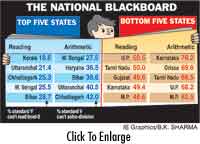
Bihar paradox: worst schools, best kids
National survey shows nearly 60% of kids can’t read a paragraph
VARGHESE K GEORGE
NEW DELHI, JANUARY 17: At a time when top on the HRD Ministry’s agenda is to stop IIM from going to Singapore comes a comprehensive national survey showing that nearly 60 per cent of the country’s school children cannot read a paragraph with long sentences.
The Annual Status of Education Report (ASER), prepared by Pratham, NGO, paints a dismal picture of educational infrastructure nationwide putting a huge question mark on the future of an entire generation.
The only silver lining is that students in Bihar and Chhattisgarh, which have the worst educational facilities, show better learning capabilities in reading and arithmetic compared to Tamil Nadu, Karnataka and Gujarat which have better infrastructure. Message: lack of infrastructure is crippling tomorrow’s talent.
Covering 9,252 schools in 28 states and UTs, the survey has found that children of Bihar, more than 59 per cent in primary level, do not even have text books. Bihar is the worst on most parameters—only 51 per cent enrolled children attend schools and 13 per cent not enrolled at all.
And yet West Bengal, Chhattisgarh, Uttaranchal and Bihar are among top five in reading and arithmetic categories. Still, it’s one of the five states—with UP, Rajasthan, AP and Orissa—accounting for almost three-quarters of out-of-school children. In Bihar and UP, only 38 and 53 per cent schools are served mid-day meals compared to Chhattisgarh’s 95 per cent and Kerala’s 94 per cent. Planning Commission Deputy Chairman Montek Singh Ahluwalia, while releasing the report, said positive aspects must be capitalised on and better monitoring of government schemes was required to ensure betterment. Singh said that the high teacher presence in rural schools was positive. Contrary to popular perception, nearly 75 per cent teachers were present in the schools surveyed.
The most alarming scene was in reading and arithmetic skills of school children. Children were tested in reading paragraphs with short sentences and long sentences, subtraction and division. Of them, 34 per cent could not read even short sentences. Students in private schools were found to be relatively better than government school students. Tamil Nadu and Karnataka, home to IT hubs, were among the bottom five in terms of arithmetic abilities: 76 per cent of Standard V students in Karnataka and 68 per cent in Tamil Nadu were unable to do simple division. “These states must seriously examine the way mathematics is taught in schools,” the report suggested.
These IT hubs are in the company of Orissa (69%), UP (68%) and MP (62%). Kerala tops in terms of reading capability whereas West Bengal tops in arithmetic. Kerala finds place in only reading and Haryana in arithmetic.
BUILDING BRAND BIHAR
Rebranding of Bihar
Nitish must do this by forging coalition of extremes, building institutions
SHAIBAL GUPTA
Posted online: Wednesday, January 18, 2006 at 0000 hours IST
On the face of it, Bihar continues to make news for the same reasons — another schoolboy was abducted even as an abducted businessman was reportedly freed on Tuesday. But take another look, and Chief Minister Nitish Kumar has already created a different wave within a short span of barely six weeks both in the provincial and national media. He is possibly the first chief minister of the state since Independence who is trying to build a �brand’ for Bihar.
It is interesting that not only the president of India, but even the country’s prime minister belonging to a rival political formation, are showing keen interest in the development of Bihar. The national middle classes that make and break public opinion have also found an icon who could change Bihar. Nitish Kumar has become a national icon in spite of being engaged with a provincial agenda, that too of a state that is not a front rank sunrise state. All other national political icons have operated on the national spectrum with an all-India agenda. The achievement of Nitish Kumar is, thus, a spectacular one. Adulation for him reached its pinnacle in the recent Pravasi Bhartiya Sammelan in Hyderabad.
Now that �brand Nitish’ is trying to build �brand Bihar’, one wonders about the extent to which these two brands are independent, or synonymous. Brand Nitish was built over years, as he journeyed from being a socialist activist to a JP acolyte to an architect of the social justice renaissance, and finally an able administrator. Now, this substantive brand Nitish is in the business of building brand Bihar, as yet unsubstantive.
In fact, over the years, Bihar has emerged as a counter brand. Bihar is not only at the lowest level of development, it is also the crucible of all plebeian ideologies. It is not only the home of a million mutinies, but it is here that the most subaltern class, unrecognisable nationally, was in the seat of political power, albeit without the road map of governance. Nitish Kumar’s task of converting this counter brand into a mainstream one is an extremely challenging one.
Even an established brand cannot hope to become permanent unless it continuously reinvents itself. A brand cannot be built entirely through propaganda; it also demands substantive content. In history, many brands have once shone, to be thrown away soon, unlamented. The political family brands like the Nehru-Gandhis have a more enduring image. Starting in the 1920s, brand Nehru has traversed a long journey from the folklore of privilege and opulence to Sonia Gandhi’s grand refusal of primeministership. In between, its focus changed from state to market, on the one hand, and from unflinching commitment to democracy and secularism to benevolent autocracy and soft communalism on the other. Brand building and its constant updating is high on the agenda in an increasingly market centric economy.
The brand building of the state by Nitish Kumar, however, must keep to a provincial path. The core strength of the state has to be identified and promoted with full vigour. The Gujarat model cannot be replicated here. The hallmark of a state brand is now determined by the number of SEZs (Special Economic Zone) that have been created which act as the fulcrum of investment, both national and international.
It is erroneous to believe that brand Gujarat has been created by the personal predilections of the present chief minister. In fact, Gujarat was on the threshold of the industrial revolution even before the advent of the British. After the British came, while Gujarat escaped the plunder and extermination of artisans and traders, Bihar was subjected to a systematic de-industrialisation. Later, an open sea front, resources from its non-residents and, above all, Gujarati sub-nationalism created a unique industrial revolution. A similar process for Bihar did not materialise for several reasons, like the absence of authentic indigenous entrepreneurs or due to its landlocked location.
Even in the realm of institution building, another prerequisite of brand building, there has not been any significant effort, other than the contribution of Sir Ganesh Dutt. The first chief minister of the state, Srikrishna Sinha, contrary to the general impression, could not set the agenda of building a modern Bihar. Even if the fiction of Appelby is to be believed, the state was considered to be �well governed’ merely because it could keep in check the rising popular aspirations in the realm of policing. Benchmarking in the realm of development had not yet begun.
But when the development agenda was initiated, the chink in the armoury of good governance was revealed. By 1971, Bihar had sunk to the bottom of Indian states. This position remains unchanged though it has been governed by three sets of elites — traditional, vernacular or cockney — since Independence.
Where others have failed, Nitish Kumar must succeed. He must build the brand of Bihar not only for those who are above the threshold, but also for the rest who are outside the market structure. This would demand that he forge a �coalition of extremes’, a difficult task indeed.
At the national level, this was achieved by the Gandhi and Nehru during the struggle for independence. In Bihar, this agenda will also require the building of new institutions, strengthening of existing ones, and also crafting of sub-national cohesion. The strengthening as well as simultaneous dismantling of some part of the state has to be done with a vengeance. Only then can the market expand which in turn will ultimately link the state with the national and international industrial grid.
For this, brand Nitish will need further reinvention. He has to be the �Nehru’ of Bihar, not only by co-opting the marginal and the minorities but also by building provincial institutions which can give an authentic ring to brand Bihar. Nehru tried to build India through promoting industrialisation, quite often ignoring agriculture. Nitish cannot possibly do that; he must focus on agriculture. While brand Nehru was of immense help in building the nation immediately after Independence, brand Nitish can act as a catalytic agent for rebuilding the state.
The writer is member secretary, Asian Development Research Institute, Patna
Nitish must do this by forging coalition of extremes, building institutions
SHAIBAL GUPTA
Posted online: Wednesday, January 18, 2006 at 0000 hours IST
On the face of it, Bihar continues to make news for the same reasons — another schoolboy was abducted even as an abducted businessman was reportedly freed on Tuesday. But take another look, and Chief Minister Nitish Kumar has already created a different wave within a short span of barely six weeks both in the provincial and national media. He is possibly the first chief minister of the state since Independence who is trying to build a �brand’ for Bihar.
It is interesting that not only the president of India, but even the country’s prime minister belonging to a rival political formation, are showing keen interest in the development of Bihar. The national middle classes that make and break public opinion have also found an icon who could change Bihar. Nitish Kumar has become a national icon in spite of being engaged with a provincial agenda, that too of a state that is not a front rank sunrise state. All other national political icons have operated on the national spectrum with an all-India agenda. The achievement of Nitish Kumar is, thus, a spectacular one. Adulation for him reached its pinnacle in the recent Pravasi Bhartiya Sammelan in Hyderabad.
Now that �brand Nitish’ is trying to build �brand Bihar’, one wonders about the extent to which these two brands are independent, or synonymous. Brand Nitish was built over years, as he journeyed from being a socialist activist to a JP acolyte to an architect of the social justice renaissance, and finally an able administrator. Now, this substantive brand Nitish is in the business of building brand Bihar, as yet unsubstantive.
In fact, over the years, Bihar has emerged as a counter brand. Bihar is not only at the lowest level of development, it is also the crucible of all plebeian ideologies. It is not only the home of a million mutinies, but it is here that the most subaltern class, unrecognisable nationally, was in the seat of political power, albeit without the road map of governance. Nitish Kumar’s task of converting this counter brand into a mainstream one is an extremely challenging one.
Even an established brand cannot hope to become permanent unless it continuously reinvents itself. A brand cannot be built entirely through propaganda; it also demands substantive content. In history, many brands have once shone, to be thrown away soon, unlamented. The political family brands like the Nehru-Gandhis have a more enduring image. Starting in the 1920s, brand Nehru has traversed a long journey from the folklore of privilege and opulence to Sonia Gandhi’s grand refusal of primeministership. In between, its focus changed from state to market, on the one hand, and from unflinching commitment to democracy and secularism to benevolent autocracy and soft communalism on the other. Brand building and its constant updating is high on the agenda in an increasingly market centric economy.
The brand building of the state by Nitish Kumar, however, must keep to a provincial path. The core strength of the state has to be identified and promoted with full vigour. The Gujarat model cannot be replicated here. The hallmark of a state brand is now determined by the number of SEZs (Special Economic Zone) that have been created which act as the fulcrum of investment, both national and international.
It is erroneous to believe that brand Gujarat has been created by the personal predilections of the present chief minister. In fact, Gujarat was on the threshold of the industrial revolution even before the advent of the British. After the British came, while Gujarat escaped the plunder and extermination of artisans and traders, Bihar was subjected to a systematic de-industrialisation. Later, an open sea front, resources from its non-residents and, above all, Gujarati sub-nationalism created a unique industrial revolution. A similar process for Bihar did not materialise for several reasons, like the absence of authentic indigenous entrepreneurs or due to its landlocked location.
Even in the realm of institution building, another prerequisite of brand building, there has not been any significant effort, other than the contribution of Sir Ganesh Dutt. The first chief minister of the state, Srikrishna Sinha, contrary to the general impression, could not set the agenda of building a modern Bihar. Even if the fiction of Appelby is to be believed, the state was considered to be �well governed’ merely because it could keep in check the rising popular aspirations in the realm of policing. Benchmarking in the realm of development had not yet begun.
But when the development agenda was initiated, the chink in the armoury of good governance was revealed. By 1971, Bihar had sunk to the bottom of Indian states. This position remains unchanged though it has been governed by three sets of elites — traditional, vernacular or cockney — since Independence.
Where others have failed, Nitish Kumar must succeed. He must build the brand of Bihar not only for those who are above the threshold, but also for the rest who are outside the market structure. This would demand that he forge a �coalition of extremes’, a difficult task indeed.
At the national level, this was achieved by the Gandhi and Nehru during the struggle for independence. In Bihar, this agenda will also require the building of new institutions, strengthening of existing ones, and also crafting of sub-national cohesion. The strengthening as well as simultaneous dismantling of some part of the state has to be done with a vengeance. Only then can the market expand which in turn will ultimately link the state with the national and international industrial grid.
For this, brand Nitish will need further reinvention. He has to be the �Nehru’ of Bihar, not only by co-opting the marginal and the minorities but also by building provincial institutions which can give an authentic ring to brand Bihar. Nehru tried to build India through promoting industrialisation, quite often ignoring agriculture. Nitish cannot possibly do that; he must focus on agriculture. While brand Nehru was of immense help in building the nation immediately after Independence, brand Nitish can act as a catalytic agent for rebuilding the state.
The writer is member secretary, Asian Development Research Institute, Patna
Thursday, January 12, 2006


THEME ARTICLE
The Amul Story
Every day Amul collects 447,000 litres of milk from 2.12 million farmers (many illiterate), converts the milk into branded, packaged products, and delivers goods worth Rs 6 crore (Rs 60 million) to over 500,000 retail outlets across the country.
Its supply chain is easily one of the most complicated in the world. How do managers at Amul prevent the milk from souring?
Walk in to any Amul or Gujarat Cooperative Milk Marketing Federation (GCMMF) office, and you may or may not see a photograph of Mahatma Gandhi, but you will certainly see one particular photograph. It shows a long line of Gujarati women waiting patiently for a union truck to come and collect the milk they have brought in shining brass matkas.
The picture is always prominently displayed. The message is clear: never forget your primary customer. If you don't, success is certain. The proof? A unique, Rs 2,200 crore (Rs 22 billion) enterprise.
Organization structure
It all started in December 1946 with a group of farmers keen to free themselves from intermediaries, gain access to markets and thereby ensure maximum returns for their efforts.
Based in the village of Anand, the Kaira District Milk Cooperative Union (better known as Amul) expanded exponentially. It joined hands with other milk cooperatives, and the Gujarat network now covers 2.12 million farmers, 10,411 village level milk collection centers and fourteen district level plants (unions) under the overall supervision of GCMMF.
There are similar federations in other states. Right from the beginning, there was recognition that this initiative would directly benefit and transform small farmers and contribute to the development of society.
Markets, then and even today are primitive and poor in infrastructure. Amul and GCMMF acknowledged that development and growth could not be left to market forces and that proactive intervention was required. Two key requirements were identified.
The first, that sustained growth for the long term would depend on matching supply and demand. It would need heavy investment in the simultaneous development of suppliers and consumers.
Second, that effective management of the network and commercial viability would require professional managers and technocrats.
To implement their vision while retaining their focus on farmers, a hierarchical network of cooperatives was developed, which today forms the robust supply chain behind GCMMF's endeavors. The vast and complex supply chain stretches from small suppliers to large fragmented markets.
Management of this network is made more complex by the fact that GCMMF is directly responsible only for a small part of the chain, with a number of third party players (distributors, retailers and logistics support providers) playing large roles.
Managing this supply chain efficiently is critical as GCMMF's competitive position is driven by low consumer prices supported by a low cost system.
Developing demand
At the time Amul was formed, consumers had limited purchasing power, and modest consumption levels of milk and other dairy products. Thus Amul adopted a low-cost price strategy to make its products affordable and attractive to consumers by guaranteeing them value for money.
Introducing higher value products
Beginning with liquid milk, GCMMF enhanced the product mix through the progressive addition of higher value products while maintaining the desired growth in existing products.
Despite competition in the high value dairy product segments from firms such as Hindustan Lever, Nestle and Britannia, GCMMF ensures that the product mix and the sequence in which Amul introduces its products is consistent with the core philosophy of providing milk at a basic, affordable price.
The distribution network
Amul products are available in over 500,000 retail outlets across India through its network of over 3,500 distributors. There are 47 depots with dry and cold warehouses to buffer inventory of the entire range of products.
GCMMF transacts on an advance demand draft basis from its wholesale dealers instead of the cheque system adopted by other major FMCG companies. This practice is consistent with GCMMF's philosophy of maintaining cash transactions throughout the supply chain and it also minimizes dumping.
Wholesale dealers carry inventory that is just adequate to take care of the transit time from the branch warehouse to their premises. This just-in-time inventory strategy improves dealers' return on investment (ROI). All GCMMF branches engage in route scheduling and have dedicated vehicle operations.
Umbrella brand
The network follows an umbrella branding strategy. Amul is the common brand for most product categories produced by various unions: liquid milk, milk powders, butter, ghee, cheese, cocoa products, sweets, ice-cream and condensed milk.
Amul's sub-brands include variants such as Amulspray, Amulspree, Amulya and Nutramul. The edible oil products are grouped around Dhara and Lokdhara, mineral water is sold under the Jal Dhara brand while fruit drinks bear the Safal name.
By insisting on an umbrella brand, GCMMF not only skillfully avoided inter-union conflicts but also created an opportunity for the union members to cooperate in developing products.
Managing the supply chain
Even though the cooperative was formed to bring together farmers, it was recognized that professional managers and technocrats would be required to manage the network effectively and make it commercially viable.
Coordination
Given the large number of organizations and entities in the supply chain and decentralized responsibility for various activities, effective coordination is critical for efficiency and cost control. GCMMF and the unions play a major role in this process and jointly achieve the desired degree of control.
Buy-in from the unions is assured as the plans are approved by GCMMF's board. The board is drawn from the heads of all the unions, and the boards of the unions comprise of farmers elected through village societies, thereby creating a situation of interlocking control.
The federation handles the distribution of end products and coordination with retailers and the dealers. The unions coordinate the supply side activities.
These include monitoring milk collection contractors, the supply of animal feed and other supplies, provision of veterinary services, and educational activities.
Managing third party service providers
From the beginning, it was recognized that the unions' core activity lay in milk processing and the production of dairy products. Accordingly, marketing efforts (including brand development) were assumed by GCMMF. All other activities were entrusted to third parties. These include logistics of milk collection, distribution of dairy products, sale of products through dealers and retail stores, provision of animal feed, and veterinary services.
It is worth noting that a number of these third parties are not in the organized sector, and many are not professionally managed with little regard for quality and service.
This is a particularly critical issue in the logistics and transport of a perishable commodity where there are already weaknesses in the basic infrastructure.
Establishing best practices
A key source of competitive advantage has been the enterprise's ability to continuously implement best practices across all elements of the network: the federation, the unions, the village societies and the distribution channel.
In developing these practices, the federation and the unions have adapted successful models from around the world. It could be the implementation of small group activities or quality circles at the federation. Or a TQM program at the unions. Or housekeeping and good accounting practices at the village society level.
More important, the network has been able to regularly roll out improvement programs across to a large number of members and the implementation rate is consistently high.
For example, every Friday, without fail, between 10.00 a.m. and 11.00 a.m., all employees of GCMMF meet at the closest office, be it a department or a branch or a depot to discuss their various quality concerns.
Each meeting has its pre-set format in terms of Purpose, Agenda and Limit (PAL) with a process check at the end to record how the meeting was conducted. Similar processes are in place at the village societies, the unions and even at the wholesaler and C&F agent levels as well.
Examples of benefits from recent initiatives include reduction in transportation time from the depots to the wholesale dealers, improvement in ROI of wholesale dealers, implementation of Zero Stock Out through improved availability of products at depots and also the implementation of Just-in-Time in finance to reduce the float.
Kaizens at the unions have helped improve the quality of milk in terms of acidity and sour milk. (Undertaken by multi-disciplined teams, Kaizens are highly focussed projects, reliant on a structured approach based on data gathering and analysis.) For example, Sabar Union's records show a reduction from 2.0% to 0.5% in the amount of sour milk/curd received at the union.
The most impressive aspect of this large-scale roll out is that improvement processes are turning the village societies into individual improvement centers.
Technology and e-initiatives
GCMMF's technology strategy is characterized by four distinct components: new products, process technology, and complementary assets to enhance milk production and e-commerce.
Few dairies of the world have the wide variety of products produced by the GCMMF network. Village societies are encouraged through subsidies to install chilling units. Automation in processing and packaging areas is common, as is HACCP certification. Amul actively pursues developments in embryo transfer and cattle breeding in order to improve cattle quality and increases in milk yields.
GCMMF was one of the first FMCG (fast-moving consumer goods) firms in India to employ Internet technologies to implement B2C commerce.
Today customers can order a variety of products through the Internet and be assured of timely delivery with cash payment upon receipt.
Another e-initiative underway is to provide farmers access to information relating to markets, technology and best practices in the dairy industry through net enabled kiosks in the villages.
GCMMF has also implemented a Geographical Information System (GIS) at both ends of the supply chain, i.e. milk collection as well as the marketing process.
Farmers now have better access to information on the output as well as support services while providing a better planning tool to marketing personnel.
(Source Rediff.com & The Smart Manager)
The Amul Story
Every day Amul collects 447,000 litres of milk from 2.12 million farmers (many illiterate), converts the milk into branded, packaged products, and delivers goods worth Rs 6 crore (Rs 60 million) to over 500,000 retail outlets across the country.
Its supply chain is easily one of the most complicated in the world. How do managers at Amul prevent the milk from souring?
Walk in to any Amul or Gujarat Cooperative Milk Marketing Federation (GCMMF) office, and you may or may not see a photograph of Mahatma Gandhi, but you will certainly see one particular photograph. It shows a long line of Gujarati women waiting patiently for a union truck to come and collect the milk they have brought in shining brass matkas.
The picture is always prominently displayed. The message is clear: never forget your primary customer. If you don't, success is certain. The proof? A unique, Rs 2,200 crore (Rs 22 billion) enterprise.
Organization structure
It all started in December 1946 with a group of farmers keen to free themselves from intermediaries, gain access to markets and thereby ensure maximum returns for their efforts.
Based in the village of Anand, the Kaira District Milk Cooperative Union (better known as Amul) expanded exponentially. It joined hands with other milk cooperatives, and the Gujarat network now covers 2.12 million farmers, 10,411 village level milk collection centers and fourteen district level plants (unions) under the overall supervision of GCMMF.
There are similar federations in other states. Right from the beginning, there was recognition that this initiative would directly benefit and transform small farmers and contribute to the development of society.
Markets, then and even today are primitive and poor in infrastructure. Amul and GCMMF acknowledged that development and growth could not be left to market forces and that proactive intervention was required. Two key requirements were identified.
The first, that sustained growth for the long term would depend on matching supply and demand. It would need heavy investment in the simultaneous development of suppliers and consumers.
Second, that effective management of the network and commercial viability would require professional managers and technocrats.
To implement their vision while retaining their focus on farmers, a hierarchical network of cooperatives was developed, which today forms the robust supply chain behind GCMMF's endeavors. The vast and complex supply chain stretches from small suppliers to large fragmented markets.
Management of this network is made more complex by the fact that GCMMF is directly responsible only for a small part of the chain, with a number of third party players (distributors, retailers and logistics support providers) playing large roles.
Managing this supply chain efficiently is critical as GCMMF's competitive position is driven by low consumer prices supported by a low cost system.
Developing demand
At the time Amul was formed, consumers had limited purchasing power, and modest consumption levels of milk and other dairy products. Thus Amul adopted a low-cost price strategy to make its products affordable and attractive to consumers by guaranteeing them value for money.
Introducing higher value products
Beginning with liquid milk, GCMMF enhanced the product mix through the progressive addition of higher value products while maintaining the desired growth in existing products.
Despite competition in the high value dairy product segments from firms such as Hindustan Lever, Nestle and Britannia, GCMMF ensures that the product mix and the sequence in which Amul introduces its products is consistent with the core philosophy of providing milk at a basic, affordable price.
The distribution network
Amul products are available in over 500,000 retail outlets across India through its network of over 3,500 distributors. There are 47 depots with dry and cold warehouses to buffer inventory of the entire range of products.
GCMMF transacts on an advance demand draft basis from its wholesale dealers instead of the cheque system adopted by other major FMCG companies. This practice is consistent with GCMMF's philosophy of maintaining cash transactions throughout the supply chain and it also minimizes dumping.
Wholesale dealers carry inventory that is just adequate to take care of the transit time from the branch warehouse to their premises. This just-in-time inventory strategy improves dealers' return on investment (ROI). All GCMMF branches engage in route scheduling and have dedicated vehicle operations.
Umbrella brand
The network follows an umbrella branding strategy. Amul is the common brand for most product categories produced by various unions: liquid milk, milk powders, butter, ghee, cheese, cocoa products, sweets, ice-cream and condensed milk.
Amul's sub-brands include variants such as Amulspray, Amulspree, Amulya and Nutramul. The edible oil products are grouped around Dhara and Lokdhara, mineral water is sold under the Jal Dhara brand while fruit drinks bear the Safal name.
By insisting on an umbrella brand, GCMMF not only skillfully avoided inter-union conflicts but also created an opportunity for the union members to cooperate in developing products.
Managing the supply chain
Even though the cooperative was formed to bring together farmers, it was recognized that professional managers and technocrats would be required to manage the network effectively and make it commercially viable.
Coordination
Given the large number of organizations and entities in the supply chain and decentralized responsibility for various activities, effective coordination is critical for efficiency and cost control. GCMMF and the unions play a major role in this process and jointly achieve the desired degree of control.
Buy-in from the unions is assured as the plans are approved by GCMMF's board. The board is drawn from the heads of all the unions, and the boards of the unions comprise of farmers elected through village societies, thereby creating a situation of interlocking control.
The federation handles the distribution of end products and coordination with retailers and the dealers. The unions coordinate the supply side activities.
These include monitoring milk collection contractors, the supply of animal feed and other supplies, provision of veterinary services, and educational activities.
Managing third party service providers
From the beginning, it was recognized that the unions' core activity lay in milk processing and the production of dairy products. Accordingly, marketing efforts (including brand development) were assumed by GCMMF. All other activities were entrusted to third parties. These include logistics of milk collection, distribution of dairy products, sale of products through dealers and retail stores, provision of animal feed, and veterinary services.
It is worth noting that a number of these third parties are not in the organized sector, and many are not professionally managed with little regard for quality and service.
This is a particularly critical issue in the logistics and transport of a perishable commodity where there are already weaknesses in the basic infrastructure.
Establishing best practices
A key source of competitive advantage has been the enterprise's ability to continuously implement best practices across all elements of the network: the federation, the unions, the village societies and the distribution channel.
In developing these practices, the federation and the unions have adapted successful models from around the world. It could be the implementation of small group activities or quality circles at the federation. Or a TQM program at the unions. Or housekeeping and good accounting practices at the village society level.
More important, the network has been able to regularly roll out improvement programs across to a large number of members and the implementation rate is consistently high.
For example, every Friday, without fail, between 10.00 a.m. and 11.00 a.m., all employees of GCMMF meet at the closest office, be it a department or a branch or a depot to discuss their various quality concerns.
Each meeting has its pre-set format in terms of Purpose, Agenda and Limit (PAL) with a process check at the end to record how the meeting was conducted. Similar processes are in place at the village societies, the unions and even at the wholesaler and C&F agent levels as well.
Examples of benefits from recent initiatives include reduction in transportation time from the depots to the wholesale dealers, improvement in ROI of wholesale dealers, implementation of Zero Stock Out through improved availability of products at depots and also the implementation of Just-in-Time in finance to reduce the float.
Kaizens at the unions have helped improve the quality of milk in terms of acidity and sour milk. (Undertaken by multi-disciplined teams, Kaizens are highly focussed projects, reliant on a structured approach based on data gathering and analysis.) For example, Sabar Union's records show a reduction from 2.0% to 0.5% in the amount of sour milk/curd received at the union.
The most impressive aspect of this large-scale roll out is that improvement processes are turning the village societies into individual improvement centers.
Technology and e-initiatives
GCMMF's technology strategy is characterized by four distinct components: new products, process technology, and complementary assets to enhance milk production and e-commerce.
Few dairies of the world have the wide variety of products produced by the GCMMF network. Village societies are encouraged through subsidies to install chilling units. Automation in processing and packaging areas is common, as is HACCP certification. Amul actively pursues developments in embryo transfer and cattle breeding in order to improve cattle quality and increases in milk yields.
GCMMF was one of the first FMCG (fast-moving consumer goods) firms in India to employ Internet technologies to implement B2C commerce.
Today customers can order a variety of products through the Internet and be assured of timely delivery with cash payment upon receipt.
Another e-initiative underway is to provide farmers access to information relating to markets, technology and best practices in the dairy industry through net enabled kiosks in the villages.
GCMMF has also implemented a Geographical Information System (GIS) at both ends of the supply chain, i.e. milk collection as well as the marketing process.
Farmers now have better access to information on the output as well as support services while providing a better planning tool to marketing personnel.
(Source Rediff.com & The Smart Manager)
Wednesday, January 11, 2006
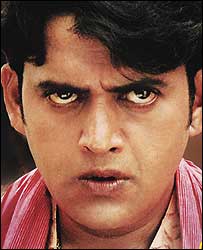
Saturday, January 07, 2006
Even Lohiaites are learning
Home > Columns
NATIONAL INTEREST
Even Lohiaites are learning
And you thought Buddha was the only one to let reforms sweep his ideological cobwebs away; look at latest converts
SHEKHAR GUPTA
Posted online: Saturday, January 07, 2006 at 0000 hours IST
If, like this writer, you too are a believer in economic reform leading to free markets, shrinking of the state’s role in economics and unshackling India’s creative and entrepreneurial energies, and are dismayed at the road-blocks and rollbacks at the national level, look at some of our states for the good news. Or rather look at what some of our state-level politicians are doing, and the picture won’t look so bad. And I am not talking only about Buddhadeb Bhattacharjee.
The cause for this cheer comes from a category of politicians you would last expect to break into headlines with their reformist actions. The Lohiaites, over the decades, have been the most retrograde of all socialists, serving a murderous cocktail of pseudo-socialism and pseudo-nationalism. But today, the leading lights of that uniquely Indian, or rather Hindi heartland, faith are breaking away from that past. The Lohiaites have been one of the main causes, and also the biggest beneficiaries, of the Congress party’s decline in its traditional strongholds. Between Bihar and Uttar Pradesh they control twice as much political territory. So far they had resisted the winds of change even more stubbornly than the Left. But the picture is changing now, and changing for the better.
I have maintained for a long time that among the last sectors to be reformed in India will be the railways and real estate. That is because of the great political vested interest in discretionary powers, patronage and, consequently, the scope for money-making both provide. That is why Laloo Yadav’s stint in the rail ministry has been such a pleasant surprise. Please do not be blinded for one moment by his obstinate refusal (so far) to increase passenger tariffs, or inconsequential populism like promoting milk, lassi and earthen kulhads in his trains. One look at the railways’ financial performance, even in two years of rising fuel prices and increased competition from truckers on rapidly improving highways, and you know there is a good news story in the making.
THE cynical explanation, of course, is that just because Laloo has been so embroiled in Bihar politics, two elections and his court cases, he may not have had any time for his ministry and so its officials have been free to do the good things. But that is not how things work in our system where bureaucracies tend to be even more possessive of state power and control than politicians. In fact, no reform ever takes place unless pushed and supported vigorously by the political leadership. Ask any senior member of the Cabinet and he will tell you Laloo has been a particularly good minister, particularly on economic issues. He has almost never blocked any reformist decision and has taken a very constructive view on new ideas of public-private partnerships, special purpose vehicles (SPVs), even outsourcing of services, all things that Rail Bhavan bureaucrats would normally abhor.
That is why my most cheerful headline in a long time is Laloo opening up the railways container business to the private sector. Sure enough, he had promised this in the last railways budget. But so did Chidambaram promise 49 per cent foreign equity in insurance in his 2004 budget and now nobody is even talking about it. The real test is not making reformist promises, but in delivery.
Similarly his fellow Lohiaite (though now political adversary) Nitish Kumar has started his innings on a reformist note entirely unfamiliar, and unexpected in Bihar, and I am not talking of his television commercials soliciting private investments in his state. One of his first actions has been to unbundle his completely moribund electricity board into four zonal corporations. As is to be expected, his unions have threatened to go on strike. But some day, somebody, had to bell that cat in a state where a majority of the villages are not yet electrified and where the electricity board makes a Rs 3.5-crore loss per day. It is early days yet, but to see his initial actions in perspective you have to consider the fact that chief ministers of at least two major Congress-run states, Punjab and Kerala, have not yet dared to do this.
My third cheering story of the week did not even make front-page headlines. I found it buried on one of the commodity pages of Business Standard this Thursday and from my reading at least it seemed as if the reporter had missed the point a bit. The story complained that government-owned sugar mills were struggling to get steady cane supplies because private companies in the state were offering prices higher than the state-mandated minimum support price of Rs 113 per quintal. Some private companies, the report said, were offering up to 15 rupees more than that. Some were even luring the farmer with freebies like tins of desi ghee and sacks of DAP fertiliser (needed in large amounts in this, the rabi wheat season).
NOW this is in a state that was notorious for starving sugarcane farmers by delaying payment for their supplies to its own sugar mills for years together. In fact it was in response to this that Rahul Gandhi had made his maiden intervention in the Lok Sabha to get the cane farmers’ “arrears” released. If in that very state the farmers are now not merely being paid on time, but paid more than the minimum support price and also wooed with freebies by private companies, isn’t that a story of reform?
Whatever else you may say about the Samajwadi Party government and the Mulayam Singh Yadav-Amar Singh combine, their basic approach to the sugar business has been reformist. Private sugar mills have blossomed and instead of begging, pleading, agitating, blocking roads and burning buses to get his own dues, the farmer is now being wooed as a supplier crucial to the sugar business. Now if that isn’t the very definition of reform in agriculture, what is?
There will be crony capitalism as long as there are politicians and businessmen. No politician in India can claim sainthood on that. But the test is, what does that cronyism yield. Even under the darkest-sounding Lohiaites, Uttar Pradesh has persisted with power reform, riding roughshod over the unions (and, of course, you do not expect the Left leaders to go protesting when this happens in non-Congress, non-BJP states, just as they embrace reform so wholeheartedly in states they control). Mulayam is trying to build modern townships, and while allegations of money-making will be there whenever a politician touches real estate, at least he is not muddled in his head as the Congress has been in Mumbai and Delhi on the issue of urban renewal.
These are early days yet and much can go wrong. But what these three Lohiaites are telling you is that, just like Buddhadeb Bhattacharjee, they have discovered that plain, socialist populism and rhetoric has outlived its use-by date. The key to not merely defying anti-incumbency but the very survival in politics, is now performance on issues that matter: bijli, sadak, pani, padhai, naukri. It is not possible to do any of that without reforming. Ideology be damned, it’s the politics, stupid. And you cannot run your politics any more without free market reform, private investment, modernisation. When even the Lohiaites buy that mantra, you know India is on to a good thing.
Write to sg@expressindia.com
NATIONAL INTEREST
Even Lohiaites are learning
And you thought Buddha was the only one to let reforms sweep his ideological cobwebs away; look at latest converts
SHEKHAR GUPTA
Posted online: Saturday, January 07, 2006 at 0000 hours IST
If, like this writer, you too are a believer in economic reform leading to free markets, shrinking of the state’s role in economics and unshackling India’s creative and entrepreneurial energies, and are dismayed at the road-blocks and rollbacks at the national level, look at some of our states for the good news. Or rather look at what some of our state-level politicians are doing, and the picture won’t look so bad. And I am not talking only about Buddhadeb Bhattacharjee.
The cause for this cheer comes from a category of politicians you would last expect to break into headlines with their reformist actions. The Lohiaites, over the decades, have been the most retrograde of all socialists, serving a murderous cocktail of pseudo-socialism and pseudo-nationalism. But today, the leading lights of that uniquely Indian, or rather Hindi heartland, faith are breaking away from that past. The Lohiaites have been one of the main causes, and also the biggest beneficiaries, of the Congress party’s decline in its traditional strongholds. Between Bihar and Uttar Pradesh they control twice as much political territory. So far they had resisted the winds of change even more stubbornly than the Left. But the picture is changing now, and changing for the better.
I have maintained for a long time that among the last sectors to be reformed in India will be the railways and real estate. That is because of the great political vested interest in discretionary powers, patronage and, consequently, the scope for money-making both provide. That is why Laloo Yadav’s stint in the rail ministry has been such a pleasant surprise. Please do not be blinded for one moment by his obstinate refusal (so far) to increase passenger tariffs, or inconsequential populism like promoting milk, lassi and earthen kulhads in his trains. One look at the railways’ financial performance, even in two years of rising fuel prices and increased competition from truckers on rapidly improving highways, and you know there is a good news story in the making.
THE cynical explanation, of course, is that just because Laloo has been so embroiled in Bihar politics, two elections and his court cases, he may not have had any time for his ministry and so its officials have been free to do the good things. But that is not how things work in our system where bureaucracies tend to be even more possessive of state power and control than politicians. In fact, no reform ever takes place unless pushed and supported vigorously by the political leadership. Ask any senior member of the Cabinet and he will tell you Laloo has been a particularly good minister, particularly on economic issues. He has almost never blocked any reformist decision and has taken a very constructive view on new ideas of public-private partnerships, special purpose vehicles (SPVs), even outsourcing of services, all things that Rail Bhavan bureaucrats would normally abhor.
That is why my most cheerful headline in a long time is Laloo opening up the railways container business to the private sector. Sure enough, he had promised this in the last railways budget. But so did Chidambaram promise 49 per cent foreign equity in insurance in his 2004 budget and now nobody is even talking about it. The real test is not making reformist promises, but in delivery.
Similarly his fellow Lohiaite (though now political adversary) Nitish Kumar has started his innings on a reformist note entirely unfamiliar, and unexpected in Bihar, and I am not talking of his television commercials soliciting private investments in his state. One of his first actions has been to unbundle his completely moribund electricity board into four zonal corporations. As is to be expected, his unions have threatened to go on strike. But some day, somebody, had to bell that cat in a state where a majority of the villages are not yet electrified and where the electricity board makes a Rs 3.5-crore loss per day. It is early days yet, but to see his initial actions in perspective you have to consider the fact that chief ministers of at least two major Congress-run states, Punjab and Kerala, have not yet dared to do this.
My third cheering story of the week did not even make front-page headlines. I found it buried on one of the commodity pages of Business Standard this Thursday and from my reading at least it seemed as if the reporter had missed the point a bit. The story complained that government-owned sugar mills were struggling to get steady cane supplies because private companies in the state were offering prices higher than the state-mandated minimum support price of Rs 113 per quintal. Some private companies, the report said, were offering up to 15 rupees more than that. Some were even luring the farmer with freebies like tins of desi ghee and sacks of DAP fertiliser (needed in large amounts in this, the rabi wheat season).
NOW this is in a state that was notorious for starving sugarcane farmers by delaying payment for their supplies to its own sugar mills for years together. In fact it was in response to this that Rahul Gandhi had made his maiden intervention in the Lok Sabha to get the cane farmers’ “arrears” released. If in that very state the farmers are now not merely being paid on time, but paid more than the minimum support price and also wooed with freebies by private companies, isn’t that a story of reform?
Whatever else you may say about the Samajwadi Party government and the Mulayam Singh Yadav-Amar Singh combine, their basic approach to the sugar business has been reformist. Private sugar mills have blossomed and instead of begging, pleading, agitating, blocking roads and burning buses to get his own dues, the farmer is now being wooed as a supplier crucial to the sugar business. Now if that isn’t the very definition of reform in agriculture, what is?
There will be crony capitalism as long as there are politicians and businessmen. No politician in India can claim sainthood on that. But the test is, what does that cronyism yield. Even under the darkest-sounding Lohiaites, Uttar Pradesh has persisted with power reform, riding roughshod over the unions (and, of course, you do not expect the Left leaders to go protesting when this happens in non-Congress, non-BJP states, just as they embrace reform so wholeheartedly in states they control). Mulayam is trying to build modern townships, and while allegations of money-making will be there whenever a politician touches real estate, at least he is not muddled in his head as the Congress has been in Mumbai and Delhi on the issue of urban renewal.
These are early days yet and much can go wrong. But what these three Lohiaites are telling you is that, just like Buddhadeb Bhattacharjee, they have discovered that plain, socialist populism and rhetoric has outlived its use-by date. The key to not merely defying anti-incumbency but the very survival in politics, is now performance on issues that matter: bijli, sadak, pani, padhai, naukri. It is not possible to do any of that without reforming. Ideology be damned, it’s the politics, stupid. And you cannot run your politics any more without free market reform, private investment, modernisation. When even the Lohiaites buy that mantra, you know India is on to a good thing.
Write to sg@expressindia.com
Thursday, January 05, 2006
Kalam’s Bihar vision: Progress by 2015
President Agrees to help Nitish Kumar, will again visit state in March to lay down roadmap
PATNA, DECEMBER 30: President A P J Abdul Kalam today presented his vision for Bihar to emerge as a developed state by 2015 and expressed his confidence on Chief Minister Nitish Kumar’s leadership to achieve the goal.
��He has taken the big responsibility of developing Bihar on his shoulders. He seems to be confident, and thereby, I am hopeful that he will succeed,’’ Kalam said while addressing a function after inaugurating a ward at the Mahavir Cancer Institute.
Nitish Kumar, who was also present at the occasion, used the opportunity and sought the President’s guidance for his mission to develop the state, and the latter agreed instantly. The President would visit Bihar in March next year for laying down the roadmap.
We have to work. There is no other alternative. I have requested the President to guide me in Bihar’s development and he has accepted it. He has also accepted my invitation to come here once again in March,’’ Nitish Kumar said while addressing a function along with Kalam in the Patna High Court.
The President arrived here yesterday on a two-day visit. He attended several functions and talked about the country’s as well as Bihar’s development. Bihar Vision: Developed State by 2015—read the concluding portion of his speech during a convocation ceremony of the Patna University.
Stressing the need for the state’s development, the President said that India cannot be emerged as a developed country till Bihar is developed.
In Darbhanga, Kalam said, ��According to economists, our country should grow at a rate of 10 per cent per annum for a decade to uplift 250 million people living the below poverty line. Our GDP is growing at over seven per annum on an average.’’ “Bihar’s fertile soil can be a great contributor in achieving the aim of $1 billion export in medicinal, floriculture and aromatic plants and even orchids,’’ he said.
On crime and corruption, he said that it is very shameful when India is referred to as a country entrapped by corruption. ��Children could be a great force in wiping out corruption from the country,’’ Kalam added.
Nitish Kumar refuses to wear gown at convocation
PATNA: Bihar Chief Minister Nitish Kumar on Friday refused to be dressed in a gown for the convocation of Patna University, addressed by President A.P.J. Abdul Kalam, as a ��mark of protest’’.
��I was asked by the PU officials to put on the gown but I did not not entertain it as a protest,’’ Kumar said. ��But you should know why I did not wear the gown though even dignitaries on the dais including President, Governor and my ministerial colleague Brishen Patel wore it. I, too, had dreamt of wearing a gown at a convocation when I graduated, but never got an opportunity then.’’ —PTI
PATNA, DECEMBER 30: President A P J Abdul Kalam today presented his vision for Bihar to emerge as a developed state by 2015 and expressed his confidence on Chief Minister Nitish Kumar’s leadership to achieve the goal.
��He has taken the big responsibility of developing Bihar on his shoulders. He seems to be confident, and thereby, I am hopeful that he will succeed,’’ Kalam said while addressing a function after inaugurating a ward at the Mahavir Cancer Institute.
Nitish Kumar, who was also present at the occasion, used the opportunity and sought the President’s guidance for his mission to develop the state, and the latter agreed instantly. The President would visit Bihar in March next year for laying down the roadmap.
We have to work. There is no other alternative. I have requested the President to guide me in Bihar’s development and he has accepted it. He has also accepted my invitation to come here once again in March,’’ Nitish Kumar said while addressing a function along with Kalam in the Patna High Court.
The President arrived here yesterday on a two-day visit. He attended several functions and talked about the country’s as well as Bihar’s development. Bihar Vision: Developed State by 2015—read the concluding portion of his speech during a convocation ceremony of the Patna University.
Stressing the need for the state’s development, the President said that India cannot be emerged as a developed country till Bihar is developed.
In Darbhanga, Kalam said, ��According to economists, our country should grow at a rate of 10 per cent per annum for a decade to uplift 250 million people living the below poverty line. Our GDP is growing at over seven per annum on an average.’’ “Bihar’s fertile soil can be a great contributor in achieving the aim of $1 billion export in medicinal, floriculture and aromatic plants and even orchids,’’ he said.
On crime and corruption, he said that it is very shameful when India is referred to as a country entrapped by corruption. ��Children could be a great force in wiping out corruption from the country,’’ Kalam added.
Nitish Kumar refuses to wear gown at convocation
PATNA: Bihar Chief Minister Nitish Kumar on Friday refused to be dressed in a gown for the convocation of Patna University, addressed by President A.P.J. Abdul Kalam, as a ��mark of protest’’.
��I was asked by the PU officials to put on the gown but I did not not entertain it as a protest,’’ Kumar said. ��But you should know why I did not wear the gown though even dignitaries on the dais including President, Governor and my ministerial colleague Brishen Patel wore it. I, too, had dreamt of wearing a gown at a convocation when I graduated, but never got an opportunity then.’’ —PTI
Tuesday, December 27, 2005
Indians Find They Can Go Home Again
Indians Find They Can Go Home Again
E-Mail This
Printer-Friendly
Single-Page
Reprints
Save Article
By SARITHA RAI
Published: December 26, 2005
BANGALORE, India - Standing amid the rolling lawns outside his four-bedroom villa, Ajay Kela pondered his street in the community of Palm Meadows. One of his neighbors recently returned to India from Cupertino, Calif., to run a technology start-up funded by the venture capital firm Kleiner, Perkins, Caufield & Byers.
Skip to next paragraph
Namas Bhojani for The New York Times
Ajay Kela with his son, Ankur, and daughter, Payal. The family returned to India from California.
Across the street from Mr. Kela is another Indian executive, this one from Fremont, Calif., who works with the outsourcing firm Infosys Technologies. On the other side is the top executive of Cisco Systems in India, who returned here after decades in the Bay Area and New York.
Also on the block is a returnee from the United Kingdom, who heads the technology operations of Deutsche Bank.
Mr. Kela's neighborhood is just a small sample of a reverse brain drain benefiting India. The gated community of Palm Meadows in the Whitefield suburbs, and many others in the vicinity, with names like Ozone and Lake Vista, are full of Indians who were educated in and worked in the United States and Europe, but who have been lured home by the surging Indian economy and its buoyant technology industry.
"Nothing unusual about this lane at all," said Mr. Kela, 48, who moved from Foster City, Calif., to Palm Meadows last year and is president of the outsourcing firm Symphony Services, which is based in Palo Alto, Calif.
Nasscom, a trade group of Indian outsourcing companies, estimates that 30,000 technology professionals have moved back in the last 18 months. Bangalore, Hyderabad and the suburbs of Delhi are becoming magnets for an influx of Indians, who are the top-earning ethnic group in the United States. These cities, with their Western-style work environment, generous paychecks and quick career jumps, offer the returnees what, until now, they could only get in places like Palo Alto and Boston.
And now they offer something else: a housing boom. Homes have tripled in value in Palm Meadows over the last 12 months, and rents have quadrupled. "Expatriates are returning because India is hot," said Nandan Nilekani, chief executive of Infosys Technologies, India's second-largest outsourcing firm, which recruited 25 returnees from top American schools for its 100-seat summer internship this year. "There is an increasing feeling that significant action in the technology industry is moving to India," he said.
While most returnees are first-generation expatriates, second-generation Indians living in the United States are also returning, said Lori Blackman, a recruitment consultant in Dallas. "Among them I sense an altruistic pull to return to India to help build their home country to a greater power than the country had ever hoped to achieve," she said.
But the trend is raising fears among American specialists that it could deplete the United States of scientific talent and blunt its edge in innovation. "The United States will miss the talents of people of Indian origin who return to India," said Brink Lindsey, vice president for research at the Cato Institute in Washington, adding, that the moves could create greater possibilities for trade between the two countries.
For many returnees, the newly challenging work environment in India has tied in neatly with personal reasons for returning, such as raising their children in Indian culture and caring for aging parents.
"When I left India 25 years ago, everybody was headed to the United States," said Mr. Kela, who pursued a Ph.D. at the University of Rochester and stayed two decades, working for companies like General Electric and AutoDesk. For India's best and brightest, a technology or engineering career was an irresistible draw to the United States, even until four or five years ago.
"But now they all want to get on the plane home," said Mr. Kela, who returned with his wife and two children.
Once a regular at Silicon Valley job fairs, trying to woo Indians back home, Mr. Kela no longer needs to sell India. He receives 10 résumés a month from people with decades of work experience in the United States yearning to relocate.
With globalization, many Americans of Indian origin in the high-technology industry are looking at India as a "career-enhancing move," said Anuradha Parthasarathy, the chief executive of Global Executive Talent, a search firm in Menlo Park, Calif., who is swamped by such job-seekers. Many technology companies - multinationals and Indian outsourcing firms as well as start-ups - are eager to hire returnees with Western managerial experience or technology specialization.
Companies based in the United States, like ipValue, a company in Palo Alto that commercializes intellectual assets for large technology companies like British Telecom and the Xerox Corporation, are helping accelerate the trend. When ipValue recently decided to expand its operations, it chose to do so in India.
"We are really betting on the Indian diaspora returning home," said Vincent Pluvinage, its chief executive. The firm just hired a top executive from Oracle to head its Indian operations and expects a third of its 20-member team in India to consist of returnees by January 2006.
The passage back is no longer an ordeal, because much has changed in India. Whereas watching a movie in a dingy hall was once a weekend high point, now fancy multiplexes, bowling alleys and shopping malls offer entertainment, and pizzerias and cafes are ubiquitous at street corners. Indians who once could choose between only two car models and fly a single airline find they have returned to a profusion of choices.
Even as the lifestyle gaps between India and the West have narrowed rapidly, salary differences at top executive levels have virtually disappeared. Annual pay packages of a half-million dollars are common in Bangalore, but even for those taking a pay cut to return home, the lower cost of living balances smaller paychecks. Starting salaries for engineers are about $12,000 in India, versus $60,000 in Silicon Valley.
But relocating is not without its challenges, as Venki Sundaresan, 38, discovered a year ago when, after 15 years abroad, he moved to India with his wife and twin daughters to be the information technology director of Cypress Semiconductor.
In atypical fashion, Mr. Sundaresan scorned the "soft landing" that many returning Indians seek by living in gated communities. Instead, to have the "true Indian experience," the family opted to live in the teeming Indiranagar neighborhood. For his 5-year-old twins, he spurned upmarket international schools popular with other returnees and enrolled them in a neighborhood school. Mr. Sundaresan owns an Indian-made car, a Maruti Baleno.
"We've already driven the Mercedes and the BMW in the United States," he said. "What is the point of dodging around Bangalore's potholes in a limo?"
Living in Palm Meadows, Mr. Kela and his neighbor Sanjay Swamy, 41, who heads the Indian operations of Ketera Technologies, face very little transition anxiety. Mr. Swamy bought and moved into a Palm Meadows villa with his wife, Tulsi, a financial consultant, and 8-year-old son, Ashwin.
The communities buffer returnees from Bangalore's bumper-to-bumper traffic, unpaved sidewalks and swarming neighborhoods. Mr. Kela; his 9-year-old daughter, Payal; and 6-year-old son, Ankur, enjoy riding bikes on weekends, and they often play cricket, which Mr. Kela is passionate about. His daughter is learning the classical Indian dances of Kathak and Bharatanatyam. For Halloween this year, Mr. Kela led his children on a trick-or-treat walk.
Mr. Kela says he misses the freedom to drive anywhere or go on long hikes. Yet, life is comfortable, with two live-in maids, a full-time driver and another on call, all of whom are "outrageously affordable."
His neighbor Mr. Swamy is immersed in building a Silicon Valley-style team in Bangalore, but with some local adjustments. When he learned that the company routinely received calls from prospective fathers-in-law of employees, asking to verify their ages, titles and salary details, Mr. Swamy wrote a memo titled "HR Policy on Disclosing Employee Information to Prospective Fathers-in-Law."
"While I want to be entirely supportive of ensuring that our confidentiality agreement does not result in your missing out on the spouse of your dreams," Mr. Swamy said, "I don't want competitors to use this as a ploy to get at sensitive information."
E-Mail This
Printer-Friendly
Single-Page
Reprints
Save Article
By SARITHA RAI
Published: December 26, 2005
BANGALORE, India - Standing amid the rolling lawns outside his four-bedroom villa, Ajay Kela pondered his street in the community of Palm Meadows. One of his neighbors recently returned to India from Cupertino, Calif., to run a technology start-up funded by the venture capital firm Kleiner, Perkins, Caufield & Byers.
Skip to next paragraph
Namas Bhojani for The New York Times
Ajay Kela with his son, Ankur, and daughter, Payal. The family returned to India from California.
Across the street from Mr. Kela is another Indian executive, this one from Fremont, Calif., who works with the outsourcing firm Infosys Technologies. On the other side is the top executive of Cisco Systems in India, who returned here after decades in the Bay Area and New York.
Also on the block is a returnee from the United Kingdom, who heads the technology operations of Deutsche Bank.
Mr. Kela's neighborhood is just a small sample of a reverse brain drain benefiting India. The gated community of Palm Meadows in the Whitefield suburbs, and many others in the vicinity, with names like Ozone and Lake Vista, are full of Indians who were educated in and worked in the United States and Europe, but who have been lured home by the surging Indian economy and its buoyant technology industry.
"Nothing unusual about this lane at all," said Mr. Kela, 48, who moved from Foster City, Calif., to Palm Meadows last year and is president of the outsourcing firm Symphony Services, which is based in Palo Alto, Calif.
Nasscom, a trade group of Indian outsourcing companies, estimates that 30,000 technology professionals have moved back in the last 18 months. Bangalore, Hyderabad and the suburbs of Delhi are becoming magnets for an influx of Indians, who are the top-earning ethnic group in the United States. These cities, with their Western-style work environment, generous paychecks and quick career jumps, offer the returnees what, until now, they could only get in places like Palo Alto and Boston.
And now they offer something else: a housing boom. Homes have tripled in value in Palm Meadows over the last 12 months, and rents have quadrupled. "Expatriates are returning because India is hot," said Nandan Nilekani, chief executive of Infosys Technologies, India's second-largest outsourcing firm, which recruited 25 returnees from top American schools for its 100-seat summer internship this year. "There is an increasing feeling that significant action in the technology industry is moving to India," he said.
While most returnees are first-generation expatriates, second-generation Indians living in the United States are also returning, said Lori Blackman, a recruitment consultant in Dallas. "Among them I sense an altruistic pull to return to India to help build their home country to a greater power than the country had ever hoped to achieve," she said.
But the trend is raising fears among American specialists that it could deplete the United States of scientific talent and blunt its edge in innovation. "The United States will miss the talents of people of Indian origin who return to India," said Brink Lindsey, vice president for research at the Cato Institute in Washington, adding, that the moves could create greater possibilities for trade between the two countries.
For many returnees, the newly challenging work environment in India has tied in neatly with personal reasons for returning, such as raising their children in Indian culture and caring for aging parents.
"When I left India 25 years ago, everybody was headed to the United States," said Mr. Kela, who pursued a Ph.D. at the University of Rochester and stayed two decades, working for companies like General Electric and AutoDesk. For India's best and brightest, a technology or engineering career was an irresistible draw to the United States, even until four or five years ago.
"But now they all want to get on the plane home," said Mr. Kela, who returned with his wife and two children.
Once a regular at Silicon Valley job fairs, trying to woo Indians back home, Mr. Kela no longer needs to sell India. He receives 10 résumés a month from people with decades of work experience in the United States yearning to relocate.
With globalization, many Americans of Indian origin in the high-technology industry are looking at India as a "career-enhancing move," said Anuradha Parthasarathy, the chief executive of Global Executive Talent, a search firm in Menlo Park, Calif., who is swamped by such job-seekers. Many technology companies - multinationals and Indian outsourcing firms as well as start-ups - are eager to hire returnees with Western managerial experience or technology specialization.
Companies based in the United States, like ipValue, a company in Palo Alto that commercializes intellectual assets for large technology companies like British Telecom and the Xerox Corporation, are helping accelerate the trend. When ipValue recently decided to expand its operations, it chose to do so in India.
"We are really betting on the Indian diaspora returning home," said Vincent Pluvinage, its chief executive. The firm just hired a top executive from Oracle to head its Indian operations and expects a third of its 20-member team in India to consist of returnees by January 2006.
The passage back is no longer an ordeal, because much has changed in India. Whereas watching a movie in a dingy hall was once a weekend high point, now fancy multiplexes, bowling alleys and shopping malls offer entertainment, and pizzerias and cafes are ubiquitous at street corners. Indians who once could choose between only two car models and fly a single airline find they have returned to a profusion of choices.
Even as the lifestyle gaps between India and the West have narrowed rapidly, salary differences at top executive levels have virtually disappeared. Annual pay packages of a half-million dollars are common in Bangalore, but even for those taking a pay cut to return home, the lower cost of living balances smaller paychecks. Starting salaries for engineers are about $12,000 in India, versus $60,000 in Silicon Valley.
But relocating is not without its challenges, as Venki Sundaresan, 38, discovered a year ago when, after 15 years abroad, he moved to India with his wife and twin daughters to be the information technology director of Cypress Semiconductor.
In atypical fashion, Mr. Sundaresan scorned the "soft landing" that many returning Indians seek by living in gated communities. Instead, to have the "true Indian experience," the family opted to live in the teeming Indiranagar neighborhood. For his 5-year-old twins, he spurned upmarket international schools popular with other returnees and enrolled them in a neighborhood school. Mr. Sundaresan owns an Indian-made car, a Maruti Baleno.
"We've already driven the Mercedes and the BMW in the United States," he said. "What is the point of dodging around Bangalore's potholes in a limo?"
Living in Palm Meadows, Mr. Kela and his neighbor Sanjay Swamy, 41, who heads the Indian operations of Ketera Technologies, face very little transition anxiety. Mr. Swamy bought and moved into a Palm Meadows villa with his wife, Tulsi, a financial consultant, and 8-year-old son, Ashwin.
The communities buffer returnees from Bangalore's bumper-to-bumper traffic, unpaved sidewalks and swarming neighborhoods. Mr. Kela; his 9-year-old daughter, Payal; and 6-year-old son, Ankur, enjoy riding bikes on weekends, and they often play cricket, which Mr. Kela is passionate about. His daughter is learning the classical Indian dances of Kathak and Bharatanatyam. For Halloween this year, Mr. Kela led his children on a trick-or-treat walk.
Mr. Kela says he misses the freedom to drive anywhere or go on long hikes. Yet, life is comfortable, with two live-in maids, a full-time driver and another on call, all of whom are "outrageously affordable."
His neighbor Mr. Swamy is immersed in building a Silicon Valley-style team in Bangalore, but with some local adjustments. When he learned that the company routinely received calls from prospective fathers-in-law of employees, asking to verify their ages, titles and salary details, Mr. Swamy wrote a memo titled "HR Policy on Disclosing Employee Information to Prospective Fathers-in-Law."
"While I want to be entirely supportive of ensuring that our confidentiality agreement does not result in your missing out on the spouse of your dreams," Mr. Swamy said, "I don't want competitors to use this as a ploy to get at sensitive information."
Subscribe to:
Comments (Atom)